Britain’s Most Southerly Port and the Shingle That Catches Everything
Porthleven is a good sea glass hunting beach, especially along the shingle patches immediately east of the harbour and farther along the beach towards Blue Buoy Steps. Green, brown and white are the most common finds, with blue, aqua, amber and turquoise appearing occasionally and cobalt blue, black, lavender and red among the rarer colours reported. It’s an intermediate hunt where slowing down and thoroughly working individual shingle patches is more important than covering the whole three-mile beach.
- Rating: Good Beach
- Terrain: Easy
- Level: Intermediate
- Dog friendly: Seasonal (dogs banned 1 July–31 August, 10am–6pm, from the clock tower to Blue Buoy steps; east of Blue Buoy steps is all-year dog friendly)
- Location: Porthleven, near Helston, Cornwall
- Sat Nav: TR13 9JA (Kittos Field car park) or TR13 9EU (Highburrow car park)
- Common colours: Green, brown, white
- Rare colours: Cobalt Blue, Black, Lavender, Red
Today at Porthleven
Check below for the latest ShoreSense Score and tide times. Scroll down for your full 7-day forecast
Porthleven Beach sea glass conditions
Porthleven Beach
Cornwall — Sea settling
76/100 — Excellent, best window 10:22–13:22.
Best window is 10:22–13:22 with spring tides (near full/new moon) and onshore wind, so the chance of fresh finds is excellent today.
Strong window at a solid beach
Ranked #9 in the UK ShoreSense leaderboard today.
| Tide | Time | Height |
|---|---|---|
| High water | 05:14 | 5.4 m |
| Low water | 11:52 | 0.5 m |
| High water | 17:31 | 5.7 m |
Best For:
- Historic sea glass
- Harbour finds
- Storm hunting
- Well-tumbled glass
- Long beach walks
- Shingle patch hunting
- Winter hunting
- Cornwall road trips
Why Porthleven – the most southerly working port in Britain, and a glass beach with serious credentials
Porthleven announces itself before you reach the harbour. The road drops steeply through the village, and suddenly the whole of Mount’s Bay opens up in front of you.
The harbour faces south-west into the prevailing wind, and the construction of the sea walls is massive because of it. When Atlantic storms roll in from the southwest, the waves top those granite walls and crash into the harbour basin. People come specifically to watch that happen. In winter, Porthleven’s storm-watching reputation draws visitors from across Cornwall.
That exposure is exactly why this is a glass beach worth knowing about. Porthleven is the most southerly working port in the United Kingdom, facing directly into the prevailing Atlantic weather with nothing between it and the open ocean.
The same force that makes the harbour walls shake is what tumbles glass smooth over time, and the beach east of the harbour, a three-mile shingle and sand bar stretching toward Loe Bar, catches and concentrates what those tides bring in.
The beach is known for its pebbly stretches, which provide an ideal environment for sea glass to accumulate, and Porthleven’s proximity to the Lizard Peninsula, with its history of shipwrecks and seafaring, adds to the likelihood of finding aged, well-weathered pieces.
Add to that several centuries of working harbour activity, fishing, tin and copper ore shipping, china clay exports, coastal trade and the glass origin story writes itself.
This is a town with a proper harbour character that hasn’t been entirely absorbed into the tourist economy. The clock tower, the granite pier, the old icehouse and warehouse on the harbourside, the fishing boats still landing catch- it all adds up to somewhere that feels genuine, and the glass hunting is the same: real and rewarding, rather than managed and manicured.
What you’ll find here
Colours commonly found: Green, brown, white
Occasional finds: Blue, Aqua, Amber, Turquoise
Rare finds: Cobalt Blue, Black, Lavender, Red
Bonus: Sea pottery, Victorian ceramic shards, smooth Cornish pebbles, occasional fragments of mining-era stoneware
Want to understand how unusual your find is? See our Sea Glass Colours & Rarity Guide
Found something unusual? Try GlassLore, our free sea glass scanner, to explore what it could be and log your find to the gallery and, more importantly, earn points and climb the leaderboard.
When to go
Post-storm, Porthleven is the priority above almost anywhere else in Cornwall. The harbour faces southwest into the prevailing wind and sees its fair share of Atlantic storms. After a significant blow, the beach east of the harbour is freshly stocked. Glass that has been sitting under shingle gets shifted and re-sorted. Plan your visit for the day after the weather breaks.
Low water spring tides open up the most beach. The tidal range here is around 5 metres on a spring tide, enough to expose a significantly wider band of shingle than you’ll see at high water. Arrive on an ebbing tide and work from the strandline down to the waterline.
Winter and early spring are the best seasons without question. The storms are more frequent, the beach is quiet, the dog restrictions don’t apply, and the light on Mount’s Bay on a clear February morning is extraordinary, with the white pyramid of St Michael’s Mount visible across the water to the east.
Note that the beach shelves steeply at Porthleven and bathing is not advised due to strong undercurrents. This is a hunting beach, not a swimming beach.
Key Tip:
Start at the harbour end and search every shingle patch you encounter heading east. Don’t be tempted to keep walking once you find one—many hunters pass through too quickly, but the best finds often come from slowing down and working a productive patch thoroughly.
Difficulty Level- Intermediate
- The most productive areas are concentrated in specific sections rather than spread evenly across the beach
- Success depends on identifying and thoroughly searching shingle accumulations
- Storm conditions can significantly improve the quality and quantity of finds
- The best hunting often involves walking beyond the busiest areas
- Knowledge of where harbour material naturally settles gives hunters an advantage
Hunting Style- The Patch Hunter
Porthleven rewards hunters who search selectively. Rather than covering the entire beach evenly, focus on the harbour end, shingle drifts and any areas where heavier material has accumulated. The key is recognising the hotspots and working them thoroughly before moving on.
Beach Personality
Porthleven feels shaped by the sea in every sense. The historic harbour, granite pier and powerful Atlantic swells create a coastline that is constantly sorting and reshaping material. It’s a beach with character, where storm waves, maritime history and shifting shingle patches combine to create excellent sea glass hunting opportunities. The further you venture from the harbour crowds, the more the beach begins to reveal its secrets.
Today’s ShoreSense Score & Best Hunting Window
Porthleven sits at the head of Mount’s Bay on the south Cornwall coast, facing south-southwest into the Atlantic with a tidal range of around 5 metres on a spring tide. The beach here changes significantly between high and low water.
As the tide falls, start immediately east of the harbour wall and work the strandline and first shingle pockets carefully. Then continue east, stopping whenever the beach changes from sandier ground into coarser shingle or gritty pebble patches. Around Blue Buoy Steps the beach becomes quieter, and beyond here there is more undisturbed ground to search.
Bigger spring lows expose a much wider band of mixed shingle and sand, but Porthleven shelves steeply and can carry a heavy shore break, so stay well clear of the water in rough conditions. After stronger south-westerly weather begins to settle, recheck the harbour-end strandline and the shingle patches farther east. Use today’s ShoreSense Best Window to choose when to arrive, then follow this harbour-end → shingle-patch → Blue Buoy progression once you’re there.
The widget below uses Porthleven tide data, the UKHO standard port for this section of the south Cornwall coast, to show today’s ShoreSense Score, tide curve and best hunting window. Porthleven adds approximately 10 minutes to Penzance’s high-water times.
Porthleven Beach sea glass conditions
Porthleven Beach
Cornwall — Sea settling
76/100 — Excellent, best window 10:22–13:22.
Best window is 10:22–13:22 with spring tides (near full/new moon) and onshore wind, so the chance of fresh finds is excellent today.
Strong window at a solid beach
Ranked #9 in the UK ShoreSense leaderboard today.
| Tide | Time | Height |
|---|---|---|
| High water | 05:14 | 5.4 m |
| Low water | 11:52 | 0.5 m |
| High water | 17:31 | 5.7 m |
Where to look on the beach
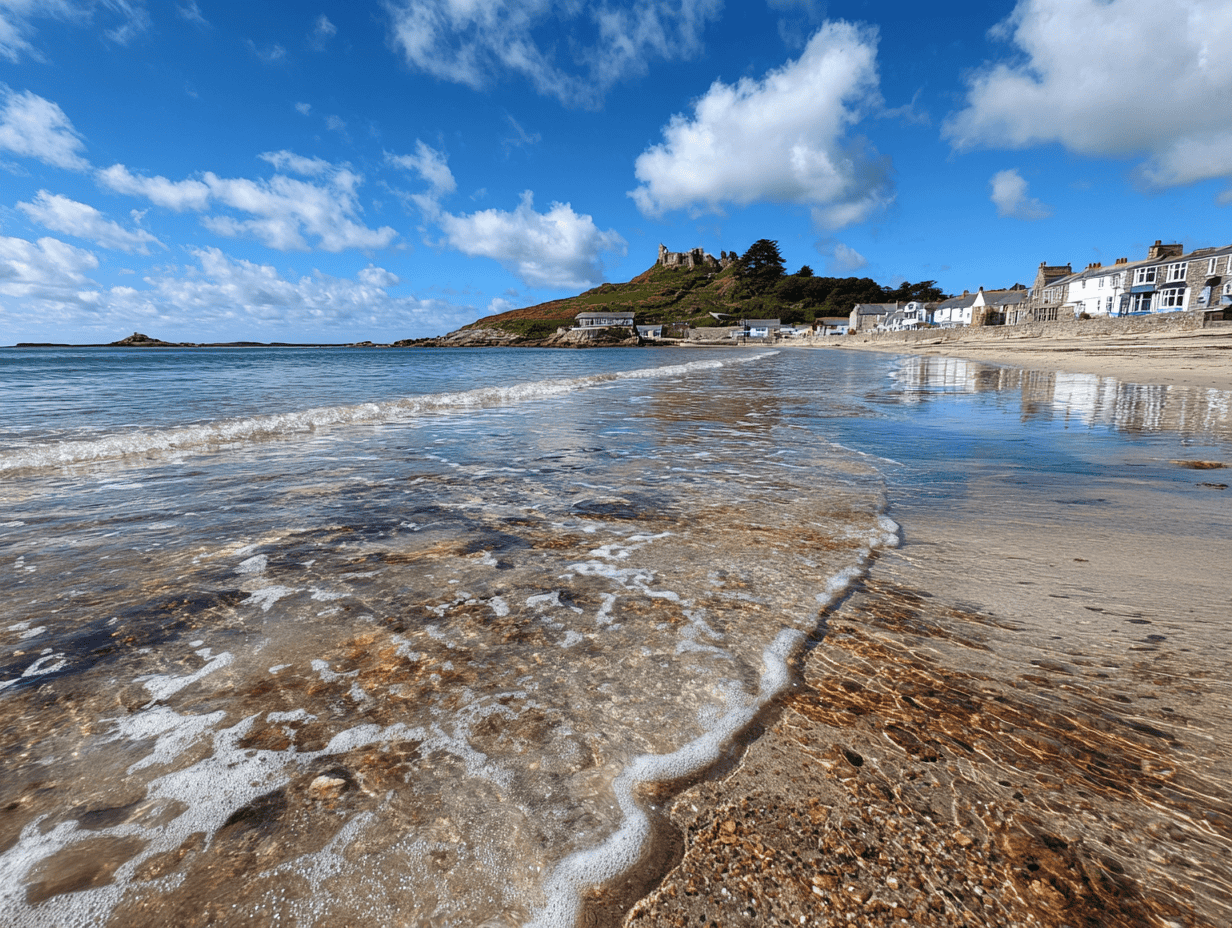
Porthleven beach runs east from the harbour wall for three miles toward Loe Bar, the shingle bank that separates the sea from the Loe Pool, Cornwall’s largest natural freshwater lake. The glass hunting is concentrated in the first mile east of the harbour rather than the full length.
The harbour end of the beach, immediately east of the granite pier and clock tower, is where the most material concentrates. The harbour has been working for two centuries, and the foreshore directly adjacent to it holds centuries of accumulated material. Work the strandline carefully here and look at the pockets of shingle where the beach meets the sea wall.
The shingle patches at mid-beach are the main hunting ground. The beach is strewn with patches of shingle and gritty sand. These shingle drifts are the best places to look, easily spotted as you walk east. Slow down when you hit a shingle patch and work it thoroughly before moving on.
Blue Buoy Steps – the flight of steps roughly midway along the beach marks the boundary between the seasonally restricted western section and the year-round eastern section. East of here, the beach is quieter, sees fewer people, and on a winter visit after a storm, is worth the extra walking.
At high tide, the beach largely disappears, and you can walk along the coast path above with the beach below. Plan your arrival to coincide with the ebbing tide.
Dog friendly?
Seasonal – the western part of Porthleven Beach has seasonal dog restrictions, prohibiting dogs from 1 July to 31 August between 10am and 6pm, from the harbour wall to the Blue Buoy steps. The east end allows dogs year-round. Outside those hours and dates, the full beach is open to dogs.
In practical terms, for hunting with your dog: Porthleven is at its best in winter, when the restrictions are lifted, and the beach is freshly stocked by Atlantic storms. A January morning with your dog running the shingle east toward Loe Bar while you work the pockets is close to ideal.
Check our Yappy Places listing for Porthleven and nearby Helston for dog-friendly options after the hunt. The harbourside in Porthleven has a good range of cafés and restaurants.
Practical information
Parking: Two Cornwall Council pay-and-display car parks in Porthleven -Kittos Field (TR13 9JA) and Highburrow (TR13 9EU). Both are a short walk from the harbour and beach. The town also has street parking. Arrive early in summer – Porthleven has become a popular food destination, and the car parks fill up.
Toilets: Public toilets in Porthleven town, a short walk from the beach.
Food and drink: Porthleven has become well known for its food scene; the harbourside has a range of restaurants and cafés, from fish and chips to well-regarded independent restaurants. The Ship Inn on the harbourside is the obvious pub stop. Several cafés are open year-round.
Getting there without a car: No direct rail access. The nearest station is Camborne or Redruth, with bus connections to Helston and onward to Porthleven. Check current First Kernow services. Not the easiest beach by public transport, but manageable.
Accessibility: The harbour and harbourside are accessible. Access to the beach is via a reasonably flat slope by the pier. The shingle beach itself requires sturdy footwear, but the terrain is not steep once you’re on it.
What to bring
- Sturdy shoes or wellies – the shingle is steep near the harbour and can be loose underfoot
- A bag or tin for finds – glass at Porthleven is well-frosted from the Atlantic swell action
- A hand rake for working the shingle patches along the beach
- Layers and a windproof outer – Porthleven faces southwest, and the wind off Mount’s Bay has real force in winter
- A tide table or app – the difference between high and low water is significant on this steeply shelving beach
- A camera – the light on the harbour and St Michael’s Mount across the bay, particularly in winter morning light, is worth stopping for
The history behind the glass
Porthleven’s glass story begins with geography. The harbour faces southwest into the prevailing wind, making it one of the most exposed working ports in Britain – and for centuries before the harbour existed, that exposure made this stretch of coast a graveyard for ships caught in Mount’s Bay storms with nowhere to shelter.
By the early 1800s, the losses at sea had become too much, and in 1811, Parliament passed an Act creating the Porthleven Harbour Company to build a harbour strong enough to provide a safe refuge on this dangerous stretch of coast. The project had consultancy from the renowned engineer Thomas Telford and cost £200,000 against initial estimates of £60,000. It was finally completed in 1825.
From the moment the harbour opened, Porthleven became a working port feeding off the mining wealth of inland Cornwall. It became important for the shipping of tin and other ores, copper, lead and silver from nearby mines, and for a period in the mid-19th century, it enjoyed a thriving trade in pilchards. In the late 18th century, William Cookworthy discovered kaolin at Tregonning Hill, a key ingredient for porcelain, linking the district to a growing industrial network of china clay and china stone exports.
The lead mines at Wheal Rose and Wheal Penrose, reputedly the oldest lead mines in Cornwall, mentioned in documents from 1625, fed material through this coast for two and a half centuries. Mining operations, fishing fleets, coastal trade, limestone imports for the kilns still standing on the harbourside, all of it generated the glass, stoneware and ceramic waste that eventually enters the sea.
The harbour once had a fleet of more than 100 drifters used to fish for pilchard and mackerel. A working fleet of that size over a century of operation represents an enormous quantity of broken bottles, crockery and domestic waste, and all of it went into Mount’s Bay, worked by the Atlantic swell, and deposited on the shingle east of the harbour.
The old icehouse and warehouse on the harbourside, both historic listed buildings still standing, are physical evidence of the scale of trade this small port once handled. The limestone kiln, restored and protected, stands beside them. Look at those buildings and then look at the shingle below you. The connection is direct.
From beach to jewellery
Found something in the Porthleven shingle? At Mermaid Tears, every piece starts exactly where you’re standing, sea glass hand-hunted from UK beaches and handmade into something lasting. Browse the collection
Disclaimer: Tide times, dog restrictions, parking charges and beach conditions change regularly. Always verify before visiting. Dog restriction zones and dates are subject to annual review. Check the current byelaws with Cornwall Council before visiting with a dog. The beach shelves steeply at Porthleven, and bathing is not advised due to strong undercurrents and heavy shore break. Always check sea conditions before visiting.
Last updated: Aug 2026
Frequently asked questions
Is Porthleven good for sea glass? Yes – it’s a reliable Good Beach, particularly productive after Atlantic storms and at low tide on the shingle patches east of the harbour. The centuries of working harbour activity and mining-era coastal trade give the glass here real historical depth. Best visited in autumn and winter when the storms are frequent, and the beach is quiet.
Where exactly should I look for sea glass at Porthleven? Concentrate on the shingle patches east of the harbour wall and the strandline immediately adjacent to the pier. The pockets of coarser shingle scattered along the beach east toward Blue Buoy Steps hold glass that has been sorted and concentrated by tidal action. Post-storm, work the full length of the accessible beach.
Are dogs allowed at Porthleven beach? Seasonally, dogs are banned from the harbour wall to Blue Buoy Steps between 1 July and 31 August, 10am to 6pm. East of Blue Buoy Steps is dog-friendly all year round. Outside the restricted season, the full beach is open to dogs.
What is the best time of year to visit Porthleven for sea glass? Autumn and winter, particularly after a significant Atlantic southwesterly swell. Porthleven is one of the most exposed south coast ports in Britain. The storms that make it famous for storm-watching are the same storms that refresh the glass on the beach. January and February visits after a blow are consistently the most productive.
What is the Loe Bar at Porthleven? The shingle bar at the eastern end of Porthleven beach that separates the sea from the Loe Pool, Cornwall’s largest natural freshwater lake. At low tide, you can walk the full three miles from the harbour to Loe Bar and back. The Penrose Estate (National Trust) lies behind the Loe Pool and makes a good extension walk.
What is Porthleven famous for besides sea glass? Storm watching: the harbour faces directly into Atlantic weather, and in big winter swells, the waves top the harbour walls spectacularly. The town has also become well known for its food scene and independent restaurants. The historic harbour, clock tower, icehouse and restored lime kiln make it one of the most characterful working ports on the south Cornwall coast.
Other Beaches
Check out our interactive map to find more beaches; you can even filter by colour.




Our full Cornwall Guide will help you if you decide to take a sea glass road trip around one of the most beautiful places in the UK.
