Pilchards, Painters and a Thousand Years of Maritime Waste
St Ives Harbour is a good sea glass hunting spot, especially if you treat the area as three separate hunts: the main Harbour Beach strandline, the rockier Bamaluz cove and the shingle and rock pockets around Smeaton’s Pier. Green, brown, and white are the most common finds, with blue, aqua, amber, and turquoise appearing occasionally, and cobalt blue, black, lavender, red, orange, and pink among the rarer colours reported. It’s an intermediate hunt where moving between different shoreline types matters more than covering lots of sand.
- Rating: Good Beach
- Terrain: Easy
- Level: Intermediate
- Dog friendly: Seasonal – Harbour Beach restricted 1 July–31 August, 10am–6pm; Bamaluz, Lambeth Walk and the north side of Smeaton’s Pier are dog-friendly all year
- Location: St Ives, West Cornwall
- Sat Nav: TR26 1SY (The Island car park)
- Common colours: Green, brown, white
- Rare colours: Cobalt Blue, Black, Lavender, Red, Orange, Pink
Today at St Ives Harbour Beach
Check below for your latest ShoreSense Score and tide times. Scroll down for the full 7-day forecast
St Ives sea glass conditions
St Ives
Cornwall — Sea settling
89/100 — Excellent, best window 10:11–13:11.
Best window is 10:11–13:11 with big seas in the last few days, now easing — glass should be washing in and spring tides (near full/new moon), so the chance of fresh finds is excellent today. Great combo of sea state and weather — worth the trip.
Strong window at a solid beach
Ranked #7 in the UK ShoreSense leaderboard today.
| Tide | Time | Height |
|---|---|---|
| High water | 05:13 | 6.8 m |
| Low water | 11:41 | 0.8 m |
| High water | 17:32 | 6.9 m |
Best For:
- Sea glass hunting
- Harbour finds
- Sea pottery
- Family visits
Why St Ives Harbour Beach – the most famous town in Cornwall, and glass worth hunting
St Ives doesn’t need much introduction. The narrow cobbled streets, the whitewashed fishermen’s cottages, the Tate gallery on the clifftop, the harbour with its granite piers and working boats- it’s one of the most painted, photographed and written-about towns on the British coast, and for good reason. On a clear day in October, when the summer crowds have thinned, it’s genuinely one of the most beautiful places in England.
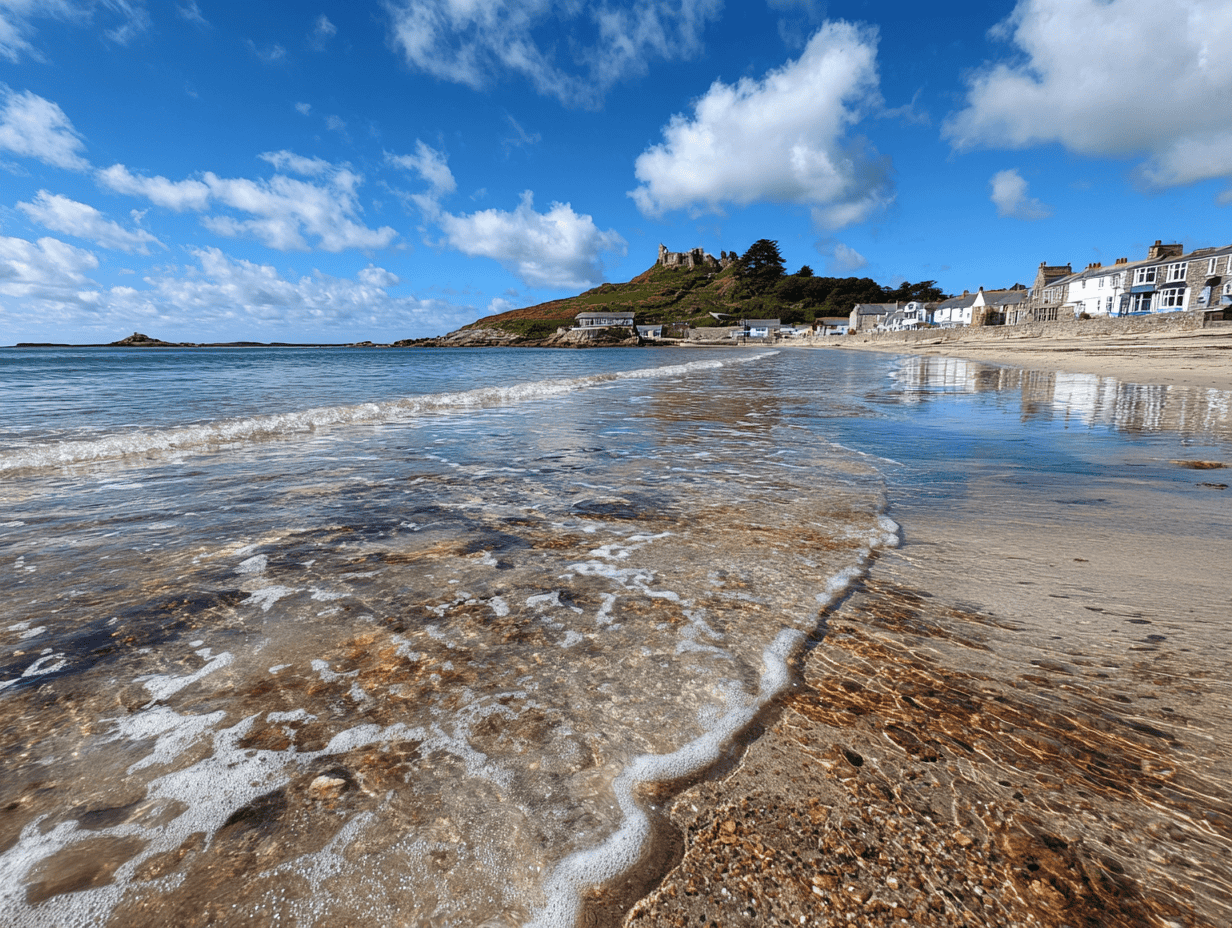
What most visitors walking the harbourside don’t realise is that the sheltered crescent of sand below the quay is one of the more consistently productive sea glass spots in Cornwall. Centuries of fishing and coastal trade put a great deal of glass into this bay, and the currents that sweep around the piers bring it back in, well tumbled by the time it reaches the sand. The wrack line and the seaweed patches are where it gathers.
The harbour beach itself is small and sandy, sheltered by three granite quays: New Pier, Smeaton’s Pier and West Pier. To the north sits Bamaluz, a tiny cove tucked between the harbour and Porthgwidden, backed by the remains of the Wheal Dream tin mine and open to dogs all year.
That combination of a sheltered harbour beach, an adjacent rocky cove, and extraordinary town history makes St Ives a glass-hunting destination that earns its place on the list, even without the dramatic cliffs and Atlantic swell of the north coast.
What you’ll find here
Colours commonly found: Green, brown, white
Occasional finds: Blue, Aqua, Amber, Turquoise
Rare finds: Cobalt Blue, Black, Lavender, Red, Orange, Pink
Bonus: Sea pottery, Victorian ceramic sherds, clay pipe stems and milk glass. The harbour’s long domestic and fishing history means ceramics turn up as reliably as glass.
Want to understand how unusual your find is? See our Sea Glass Colours & Rarity Guide
Found something unusual? Try GlassLore, our free sea glass scanner, to explore what it could be and log your find to the gallery and, more importantly, earn points and climb the leaderboard.
When to go
Early morning on an ebbing tide is the window at St Ives. The harbour beach is swept clean and restocked by every tide, and getting down before the town wakes up means you’re first over fresh ground. Check the tide times before you go.
The harbour beach at St Ives is more sheltered than north coast beaches, which means wave energy is lower, and glass accumulation is steadier rather than dramatic. Post-storm visits after a sustained westerly or northwesterly swell are worth planning, when the exposed north coast outside the harbour gets worked, material is driven around the headland and into the bay.
Spring tides expose more of the lower harbour foreshore, including the area around the base of Smeaton’s Pier and the rocky edges of the harbour mouth, worth prioritising on bigger tidal ranges.
Autumn and winter are best. The summer crowds clear, the dog restrictions lift, and the town takes on the quieter character that the artists who settled here in the early 20th century would recognise.
Today’s ShoreSense Score & Best Hunting Window
St Ives Harbour Beach faces east into St Ives Bay, sheltered from the full force of the Atlantic by the Penwith peninsula to the west. The tidal range runs to around 5 to 6 metres on a spring tide, enough to open up the lower harbour foreshore, the rocky edges of the harbour mouth and the sand around the base of Smeaton’s Pier.
As the tide falls, start on the main Harbour Beach strandline and work the full crescent between West Pier and New Pier, paying particular attention to shingle and debris gathered against the granite quay walls. As more foreshore opens, move around to Bamaluz and check the rock-pool margins and small gravel pockets before finishing around the base of Smeaton’s Pier and the Breakwater side.
Bigger spring lows expose more of the lower harbour foreshore and rocky edges, but Bamaluz and Breakwater Beach are strongly tide-dependent and can largely disappear again on the flood. After stronger westerly or north-westerly conditions begin to settle, recheck the strandline and harbour-edge pockets. Use today’s ShoreSense Best Window to choose when to arrive, then follow this Harbour Beach → Bamaluz → Smeaton’s Pier progression once you’re there.
The ShoreSense widget below combines recent marine conditions, tide timing and practical hunting weather to show today’s overall ShoreSense Score, Hunting Potential, Comfort and the best available hunting window for St Ives Harbour. It uses current UKHO tide data alongside marine and weather inputs to help you judge whether conditions look promising for a hunt.
St Ives sea glass conditions
St Ives
Cornwall — Sea settling
89/100 — Excellent, best window 10:11–13:11.
Best window is 10:11–13:11 with big seas in the last few days, now easing — glass should be washing in and spring tides (near full/new moon), so the chance of fresh finds is excellent today. Great combo of sea state and weather — worth the trip.
Strong window at a solid beach
Ranked #7 in the UK ShoreSense leaderboard today.
| Tide | Time | Height |
|---|---|---|
| High water | 05:13 | 6.8 m |
| Low water | 11:41 | 0.8 m |
| High water | 17:32 | 6.9 m |
Where to look on the beach
St Ives has several distinct hunting zones within easy walking distance of each other: the harbour section, Bamaluz, and the rocks around Smeaton’s Pier.
St Ives Harbour Beach itself is an east-facing crescent of sand bounded by the three granite quays. At low tide, the beach widens considerably, and the lower foreshore opens up. Work the strandline first, the full width of the beach from the West Pier end to New Pier, then drop to the waterline. The area immediately below the quay walls where shingle accumulates against the granite is worth particular attention.
Bamaluz Beach, tucked between the harbour and Porthgwidden around the back of The Island headland, is reached by steps from Wheal Dream, near the St Ives Museum. The beach is backed by large rocks with plenty of rock pools to explore at low tide, and is dog-friendly all year round. The rock pool margins here concentrate glass. Note that Bamaluz almost entirely disappears at high tide. Check before you go.
The rocks around Smeaton’s Pier – the historic granite pier at the harbour entrance- are worth working at low water. The seaward face of the pier and the rocks at its base accumulate material driven in by the bay. Breakwater Beach on the seaward side of Smeaton’s Pier opens up at low tide to a wide stretch of sand leading to the lighthouse. Work the junction between the sand and the pier’s rocky base carefully. The north side of the pier also has level access and is dog-friendly year-round, making it the easiest of the three zones to hunt with a dog in summer.
The harbour is busy in summer- an early start is not just preferable; it’s essential.
Key Tip:
Treat St Ives as three separate hunting grounds rather than one beach. Start in the harbour, explore Bamaluz at low tide, then finish around Smeaton’s Pier, where glass and pottery often collect against the granite structures.
Difficulty Level – Intermediate
- Multiple hunting zones require some planning around the tides
- Bamaluz is largely covered at high tide
- Productive areas are often found around rocks and harbour structures
- Low tide opens up significantly more hunting ground
- Care is needed when exploring slippery rock pools and granite ledges
Hunting Style – The Harbour Explorer
St Ives rewards hunters who enjoy moving between different environments. Search the harbour strandline, inspect shingle trapped against the quay walls, then work the rock pool margins at Bamaluz before exploring the rocky base of Smeaton’s Pier. Success comes from methodically hunting each zone rather than focusing on a single stretch of beach.
Beach Personality
St Ives combines the charm of a historic Cornish fishing port with surprisingly varied sea glass hunting. Granite quays, hidden coves, rock pools and working harbour walls create a shoreline full of small opportunities waiting to be discovered. The scenery is every bit as memorable as the finds, and a day spent hunting here feels as much like exploring a living maritime town as searching for sea glass.
Dog friendly?
Seasonal on the main Harbour Beach, and easy to work around. Dogs aren’t allowed on St Ives Harbour Beach between 1 July and 31 August, 10am to 6pm. Outside those hours and dates, dogs are welcome. Enforcement officers patrol the town in summer and can issue a £100 fixed penalty notice.
Two of the three hunting zones are unaffected. Bamaluz Beach and the north side of Smeaton’s Pier, which has level access, are both dog-friendly all year, as is Lambeth Walk. So even in peak August, you can hunt the cove and the pier base with your dog and simply skip the harbour sand between 10 and 6.
Better still, the restriction and the best hunting window don’t overlap. An early start before 10am gives you the quietest beach, the freshest strandline and no restrictions at all. Through autumn and winter, the whole harbour beach is open.
Check our Yappy Places listing for St Ives for dog-friendly cafés and pubs; there are several within steps of the harbour.
Practical information
Parking: Smeatons Pier (TR26 1PS) and Wheal Dream (TR26 1PR) are the closest council car parks to Harbour Beach and the Bamaluz steps, so they’re the best base for hunting. The Island car park (Burrow Road, TR26 1SY) is the larger option with 129 spaces, a few minutes’ walk away. It’s pay on exit rather than pay and display, JustPark code 8419, and several St Ives car parks are now cashless, so bring a card. No motorhomes between 11pm and 8am. Don’t use Porthgwidden car park: despite the name and location, it’s entirely reserved spaces and you’ll be fined. St Ives is one of the most congested towns in Cornwall in summer, so arrive before 9am or use the park and ride from St Erth.
Toilets: Public toilets near The Island car park and at various points along the harbourfront.
Food and drink: The harbourside has an excellent range of cafés, restaurants and pasty shops. The Sloop Inn on the wharf is the historic fisherman’s pub, dated to circa 1312, making it one of the oldest inns in Cornwall. There are options to suit every mood within two minutes of the beach.
Getting there without a car: St Ives has its own branch railway line – the St Ives Bay Line from St Erth opened on 1 June 1877 and is still running, connecting to mainline services at St Erth. It is one of the most scenic short railway journeys in England. The station is a short walk from the harbour beach.
Accessibility: The harbour beach is accessed via a slope from the promenade, flat and accessible. Bamaluz involves steep steps and is not suitable for wheelchairs. Smeaton’s Pier has level access on the north side.
What to bring
- Flat shoes or light trainers – the harbour beach is sandy and easy underfoot, though Bamaluz involves scrambling over rocks
- A small bag or tin for finds – harbour glass tends to be well-frosted and varied in size
- A hand rake for working shingle pockets around the pier base
- Layers – the harbour is sheltered, but early mornings off the bay are cool
- A tide table or app – Bamaluz and the area around Smeaton’s Pier only open up at low water
- Cash for parking and the bakery – a hot pasty from the harbour on a winter morning is not optional
The history behind the glass
The town of St Ives has grown around its harbour since it was first settled in the 6th century. The name comes from the Irish saint Ia, said to have arrived here by miraculous crossing from Ireland in the 5th century. By 1337, St Ives was the largest fishing port in Penwith, and by the 15th century, it had a weekly market and was, in the 16th century, the chief port of departure from the west for passage to Ireland.
The pilchard was the engine of everything. In the decade 1747–1756, the total number of pilchards dispatched from the four principal Cornish ports averaged 30,000 hogsheads annually. The greatest number ever taken in one seine was 5,600 hogsheads at St Ives in 1868, the bulk of the catch exported to Italy. Local historian John Tregenza estimated that in the 1820s, as many as 1,500 people in St Ives depended directly on the pilchard trade. The smell of curing fish was so strong that Victorian visitors complained about it.
Smeaton’s Pier – the granite structure still defining the harbour today was built between 1767 and 1770, intended principally as a breakwater. The pier was extended between 1888 and 1890, with the building of The Arches. Every generation of harbour use, every fleet of fishing boats, every cargo vessel that came alongside, all of it feeding material into the bay over centuries.
Fishing and tin mining were important until the late 19th century. Behind Bamaluz Beach are the remains of the Wheal Dream tin mine, a reminder that the ground under St Ives was being worked as hard as the sea above it.
On 1 June 1877, the St Ives Bay Line from St Erth opened, delivering holidaymakers and artists as reliably as it carried fish. Within a decade, boarding houses had sprung up around Porthminster, turning St Ives into a seasonal resort as well as a fishing town. The artists followed, and then kept coming.
The St Ives School of painters, the Tate gallery, the studios in the old net lofts above Porthmeor Beach, a second identity laid on top of the fishing one, but the harbour remained at the heart of both.
A thousand years of maritime activity, tin mining, pilchard fleets, coastal trade and resort occupation. Every broken bottle, every ceramic jar, every piece of Victorian glassware that went into St Ives Bay has been worked by the tidal action of the bay and deposited on the harbour foreshore below Smeaton’s Pier.
That is what you’re looking at when you pick up a piece of frosted green glass from the St Ives strandline.
From beach to jewellery
Found something on the St Ives foreshore? At Mermaid Tears, every piece starts exactly where you’re standing, Seaglass hand-hunted from UK beaches and handmade into something lasting. Browse the collection.
Disclaimer: Tide times, dog restrictions, parking charges and beach conditions change regularly. Always verify before visiting. Dog control orders in St Ives are actively enforced with fixed penalty notices of £100. Always check current restrictions before visiting with a dog. Bamaluz Beach and Breakwater Beach largely disappear at high tide – check tide times before visiting. Cornwall Council updates beach byelaws annually.
Last updated: September 2026
Dog rules checked: September 2026 – Cornwall Council PSPO and St Ives Town Council
Frequently asked questions
Is St Ives Harbour Beach good for sea glass? Yes, and it’s rated Good. The harbour history gives the glass real depth, and the sheltered bay conditions produce well-frosted, varied pieces. Early morning on an ebbing spring tide is the prime window, and post-storm visits after a westerly swell are particularly rewarding.
Where exactly should I look for sea glass in St Ives? The strandline on the main Harbour Beach at low water, the rock pool margins at Bamaluz Beach, and around the base of Smeaton’s Pier at the lower tide stages. Bamaluz in particular concentrates glass in its rocky pockets and is dog-friendly all year round.
Are dogs allowed at St Ives Harbour Beach? Seasonally. Dogs are banned from Harbour Beach from 1 July to 31 August, between 10am and 6pm, with £100 fixed penalty notices for breaches. Bamaluz Beach, Lambeth Walk and the north side of Smeaton’s Pier are dog-friendly all year. Outside those dates and hours, the whole harbour beach is open.
Can I get to St Ives by train? Yes – the St Ives Bay Line runs from St Erth, where it connects to mainline services. The branch line opened in 1877 and is still running. St Ives station is a short walk from the harbour. It is one of the most scenic short railway journeys in England and is strongly recommended over driving in summer.
What is Bamaluz Beach? A small tidal cove tucked between St Ives Harbour and Porthgwidden Beach, accessed via steep steps near the St Ives Museum on Wharf Dream. All-year dog-friendly, backed by the remains of the Wheal Dream tin mine. Largely disappears at high tide -check tide times before visiting.
What is the history of Smeaton’s Pier? Built between 1767 and 1770 to the design of engineer John Smeaton, it has defined the harbour entrance ever since and was extended in 1888–1890. The first granite lighthouse on the pier was built in 1831. The pier is named after Smeaton’s more famous commission – the Eddystone Lighthouse, which he also designed.
Other Beaches
Check out our interactive map to find more beaches; you can even filter by colour.
Our full Cornwall Guide will help you if you decide to take a sea glass road trip around one of the most beautiful places in the UK.