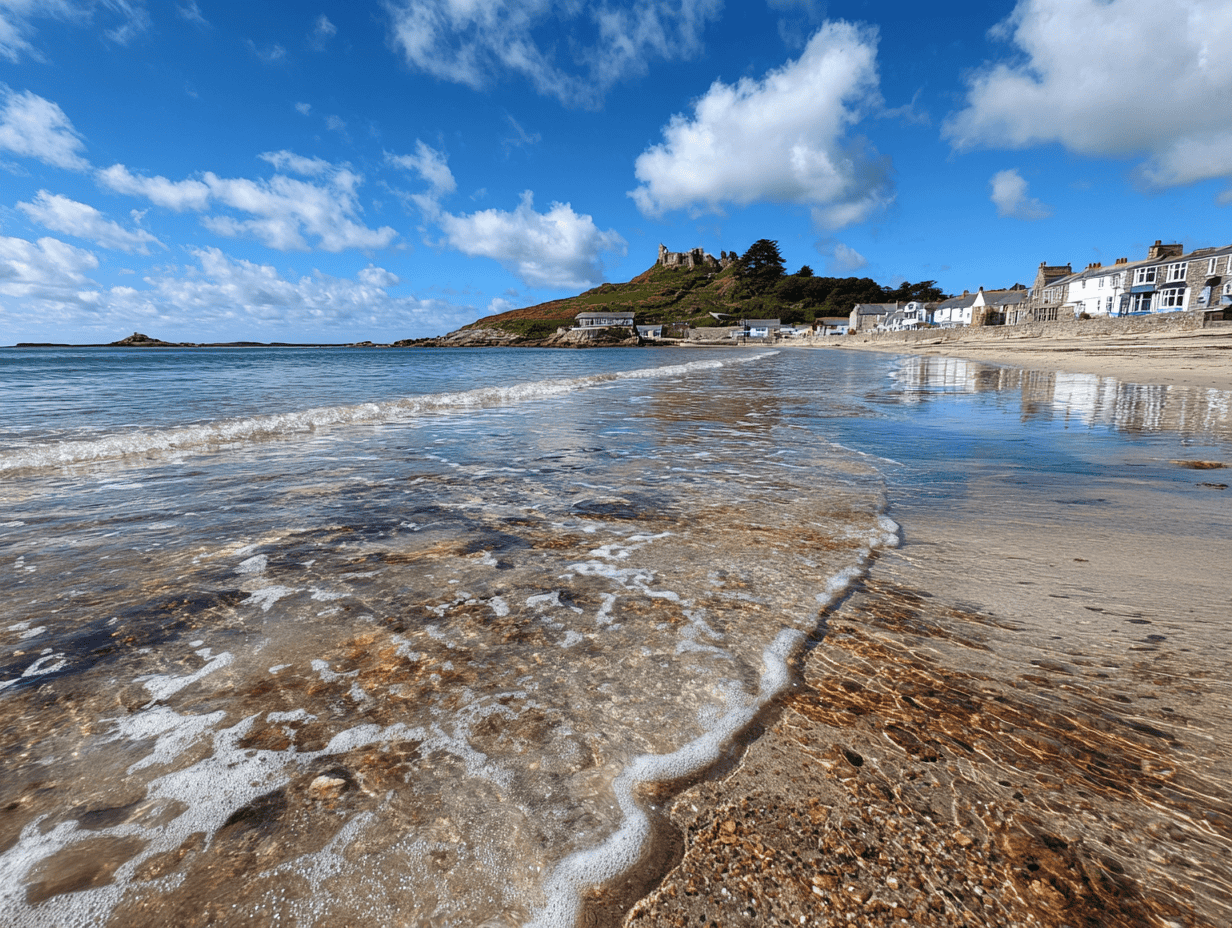
Gyllyngvase, Swanpool and Maenporth
Falmouth is a good area for sea glass hunting, especially if you treat Gyllyngvase, Swanpool and Maenporth as one three-beach route. Start with the rocky margins and rock pools at Gyllyngvase, check the shingle bar and rock edges at Swanpool, then spend the most time at Maenporth around its rock pools, pebble pockets, and cave edges. Green, brown and white are the most common finds, with blue, aqua, amber, turquoise, cobalt, black, lavender, red and orange also reported.
- Rating: Good Beach
- Terrain: Easy
- Level: Intermediate
- Dog friendly: Seasonal (Gyllyngvase- dogs banned 15 May to 30 September, 10am–6pm; Swanpool – dogs banned July and August, 10am–6pm; Maenporth – dogs banned July and August, 10am–6pm)
- Location: Falmouth, Cornwall
- Sat Nav: TR11 4DP (Gyllyngvase car park) or TR11 5HL (Maenporth car park)
- Common colours: Green, brown, white
- Rare colours: Cobalt Blue, Black, Lavender, Red, Orange
Today at Falmouth Beaches
Check below for your ShoreSense Score and tide times. Scroll down for your full 7-day forecast
Falmouth Bay sea glass conditions
Falmouth Bay
Cornwall — Building swell
64/100 — Good, best window 10:39–13:39.
Best window is 10:39–13:39 with spring tides (near full/new moon) and building SW swell, so the chance of fresh finds is good today.
Good day at a reliable beach
Ranked #38 in the UK ShoreSense leaderboard today.
| Tide | Time | Height |
|---|---|---|
| High water | 05:30 | 5.2 m |
| Low water | 12:09 | 0.5 m |
| High water | 17:50 | 5.3 m |
Best For:
- Colour variety
- Rock pool hunting
- Cave exploring
- Intermediate hunters
- Low-tide adventures
- Frosted sea glass
- Family beachcombing
- Cornwall coastal walks
Why Falmouth – three beaches, one walk, and five centuries of maritime history underfoot
Falmouth doesn’t need much introduction. The town sits at the mouth of the Carrick Roads, one of the world’s deepest natural harbours, where the River Fal meets the sea on the sheltered south Cornwall coast.
The harbour has been active for centuries: fishing, smuggling, naval operations, and, for over 150 years, the centre of Britain’s international postal network. Ships from every corner of the world have called here. All of that history feeds into the foreshore.
This is a three-beach walking guide. Gyllyngvase, Swanpool and Maenporth sit in sequence along the coast south of the town, connected by the South West Coast Path and separated by short cliff walks of fifteen to twenty minutes each.
Each beach has its own café, making the full walk from Gyllyngvase to Maenporth and back one of the most civilised glass-hunting routes in Cornwall. You can do all three in half a day, or spread them across a full day with the coast path between them.
Maenporth is the pick of the three. Its rocks, small caves and rock pools trap glass and hold it between tides, where the sandier beaches let it move on. Expect variety rather than volume: a good Falmouth hunt is a handful of well-frosted pieces in colours you won’t find together anywhere else in Cornwall.
What you’ll find here
Colours commonly found: Green, brown, white
Occasional finds: Blue, Aqua, Amber, Turquoise
Rare finds: Cobalt Blue, Black, Lavender, Red, Orange
Bonus: Sea pottery, Victorian ceramic shards, smooth Cornish pebbles, rock pool life at all three beaches
Find something special? Scan it with GlassLore, our free sea glass identifier, to explore what it could be and how rare it is. Then share it to our finds gallery and earn points to climb our hunters leaderboard. Are you ready to compete?
When to go
Low tide is essential across all three beaches. Gyllyngvase and Swanpool are primarily sandy; the productive areas are the rock pool margins and transition zones between sand and rock, and these open up only at low water. Maenporth is rockier throughout, and rewards careful searching at any tide state, but the full extent of the coves and caves at the south end only exposes at low water.
Post-storm is worth targeting even here. Falmouth Bay faces east and is open to southeasterly swells tracking up the English Channel after a sustained blow from that direction; the beaches are freshly sorted, and the strandlines restocked.
Pirate glass, so dark and deep in pigment that it looks black until you hold it to the light, is a Falmouth speciality, a product of centuries of harbour activity. Keep an eye out for pieces that look like dark rock but have that characteristic frosted edge.
Winter is the best season. The dog restrictions lift, the beaches are quiet, and the coast path walk between the three coves on a clear February morning, with the Carrick Roads visible to the north and the Lizard Peninsula to the south, is one of the finest short walks in Cornwall.
Today’s tide times & ShoreSense Score
Falmouth Bay faces east on the sheltered south Cornwall coast, with a tidal range of around 5.1 metres on a spring tide.
As the tide falls, start at Gyllyngvase and work the rocky margins and southern rock pools before following the coast path to Swanpool. At Swanpool, check the shingle bar and rocky edges rather than the open sand, then continue to Maenporth and spend most of your time around the rock pools, pebble pockets and cave edges at the southern end.
Bigger lows expose more of these margins, but you don’t need to chase the absolute lowest water everywhere. Use today’s ShoreSense Best Window to choose when to set off, then follow this Gylly – Swanpool – Maenporth progression once you’re there.
The widget below uses Falmouth tide data, the UKHO standard port for this stretch of coast, alongside recent marine conditions and practical hunting weather to show today’s overall ShoreSense Score, Hunting Potential, Comfort and the best available hunting window. Plan to arrive at Gyllyngvase about two hours before low water, then walk south to Maenporth, timing your arrival for low tide.
Falmouth Bay sea glass conditions
Falmouth Bay
Cornwall — Building swell
64/100 — Good, best window 10:39–13:39.
Best window is 10:39–13:39 with spring tides (near full/new moon) and building SW swell, so the chance of fresh finds is good today.
Good day at a reliable beach
Ranked #38 in the UK ShoreSense leaderboard today.
| Tide | Time | Height |
|---|---|---|
| High water | 05:30 | 5.2 m |
| Low water | 12:09 | 0.5 m |
| High water | 17:50 | 5.3 m |
Powered by ShoreSense, your guide to the best sea glass beaches in the UK right now
Where to look – three beaches in sequence
Gyllyngvase Beach (Gylly) is the largest and most accessible of the three, a wide crescent of golden sand with rock pools at the south end to explore at low tide. Glass hunting is concentrated along the rocky margins on both sides of the bay and in the rock pools at the southern end. The rocky areas at either end of the bay benefit from Falmouth’s long maritime history, and you’ll find older, more unique pieces here. Start at the rock pool end and work the transition zone between sand and pebble carefully before moving on to Swanpool.
Swanpool Beach is a short cliff walk south of Gylly along the coast path, fifteen minutes, with excellent views back across Falmouth Bay to Pendennis Castle. It’s a smaller, quieter beach with a freshwater pool behind it, separated from the sea by a shingle bar, a nature reserve and good for birds as well as glass. The shingle patches at the back of the beach and the rocky margins are the hunting zones. Less visited than Gylly and worth a careful look on the way through to Maenporth.
Maenporth Beach is the endpoint and the best of the three for glass. It has loads of rocks, small caves, and rock pools that capture and hold sea glass. The variety of colours and sizes found here is the most impressive of the Falmouth beaches. At low tide, the beach expands, and the rock pools are exposed, revealing patches of pebbles and treasures. Work the cave entrances and the rock pool margins at the southern end of the beach thoroughly; this is where pieces concentrate and sit undisturbed between tides.
Key Tip:
Treat Gyllyngvase, Swanpool and Maenporth as a three-beach hunting route. Start with the rock pools at Gylly, check the shingle bar and rocky margins at Swanpool, then give Maenporth the most time, especially around the caves and rock pool edges at low tide.
Difficulty Level – Intermediate
- Multiple beaches require walking between locations
- The best hunting areas are around rocks, pools and cave entrances
- Low tide reveals the most productive ground
- Some sections need careful footing on wet rock
- Success comes from exploring the margins rather than the open sand
Hunting Style – The Three-Beach Explorer
Falmouth rewards hunters who enjoy moving from one cove to the next. Work the rocky margins at Gyllyngvase first, then follow the coast path to Swanpool before finishing at Maenporth, where rock pools, caves and pebble patches hold the best glass. Each beach adds something different to the hunt.
Beach Personality
The Falmouth route feels like a proper coastal mini-adventure. Golden sand, rock pools, nature reserves, cliff paths and views across the bay make the journey as enjoyable as the finds. Gylly is the easy starting point, Swanpool is the quieter middle stop, and Maenporth is the one that rewards the most careful searching. It is a beautiful, varied route where sea glass hunting feels woven into a full day by the coast. Tip:
Head straight for the southern end at low tide and work every rock pool edge, cave entrance and pebble pocket methodically. At Maenporth, the best sea glass rarely sits in the open; it hides where wave energy drops and material becomes trapped between tides.
Dog friendly?
Seasonal across all three beaches, with different dates worth knowing:
Gyllyngvase bans dogs from 15 May to 30 September, 10am to 6pm, because it’s a Blue Flag beach. Swanpool and Maenporth only ban dogs in July and August, 10am to 6pm. That means Swanpool and Maenporth are open to your dog through May, June and September, as well as all autumn and winter. Sunny Cove, the small cove between them, allows dogs year-round, making it a useful backup in peak summer.
The coast path between all three beaches is dog-friendly year-round and is the best part of the walk in any season.
Check our Yappy Places listing for Falmouth for dog-friendly cafés and pubs. The award-winning Gylly Beach Café on Gyllyngvase allows dogs on the veranda and is a good start and finish point for the walk.
Practical information
Parking: Gyllyngvase car park on Queen Mary Road (TR11 4DP) has 107 spaces and sits just above the beach. Charges apply seasonally, with higher summer tariffs from April to October and reduced winter rates from November to March. Payment is available by card, contactless or JustPark (location code 8336). Swanpool has a public car park just behind the beach, while Maenporth has parking directly behind the cove (TR11 5HL). Check current signage and charges before leaving the car, as tariffs can change.
Toilets: Public toilets at Gyllyngvase and Maenporth. Facilities at all three beach cafés.
Food and drink: Gylly Beach Café is on the beachfront at Gyllyngvase, open year-round, serving breakfasts, seafood and cream teas. Swanpool has a beachside café and restaurant. Maenporth has a café directly on the sand. Three cafés for a three-beach walk. Plan accordingly.
Getting there without a car: Falmouth has a rail station served by the branch line from Truro. Gyllyngvase is a fifteen-minute walk from the town centre. Bus services run along the coast road toward Maenporth -check current First Kernow services.
Accessibility: Gyllyngvase has level access from the car park via ramps directly to the sand, with a beach sand-chair available for hire from the café. Swanpool and Maenporth require a short cliff walk between beaches – suitable for confident walkers but not suitable for wheelchairs on the coast path sections.
What to bring
- Sturdy shoes or wellies – the rock pool sections at Maenporth require careful footing, particularly when wet
- A bag or tin for finds – glass at Falmouth tends to be varied in size and well-frosted
- A hand rake for working shingle and pebble patches at Gylly and Swanpool
- Layers and a windproof layer – Falmouth Bay faces east, and the wind off the water is fresh in winter
- A tide table or app – timing arrival at each beach to coincide with the low water window makes a real difference
- A camera – the coast path view from the cliffs between Swanpool and Maenporth, looking back to Pendennis Castle with the Carrick Roads beyond, is worth stopping for
The history behind the glass
Falmouth’s history begins later than most Cornish ports. The town itself was only established in 1613, but it made up for lost time rapidly. The harbour received its Royal Charter as early as 1661, and by 1688, Falmouth had been made the Royal Mail Packet Station.
That appointment transformed the town. For over 150 years, between 1688 and 1850, Falmouth Packet ships filled the harbour, making Falmouth the information hub of the Empire, second only to London for knowing the news of the world. By the 1830s, Falmouth packet ships were sailing to Lisbon, Gibraltar, Malta, Corfu, Bermuda, the Leeward Islands, the Windward Islands, Mexico, Rio de Janeiro, and Buenos Aires.
The scale of that operation, forty vessels, crews, victualling, repairs, constant harbour traffic for 150 years, generated an enormous quantity of glass, stoneware and domestic waste entering Falmouth Bay.
The Customs and Excise had moved to Falmouth from Penryn in 1650, and on the Custom House Quay stands a chimney known as the King’s Pipe, where illegally imported tobacco was destroyed. It is a physical reminder of how widespread smuggling was, even under the noses of the revenue men. Smuggled spirits came in glass containers. Revenue cutters chased them, wreckers watched for their cargo, and eventually it all went into the sea.
A commercial dockyard was founded in 1860 when the packet ships moved away, maintaining Falmouth’s role as a major working harbour through the industrial era. The National Maritime Museum Cornwall on the harbourfront tells the full story, worth a visit on any trip to the town.
All that history feeds through the water and onto the three beaches south of the harbour. The glass here has been tumbling in Falmouth Bay for centuries. The pirate glass, black and dense in the light, revealing its true dark bottle-green colour when you hold it up, is a Falmouth signature that connects directly to that long maritime past.
From beach to jewellery
Found something in the Falmouth shingle? At Mermaid Tears, every piece starts exactly where you’re standing, hand-hunted from UK beaches and handmade into something lasting. Browse the collection.
Disclaimer: Tide times, dog restrictions, parking charges and beach conditions change regularly. Always verify before visiting. Dog restriction zones and dates are updated annually. Check the current byelaws with Falmouth Town Council and Cornwall Council before visiting with a dog. The coast path between beaches involves cliff walking; take care in wet conditions, and keep dogs under control near the cliff edge.
Last updated: September 2026
Dog rules checked: September 2026 – Cornwall Council PSPO (Gyllyngvase on the Blue Flag band, Swanpool and Maenporth on the July–August band)
Frequently asked questions
Which is the best of the Falmouth beaches for sea glass? Maenporth. The rocks, small caves and rock pools at its southern end concentrate and hold glass in a way the sandier beaches don’t. That said, all three reward a methodical low-tide search, and the walk between them is half the point.
Can I walk between all three beaches? Yes – the South West Coast Path connects Gyllyngvase to Swanpool to Maenporth in a straightforward cliff walk. Allow around fifteen to twenty minutes between each beach, with excellent views throughout. The full walk from Gylly to Maenporth and back takes around two to three hours, including time on each beach.
Are dogs allowed at Falmouth beaches? Seasonally, with different dates for each beach. Gyllyngvase bans dogs from 15 May to 30 September, 10am–6pm. Swanpool and Maenporth ban dogs in July and August only, 10am–6pm. Sunny Cove, between Swanpool and Maenporth, is dog-friendly year-round. The coast path between beaches is always open to dogs.
What is pirate glass? A dark, dense bottle glass found particularly around Falmouth that looks almost black on the beach but reveals a deep dark green or brown when held to the light. It’s associated with centuries of smuggling and maritime trade in the area and is a Falmouth speciality worth looking out for.
What is the best time of year to visit Falmouth for sea glass? Autumn and winter: the dog restrictions lift, the beaches are quieter, and post-storm conditions after southeasterly swells refresh the glass on all three beaches. Low water on a spring tide gives the most foreshore to work.
Is Falmouth worth visiting for reasons beyond sea glass? Absolutely. The National Maritime Museum Cornwall is one of the best maritime museums in the country. Pendennis Castle on the headland above Gylly is a Tudor fortress with extraordinary views. The town centre has excellent independent restaurants, cafés and shops. Falmouth is one of the most complete Cornish towns for a full-day visit.
Other Beaches
Want to visit more Cornwall beaches? Check out our full guide, or plan your trip with our interactive map; you can even filter by colour.