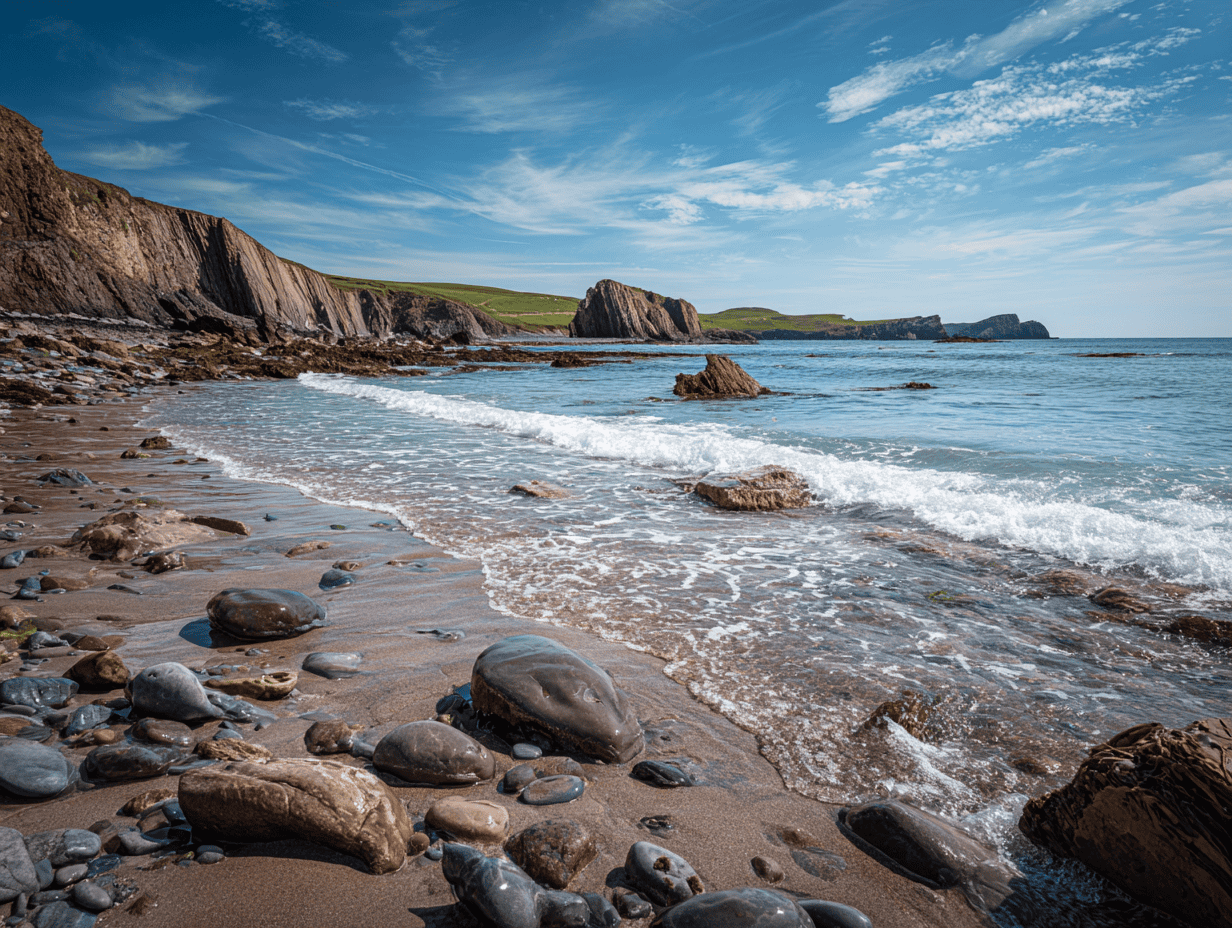
Dark Sand, Blue Water and an Industrial Ghost
Abereiddy is a good sea glass hunting beach, especially across the dark mid-beach shingle and lower slate foreshore exposed as the tide falls. Green, brown and white are the most common finds, with blue, aqua and amber appearing occasionally and cobalt blue, black, red and orange among the rarer colours reported. The dark slate makes pale frosted glass particularly easy to spot, while the ruined quarry landscape gives this hunt a character unlike almost anywhere else in Wales.
Where to hunt: Dark mid-beach shingle → lower slate foreshore → outer slate pockets on bigger lows → upper strandline as conditions change
- Rating: Good Beach
- Terrain: Tricky
- Level: Beginner-friendly
- Dog friendly: Yes, dogs welcome all year round (keep under close control near seals August–December)
- Location: Abereiddi, North Pembrokeshire, Wales
- Sat Nav: SA62 6DT (Abereiddi car park)
- Common colours: Green, brown, white
- Rare colours: Turquoise, Cobalt Blue, Black, Lavender
Today at Abereiddy Beach
Check for the latest ShoreSense Score and tide times. Scroll down to find your 7-day forecast
Abereiddy Beach sea glass conditions
Abereiddy Beach
Wales — Building swell
65/100 — Good, best window 10:45–13:45.
Best window is 10:45–13:45 with spring tides (near full/new moon) and building SW swell, so the chance of fresh finds is good today.
Good day at a reliable beach
Ranked #47 in the UK ShoreSense leaderboard today.
| Tide | Time | Height |
|---|---|---|
| High water | 05:58 | 4.4 m |
| Low water | 12:15 | 0.9 m |
| High water | 18:15 | 4.6 m |
Best For:
- Dark-substrate hunting
- Graptolite fossils
- Industrial history
- Coast path walks to Porthgain
- Year-round dog access
- Post-storm hunting
Why Abereiddy – the most atmospheric beach hunt in Wales
There is no beach in Wales that looks quite like Abereiddy. The sand is black. Not dark grey, not charcoal black, stained by centuries of slate debris from the quarry that once dominated this headland. The pebbles are dark too, the foreshore is irregular and angular, and behind the beach, the roofless shells of the quarry workers’ cottages stand open to the sky where they were abandoned over a century ago.
Walk five minutes north from the beach along the Pembrokeshire Coast Path, and you reach the Blue Lagoon, a flooded slate quarry, vivid blue-green water held inside a ring of sheer cliff walls, where Atlantic grey seals haul out in autumn, and coasteerers jump in summer. It is, by some distance, the most dramatic piece of industrial landscape in Wales.
Abereiddi beach is famous for its black sand full of tiny fossils. It is one of Pembrokeshire’s pebble-backed storm beaches. The dark substrate is the first thing hunters notice, and it turns out to be genuinely useful, because frosted glass sits pale against black slate in a way that makes it far easier to spot than on a conventional pebble beach.
The contrast effect here is real. A well-tumbled aqua or green piece on the dark shingle at Abereiddi stands out from twenty feet away.
The Blue Lagoon was formerly the main slate quarry of the St Brides Slate Company, active until 1910, and the same slate gives a brilliant aqua-blue colour to the water. That aqua colour is not a coincidence; it is the same mineral composition that produces some of the aqua tones in the glass that washes up on this beach. When you find an aqua piece at Abereiddi, you are holding something that shares its colour with the water fifty metres away.
Come at low tide, work slowly, and don’t rush for the Blue Lagoon until you’ve done the beach. Most visitors arrive, walk straight to the Lagoon, take photographs, and leave. The beach itself is quieter than that tourist footfall suggests, and the low-tide foreshore is consistently productive for the patient hunter.
What you’ll find here
Colours commonly found: Green, brown, white
Occasional finds: Blue, Aqua, Amber
Rare finds: Cobalt blue, black glass, red, orange
Bonus: Graptolite fossils in the dark slate (small, tuning-fork shaped, 450 million years old), Victorian pottery shards from the quarry workers’ cottages, occasional smooth slate pieces polished to near-glass by the sea
Fossils: Abereiddy is known for tiny graptolite fossils in the slate. Look and photograph rather than collect: the National Park advises that fossils and minerals should not be removed from SSSI sites without permission.
Find something special? Use our sea glass scanner, GlassLore, to find out rarity, value and history; then you can share to our finds gallery and, more importantly, earn points to climb our hunters leaderboard – are you ready to compete?
When to go
Low tide opens the productive foreshore at Abereiddy significantly. The beach is already backed by steep dark shingle at high water; as the tide drops, the lower foreshore of mixed sand, slate pebbles and angular fragments extends outward. Work the full width of the beach from the high-water strandline to the tideline. The pebble and slate shingle bands at mid-beach are your best hunting ground.
Abereiddi faces northwest into the Irish Sea and St George’s Channel. It is an exposed beach. Northwesterly and westerly swells are onshore conditions, the ones that sort and refresh the foreshore.
After a significant Atlantic blow, visit on the ebbing tide the following morning: the strandline will be freshly worked, and newly deposited material will be sitting on the upper beach. The beach receives strong winds and currents, which require attention when bathing, but equally create good swell for hunters after westerly weather.
Winter is the best season for all the usual reasons: fewer visitors, more storms, and the beach is quiet and open. But Abereiddy also has a seasonal dimension worth knowing: the National Trust closes the Blue Lagoon area from late September to early November for seal breeding.
The National Trust closes the Lagoon from the last Saturday in September to the first Saturday in November to protect breeding seals. The beach itself remains accessible year-round. If you are visiting with your dog in autumn, keep him away from seals on the coast path and shoreline. The grey seals pup along this stretch of coast, and disturbance from dogs causes real harm to pups.
Today’s ShoreSense Score & Best Hunting Window
Abereiddi sits on the north Pembrokeshire coast facing northwest into the Irish Sea, with a spring tidal range of around 4 to 4.5 metres, enough to expose a useful section of the dark slate foreshore as the tide retreats, including the lower pebble bands that are covered for most of the tidal cycle. The northwest-facing aspect means westerly and northwesterly Atlantic weather is onshore, the conditions that produce the best glass-sorting conditions on this exposed stretch of coast.
Start on the dark shingle band across the middle of the beach, where pale glass stands out particularly well against the slate. As the tide falls, work progressively lower through the mixed sand, slate pebbles and rougher foreshore. On bigger lows, scan the outer slate shelving and lowest shingle pockets before the tide turns. If recent weather has rearranged the upper strandline, give that a second pass on the way back. Use today’s ShoreSense Best Window to choose when to arrive, then follow this dark-shingle → lower-foreshore → outer-slate progression once you’re there.
The ShoreSense widget below combines recent marine conditions, tide timing and practical hunting weather to show today’s overall ShoreSense Score, Hunting Potential, Comfort and the best available hunting window for Abereiddy. It uses UKHO tide data alongside current marine and weather inputs to help you judge whether conditions look promising for a hunt.
Abereiddy Beach sea glass conditions
Abereiddy Beach
Wales — Building swell
65/100 — Good, best window 10:45–13:45.
Best window is 10:45–13:45 with spring tides (near full/new moon) and building SW swell, so the chance of fresh finds is good today.
Good day at a reliable beach
Ranked #47 in the UK ShoreSense leaderboard today.
| Tide | Time | Height |
|---|---|---|
| High water | 05:58 | 4.4 m |
| Low water | 12:15 | 0.9 m |
| High water | 18:15 | 4.6 m |
Compare your Beaches on our Hot Beaches page, updated daily with the best beaches for today, the next seven days, as well as the movers and shakers.
Where to look on the beach
The upper strandline after westerly weather. As Atlantic swell comes in from the north-west and sorts the beach, material concentrates along the high-water wrack line. Walk the full width of the strandline from the southern end towards the access path, checking the pebble clusters in the wrack. Post-storm, this is the most accessible productive ground before you get into the lower beach.
The lower foreshore at spring low tide. On a big low water, the outer beach extends beyond the usual foreshore into lower slate shelving and fragments. This ground gets covered quickly on the flood, but pieces that have been sitting in the lower zone tend to be better tumbled and more frosted than newer arrivals. Work outward with the tide and retreat with it.
Around the ruined cottages. The path from the car park down to the beach passes close to the old quarry workers’ cottages. Don’t miss the upper beach margins here; pieces occasionally work their way down from the collapsing structures above, and the sandy-pebble transition just below the path can produce pottery shards and older glass fragments.
Around the ruined cottages, the path from the car park down to the beach passes close to the old quarry workers’ cottages. Don’t miss the upper beach margins here; pieces occasionally work their way down from the collapsing structures above, and the pebble-sandy transition just below the path can produce pottery shards and older glass fragments.
Key Tip
The lower foreshore becomes more productive as the tide retreats. The best pieces are often hidden deep in shingle pockets between rocks rather than sitting exposed on top.
A note on fossils: Abereiddi is famous for graptolites, tiny, tuning-fork-shaped fossils in the dark slate. They are 450 million years old and easy to find once you know what to look for.
The beach is also a Site of Special Scientific Interest. Take sea glass, leave everything else. Do not take rocks, slate, or fossils.
Dog friendly?
Dogs: Dogs are welcome at Abereiddy year-round. During grey seal breeding season, roughly August to December, the National Trust asks that dogs are kept away from seals and on a short lead along the coast. Keep well back from pups and follow any temporary closure signs around the Blue Lagoon.
Outside the seal season, this is a genuinely good beach for a dog walk, wide, open, dark and dramatic, with the coast path east toward Porthgain offering an exceptional extension if you want to make a full morning of it. The Sloop Inn at Porthgain, a short coast path walk from Abereiddy, is a destination pub and worth the walk.
Check our Yappy Places listing for Pembrokeshire for dog-friendly options along this stretch of coast.
Practical information
Parking: There are two car parks at Abereiddy: the main one behind the beach, partially affected by a landslide, and a second overflow car park further back. Both charge in season (April to October ): £4 all day for a car and £10 for a minibus, paid to an attendant on site by cash or card. There’s no machine or app, so bring cash or card. The car park is small, with room for around 20 to 30 cars, an uneven stone surface and no marked spaces, at the bottom of a narrow, steep lane, so arrive early or late in summer. Out of season, parking is easier. Disabled parking is very limited. Follow signs from Croesgoch on the A487 St Davids to Fishguard road, or the narrow coast road between St Davids and Llanrhian.
Toilets: Public toilets are available at Abereiddy. The current National Park listing says there are no disabled toilets or baby-changing facilities, so check seasonal opening before relying on them outside the main visitor period.
Food and drink: Almost none at the beach itself. A mobile ice cream van appears in the car park on warm sunny days during the summer season. For food, the walk east along the coast path to Porthgain (around a mile and a half, forty minutes at a comfortable pace) takes you to the Sloop Inn and the Shed bistro, both with excellent food and harbour views. St David’s, five miles south, has a full range of cafés, restaurants and shops.
Getting there without a car: The seasonal 404 Strumble Shuttle runs between St Davids and Fishguard and stops directly at Abereiddi Car Park. In 2026 it operates daily from 23 May to 27 September. Outside the summer timetable, public transport is much more limited.
Accessibility: Abereiddy’s pebble beach itself is not wheelchair-accessible. An accessible route leads from the beach area to the Blue Lagoon, although the wider coast path includes steep and uneven sections, steps, and a bridge. The dark slate shingle on the beach is loose and difficult underfoot even for confident walkers.
What to bring
- Sturdy walking shoes or wellies with grip – the dark slate shingle is uneven, and the lower foreshore has angular fragments; the coast path onward to Porthgain also requires decent footwear
- A bag or tin for finds – glass at Abereiddi can be well-tumbled and genuinely striking against the dark substrate; the contrast effect means you’ll notice pieces you’d walk past on a paler beach
- A hand rake for working the shingle band and pebble pockets
- Layers and a proper windproof- Abereiddi faces the Atlantic and is exposed in all directions; even on calm days, the weather can be sharp
- A tide table – the beach is accessible at all tides, but low water is when the productive foreshore opens up properly
- A dog lead for the coast path in seal season -August to December, the grey seals are on this coastline
The history behind the glass
The history at Abereiddy is written in the landscape itself -you cannot miss it. The ruined cottages above the beach were home to the workers of the St Brides Slate Quarry, which operated on this headland from the 1840s. The quarry worked this headland from the 1840s, producing slate that was carried by tramway to the harbour at Porthgain for export around the Bristol Channel and to the south of England. Pembrokeshire played a leading role in the slate industry, with around a hundred quarries in the county in the late eighteenth century.
The problem was the slate itself. It proved inferior to the North Wales product, and the venture eventually collapsed, with the quarry closing in 1910. The workers’ cottages were abandoned. The ruined shells above the beach are exactly as they were left.
Then the sea took over. When slate quarrying ceased, the sea broke through into the quarry, creating a vivid blue harbour protected from the strong currents of Abereiddy Bay. Local fishermen later blasted a narrow channel to give their boats proper access, and the Blue Lagoon was born. The failed quarry became one of the most photographed locations in Wales.
But the industrial story does not end at Abereiddy. The coast path east leads to Porthgain, and Porthgain tells the rest of it. In the nineteenth and early twentieth centuries, Porthgain was a thriving industrial port. The local stone, a hard igneous rock known as diorite, was quarried for building and road surfacing, crushed and graded, and stored in large hoppers before being exported by sea. There was also a brickworks which used local clay, and much of the slate quarried at Abereiddi was shipped from here. Trade declined after World War I, and the stoneworks finally closed in 1932.
The massive brick hoppers still stand over Porthgain harbour today. The quarrymen’s cottages still line the approach. The machine house of the adjacent brickworks is now a wine bar, and the Sloop Inn is reputed to have once been a smugglers’ haunt. The whole stretch of coast from Abereiddy to Porthgain is essentially an intact industrial landscape from the Victorian and Edwardian eras, frozen at the moment industry left and the sea moved in.
The glass at Abereiddy is the accumulated domestic residue of that industrial community. Quarry workers lived here for sixty years. They had bottles, jars, medicine glasses, preserving jars, and spirit bottles. When the quarry closed and the cottages were abandoned, some of what they left behind entered the foreshore. The sea has been working on it ever since. The dark substrate makes it easier to find than almost anywhere else in Wales.
From beach to jewellery
Found something worth keeping on the dark shingle? At Mermaid Tears, every piece starts exactly where you’re standing, hand-hunted from UK beaches and handmade into something you’ll keep. The aquas that come off beaches like this one are some of the most striking pieces to work with. Browse the collection.
Disclaimer: Tide times, dog restrictions, parking charges and beach conditions change regularly. Always verify before visiting. The Blue Lagoon is closed by the National Trust annually for seal breeding- check current access dates at nationaltrust.org.uk before visiting. Coastal erosion is active at Abereiddi; heed any signage around the car park and dune areas. Pembrokeshire Coast National Park Authority byelaws apply to the foreshore. Take only sea glass; leave everything else, including fossils and rock. Always verify current dog guidance with the National Trust.
Last updated: September 2026
Dog rules checked: September 2026 – National Trust and Pembrokeshire Coast National Park (no beach restrictions; short lead near seals)
Frequently asked questions
Is Abereiddi good for sea glass? Yes – a genuine Good Beach, and one of the most visually rewarding hunts in Wales. The dark slate substrate creates a contrast effect that makes frosted glass far easier to spot than on a pale pebble beach. Aqua and green pieces stand out clearly. The glass originates from the quarry workers’ domestic waste from sixty years of occupation, and the well-tumbled pieces that have been rolling around in the slate foreshore for over a century are worth finding.
What is the Blue Lagoon at Abereiddi? A former slate quarry that flooded when the sea broke through the quarry walls after operations ceased in the early twentieth century. The slate minerals give the water its vivid blue-green colour. It is now managed by the National Trust and closed annually from late September to early November for grey seal breeding. The rest of the year it is open for coasteering, kayaking and swimming – though the water is deep and cold.
Are dogs allowed at Abereiddi? Yes, year-round with no seasonal restrictions on the beach itself. During seal breeding season, August to December, keep dogs on a short lead and well away from seals along the coast path and shoreline. Grey seals pup along this stretch of coast and disturbance from dogs is genuinely harmful to pups. Outside the seal season, the beach and coast path are fully accessible.
What are the graptolite fossils at Abereiddy? Graptolites are tiny, tuning-fork-shaped marine fossils found in the dark slate at Abereiddi. They are around 450 million years old, Ordovician period, and are remarkably easy to find once you know what to look for. The beach is a Site of Special Scientific Interest partly because of them. You can look, but not take, Pembrokeshire Coast National Park byelaws cover the foreshore.
Can I walk to Porthgain from Abereiddi? Yes – one of the best short coastal walks in Wales, around a mile and a half along the Pembrokeshire Coast Path, taking roughly forty minutes. The walk passes the ruined quarry workers’ cottages, dramatic cliff scenery and the ghostly approach to Porthgain harbour with its surviving Victorian brick hoppers. The Sloop Inn at Porthgain has good food and harbour views. The walk back makes a complete half-day with time for both the beach hunt and the industrial archaeology.
Why is the sand black at Abereiddi? The sand is saturated with slate particles from the old quarry workings above and around the beach. Slate is dark grey to black in its natural state, and centuries of quarrying, erosion and wave action have ground slate into the beach substrate. It is the same slate that was transported by tramway to Porthgain and shipped across the Bristol Channel, now reduced to sand.
More Welsh Beaches
Check out our Full Wales Beaches Guide or plan your trip with our UK Sea Glass Map.