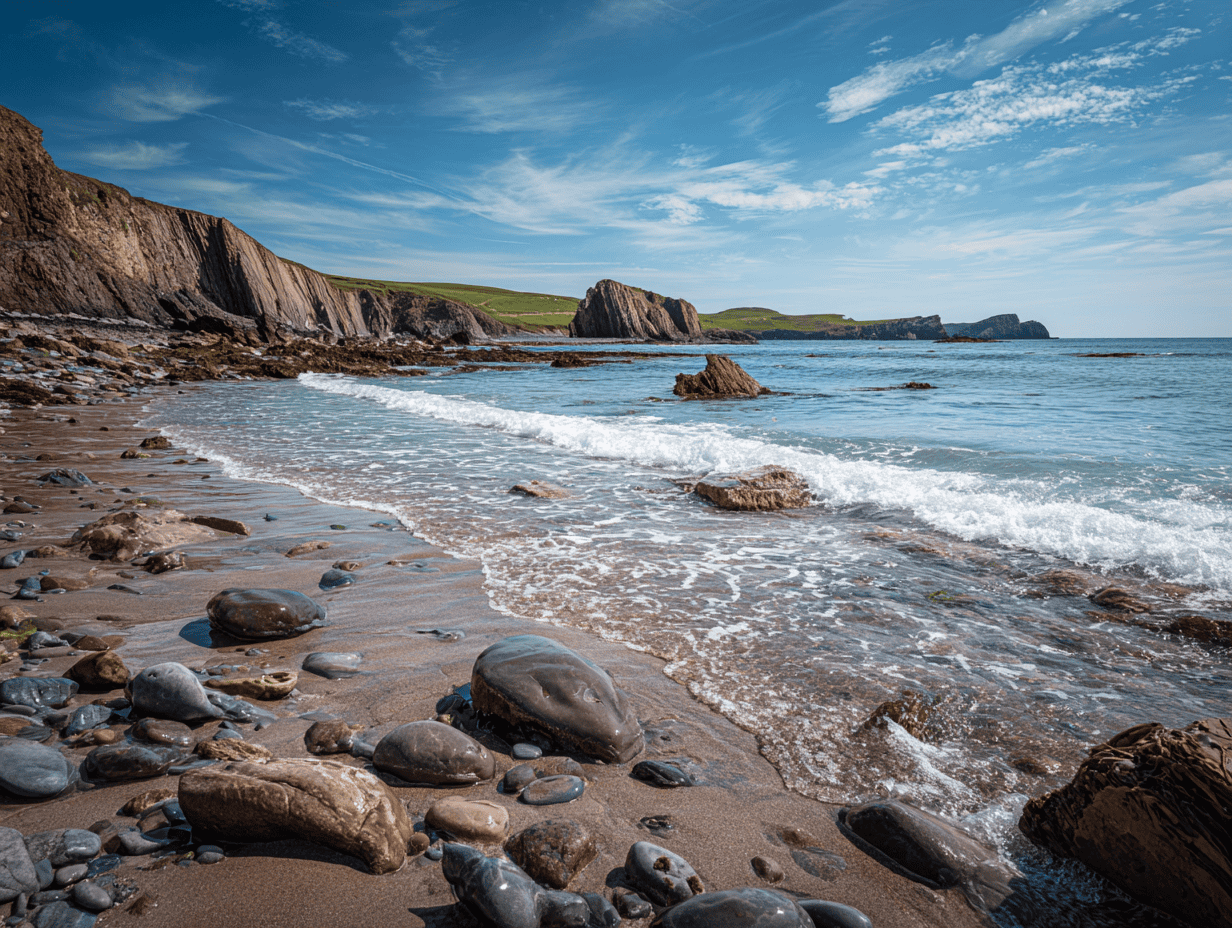
Six Centuries of Harbour Glass in a Medieval Town
Tenby is a fair but rewarding sea glass hunting destination, especially around Castle Beach and the harbour margins exposed at lower tides. Green, brown and white are the most common finds, with blue, aqua, amber, turquoise, cobalt, black, lavender and occasional red also reported. The main beaches are sandy, so the best hunting is concentrated around rocky edges, pebble pockets and the old harbour.
- Rating: Fair Beach
- Terrain: Easy
- Level: Intermediate
- Dog friendly: Seasonal (dogs banned at Castle Beach, North Beach and Harbour Beach 1 May–30 September; South Beach restricted in parts, unrestricted at the far southern end all year)
- Location: Tenby, South Pembrokeshire, Wales
- Sat Nav: SA70 7EJ (Harbour Car Park / Five Arches)
- Common colours: Green, brown, white
- Rare colours: Cobalt Blue, Black, Lavender, Red
Today at Tenby Beach
Check below for your ShoreSense Score and Tide Times. Scroll down for your 7-day forecast
Tenby Beach sea glass conditions
Tenby Beach
Pembrokeshire
49/100 — Fair, best window 12:20–15:20.
Best window is 12:20–15:20 with calm sea and little recent wave energy to move glass, so the chance of fresh finds is fair today.
Fair — expectations lower at this beach
Ranked #31 in the UK ShoreSense leaderboard today.
| Tide | Time | Height |
|---|---|---|
| Low water | 01:39 | 0.8 m |
| High water | 07:43 | 8.4 m |
| Low water | 13:50 | 1.0 m |
| High water | 19:58 | 8.3 m |
Best For:
- Sea glass hunting
- Harbour finds
- Sea pottery
- Family visits
Why Tenby – the most historic harbour hunt in Wales
Tenby is one of those places that stops you in your tracks the first time you see it. Pastel-painted Georgian houses stacked above a medieval harbour, a thirteenth-century town wall still running round most of the old town, a castle ruin on the headland, and four beaches fanning out below it all, with Caldey Island sitting two miles offshore. It is, by most measures, the most complete medieval harbour town in Wales. And it has been a port since the Vikings named it. Tenby’s Welsh name, Dinbych-y-Pysgod, means Little Fortress of the Fish.
By the time it was taken by the Normans in the early twelfth century, trade had already grown as it developed into a major seaport. By the late Middle Ages, Tenby had become a bustling port and an important trading centre with Ireland, the Bristol Channel and beyond, with merchants dealing in wool, cloth and coal.
During Tudor times, Tenby was a busy and prosperous port, and in 1566 the first shipment of oranges ever to be seen in Wales arrived in the harbour on a Portuguese ship. Henry VII sheltered here before sailing into exile. Pirates and smugglers worked the bay in the eighteenth century. The harbour has been continuously active since the Middle Ages.
As a sea glass beach, Tenby is honest Fair Beach territory: the main beaches are sandy and heavily managed, and summer footfall is enormous. But the harbour margins, Castle Beach at low tide and the quieter early morning windows before the holiday crowds arrive can produce genuine finds. The glass origin story here is exceptional: centuries of harbour trade in a compact, sheltered bay, and the beach rewards a patient low-tide search more than a casual scan. Come in October. Come early. Come with your dog.
What you’ll find here
Colours commonly found: Green, brown, white
Occasional finds: Blue, Aqua, Amber, Turquoise, Sea pottery
Rare finds: Cobalt Blue, Black, Lavender, Red
Bonus: Victorian ceramic shards from the harbour area, occasional pieces of sea pottery with transfer-print patterns, very occasional well-tumbled older glass from deeper harbour sediment
Find something special? Use our sea glass scanner, GlassLore, to find out rarity, value and history; then you can share to our finds gallery and, more importantly, earn points to climb our hunters leaderboard – are you ready to compete?
When to go
Tenby rewards timing more than most beaches. The harbour dries at low tide, the boats settle on the sand, and the foreshore around the harbour walls and the rocky margins of Castle Beach become accessible in a way that is simply not possible at high water. Give yourself two hours either side of low water and work Castle Beach while it opens, then the harbour area as the tide retreats.
At low tide, a magical thing happens: St Catherine’s Island, topped by a massive Victorian Palmerston Fort, becomes accessible on foot across the sand from Castle Beach for roughly two hours either side of low water. The rocky and pebble margins around the island approach are worth hunting on the way out, but always check tide times before crossing, as the flood tide here comes back fast.
Post-storm is worth targeting. Tenby faces east across Carmarthen Bay, and easterly and southeasterly swells are onshore. After a night of east wind, the strandline on North Beach is freshly sorted. October to April is the best season, with far fewer visitors, better storm conditions, and the dog restrictions are off, so your dog can join you properly.
Summer visits work for a casual look, but the beaches are packed and heavily managed. For a dedicated hunt, avoid July and August entirely.
Today’s ShoreSense Score & Best Hunting Window
Tenby sits on the eastern shore of the Pembrokeshire peninsula, facing east across Carmarthen Bay towards the Bristol Channel, with a spring tidal range of around 4 to 4.5 metres. The harbour dries completely at low water, exposing the rocky and pebble margins around the harbour walls and the lower foreshore of Castle Beach. The east-facing aspect means easterly and southeasterly weather is onshore, the conditions that sort and refresh the strandline on North Beach and push material toward the harbour.
Aim to arrive ninety minutes before low water at Castle Beach, work the rocky margins and pebble pockets as the foreshore opens, then move around to the harbour walls as the tide continues to drop.
The ShoreSense widget below combines recent marine conditions, tide timing and practical hunting weather to show today’s overall ShoreSense Score, Hunting Potential, Comfort and the best available hunting window for Tenby. It uses UKHO tide data alongside current marine and weather inputs to help you judge whether conditions look promising for a hunt.
Tenby Beach sea glass conditions
Tenby Beach
Pembrokeshire
49/100 — Fair, best window 12:20–15:20.
Best window is 12:20–15:20 with calm sea and little recent wave energy to move glass, so the chance of fresh finds is fair today.
Fair — expectations lower at this beach
Ranked #31 in the UK ShoreSense leaderboard today.
| Tide | Time | Height |
|---|---|---|
| Low water | 01:39 | 0.8 m |
| High water | 07:43 | 8.4 m |
| Low water | 13:50 | 1.0 m |
| High water | 19:58 | 8.3 m |
Compare your Beaches on our Hot Beaches page, updated daily with the best beaches for today, the next seven days, as well as the movers and shakers.
Where to look on the beach
Castle Beach at low tide – this small, sheltered beach sits directly below the castle headland and is the most productive hunting ground in Tenby. The beach faces east and is relatively sheltered from the worst of the swell, which means material settles and accumulates here rather than being constantly churned. Work the pebble and rocky margins at the base of the cliff rather than the open sandy centre, glass concentrates where substrate changes. At the lowest tides of the year, the rocky ground extending toward St Catherine’s Island opens up and is worth a careful look.
The harbour walls at low water, when the harbour dries, the rocky and pebble foreshore around the base of the harbour walls becomes accessible. This is old ground, centuries of boat traffic above it, centuries of provisions and domestic glass entering the water here. Work slowly around the wall bases, checking pockets and crevices at low level.
North Beach strandline after easterly weather: the main North Beach is sandy and rarely the most productive ground, but after a significant easterly blow, the strandline carries freshly sorted material the length of the beach. Walk it from the harbour end toward the northern cliffs early in the morning before the beach fills with visitors.
The far southern end of South Beach, the vast sandy expanse of South Beach, is mostly unrewarding for glass, but the rocky margins at the far southern end toward Giltar Point have pebble habitat and are dog-friendly year-round. Worth a look if you are extending the visit.
Key Tip:
Start at Castle Beach around low tide and focus on the pebble and rocky margins rather than the sandy centre. Once you’ve covered Castle Beach, move onto the harbour walls while the foreshore is exposed, as this is where Tenby’s richest hunting ground lies.
Difficulty Level – Intermediate
- The best hunting areas are only accessible around lower tides
- Productive ground is concentrated in rocky and pebble sections
- Multiple hunting zones require some planning and timing
- Harbour wall searching involves uneven terrain and crevices
- Success comes from targeting specific areas rather than the main beaches
Hunting Style – The Tide-Timing Hunter
Tenby rewards hunters who plan their visit around the tides. Search Castle Beach first, then move onto the exposed harbour foreshore as the water retreats. Work every pebble pocket, rocky margin and wall base carefully. The open sandy beaches may be beautiful, but the best finds are usually hidden where rock, shingle and history meet.
Beach Personality
Tenby feels like a historic harbour town with spectacular beaches attached. Medieval walls, colourful houses, castle ruins and centuries of maritime activity create a coastline rich in character and potential. While most visitors are drawn to the golden sands, sea glass hunters quickly discover that the real treasures are found in the quieter corners beneath the castle and around the old harbour, where generations of history have washed ashore.
Dog friendly?
Tenby has some of the most complex seasonal dog restrictions in Wales, and it’s worth understanding them properly before you visit with your dog. The ban applies to Castle Beach, North Beach (the whole beach apart from the area around the lifeboat stations), and Harbour Beach, from 1 May to 30 September. Dogs must be kept on a lead in the harbour, promenade and North Walk areas too.
For the North Beach side of town during the summer months, restrictions are in place in most parts. South Beach is the best option during the summer, and the majority of it accepts dogs. The far southern end of South Beach is unrestricted all year.
In practice, for a sea glass hunting visit with your dog, the window outside the restriction period – October to April – is when you want to be here anyway. Castle Beach and the harbour area, the two most productive sections, are fully accessible to dogs all winter.
For a post-hunt pub with a wet dog, the Hope and Anchor near the harbour has a front-facing beer garden with harbour views and an upstairs family room where dogs are allowed. The Normandie on Upper Frog Street allows dogs in the lower bar and beer garden.
Check our Yappy Places listing for Tenby for the full picture.
Practical information
Parking: The Five Arches Pay and Display car park on South Parade (SA70 7EJ) is the most convenient for Castle Beach and the harbour, a few minutes’ walk through the town walls. The multi-storey off Upper Park Road is good for North Beach.
The North Beach car park fills by 9 am on summer mornings. Arrive early or use the town centre multi-storey and walk down. Tenby town centre is compact enough that all beaches are walkable from any central car park.
Toilets: Public toilets at Castle Beach (7am–8pm, 40p charge, with disabled and baby-changing facilities) and facilities above North Beach. Good provision throughout the town.
Food and drink: Tenby is exceptionally well served for a town of its size, with good cafés, restaurants and pubs throughout the medieval town centre, all within a short walk of the beaches. The Stowaway Café is tucked into the old harbour archways. For a proper post-hunt meal in the town, the range is good, and several options are dog-friendly outside the main dining areas.
Getting there without a car: Tenby has a railway station on the South Wales Main Line, served by Transport for Wales with connections from Swansea, Cardiff and beyond. The station is around a ten-minute walk from the harbour and beaches. Bus connections also run from Pembroke and Saundersfoot.
Accessibility: Castle Beach is accessed via a steep slipway or steps. North Beach has a zigzag ramp from the north cliff, and Tenby Town Council operates a beach wheelchair hire scheme in summer (book in advance). The harbour area is paved and accessible. The town centre streets are narrow and cobbled in places.
What to bring
- Comfortable walking shoes – the castle headland approach, cobbled town streets and rocky beach margins all reward decent footwear
- A bag or tin for finds – glass at Tenby tends to be varied; the harbour history means older, well-tumbled pieces are possible alongside more recent material
- A hand rake for working pebble pockets around the harbour walls and at the base of Castle Beach cliffs
- Layers – Tenby faces east across Carmarthen Bay, and the offshore wind in October and November is sharp
- A tide table – the harbour dries completely at low water, and St Catherine’s Island is only crossable for a narrow two-hour window; know your times before you go
- An early start in summer – the town is extremely popular, and the beaches fill quickly; the best hunting window and the quietest beach overlap at around 7 am
The history behind the glass
The name says it – Dinbych-y-Pysgod, Little Fortress of the Fish. Tenby has been a fishing and trading harbour since before the Norse named it, and the natural shelter of the harbour has drawn boats to this bay for well over a thousand years.
By the late Middle Ages, Tenby had become a bustling port, an important trading centre with Ireland, the Bristol Channel and beyond. Merchants dealt in wool, cloth and coal, and the town prospered as maritime trade flourished. Jasper Tudor, uncle to King Henry VII, took refuge in Tenby during the Wars of the Roses. Henry VII himself was sheltered here before his escape into exile, led through underground tunnels to the harbour by the mayor of Tenby and slipped onto a ship in the dark. The harbour that sent a future king into exile has been active ever since.
During the Tudor period, Tenby emerged as a thriving port town, with merchants exporting goods such as wool, fish and salt to European markets, and importing luxury items like wine and spices. In 1566, the first shipment of oranges ever to be seen in Wales arrived in Tenby harbour on a Portuguese ship. That single fact tells you something about the range of trade passing through this harbour: Spanish wine, Portuguese citrus, Irish wool, Welsh coal, Bristol provisions, all of it packaged in glass and stoneware, all of it generating breakage and harbour waste over four centuries of continuous commercial activity.
In the eighteenth century, Tenby became a hotbed for smuggling activities and was frequented by pirates. The town’s narrow streets and hidden alleyways provided the perfect cover for illicit trade. Smugglers brought spirits. Spirits come in bottles. Bottles go in the harbour.
Trade fell drastically after the Tudor period, when Tenby fell into serious decline, and the final blow came when the plague struck in 1650, wiping out almost half the population. The town rebuilt itself slowly, reinventing itself as a Georgian resort by the late eighteenth century as wealthy visitors from Bristol and the Midlands discovered its beaches. Victorian tourism layered more glass onto what the medieval merchants had already contributed. The harbour wall you are hunting beside today was built for coal ships. The beach inside it was a working foreshore when Henry Tudor was a fugitive.
From beach to jewellery
Found something worth keeping at Tenby? At Mermaid Tears, every piece starts exactly where you’re standing, hand-hunted from UK beaches and handmade into something lasting. Browse the collection →
Disclaimer: Tide times, dog restrictions, parking charges and beach conditions change regularly. Always verify before visiting. St Catherine’s Island is only accessible for approximately two hours either side of low water, and the flood tide returns fast. Always check tide times before crossing. Dog restriction byelaws at Tenby are reviewed annually; always check current rules with Pembrokeshire County Council before visiting with a dog. Fines are actively enforced in season.
Last updated: Aug 2026
Frequently asked questions
Is Tenby good for sea glass? It’s an honest Fair Beach – genuine finds are possible, particularly around Castle Beach and the harbour margins at low tide, but this is not a high-volume hunt. The glass origin story is exceptional, with one of the oldest and most active harbour histories in Wales, but sandy beaches and heavy summer footfall mean you need to target the right areas and conditions. Low tide, early morning, off-season. Get those three things right, and Tenby rewards patience.
Which beach is best for sea glass at Tenby? Castle Beach at low tide is the most productive – the sheltered position concentrates material, the rocky and pebble margins around the base of the castle headland hold glass between tides, and it is far less trampled than North Beach. The harbour walls at low water are a close second. South Beach’s far southern end near Giltar Point has pebble habitat and is dog-friendly year-round.
Are dogs allowed at Tenby beaches? The restrictions are complex and strictly enforced. Castle Beach, North Beach and Harbour Beach ban dogs from 1 May to 30 September. Dogs must be kept on leads in the harbour, promenade and North Walk areas during the same period. The majority of South Beach accepts dogs, with the far southern end unrestricted all year. For a sea glass hunt with a dog, October to April is when you want to be here — the productive beaches are accessible, and the season is right for hunting anyway. Always verify current byelaws with Pembrokeshire County Council before visiting.
Can I walk to St Catherine’s Island? Yes, at low tide, the island is accessible on foot for approximately two hours either side of low water across the sand from Castle Beach. The Victorian Palmerston Fort on top is worth seeing. Always check tide times before crossing; the flood tide here returns quickly, and people do get cut off.
Is Tenby worth visiting for more than sea glass? Absolutely. Tenby is one of the most complete medieval harbour towns in Wales, with the town walls, the castle, the Tudor Merchant’s House, the Tenby Museum, and the boat trips to Caldey Island. It is a genuinely exceptional small town and easily justifies a longer visit than just the beach hunt. Off-season, Tenby, when the holiday crowds are gone and the medieval streets are quiet, is one of the better places to spend a November morning in South Wales.
When is the best time to visit Tenby for sea glass? Early morning on a low spring tide after easterly weather, October to April. The harbour and Castle Beach are accessible to dogs; the beach is quieter, and the conditions that produce good finds- easterly swell sorting the strandline- are more frequent in the autumn and winter months. Summer works for a casual, opportunistic look, but the beaches are packed, and the best areas are restricted for dogs until October.
More Welsh Beaches
Check out our Full Wales Guide or plan your trip with our UK Sea Glass Map.