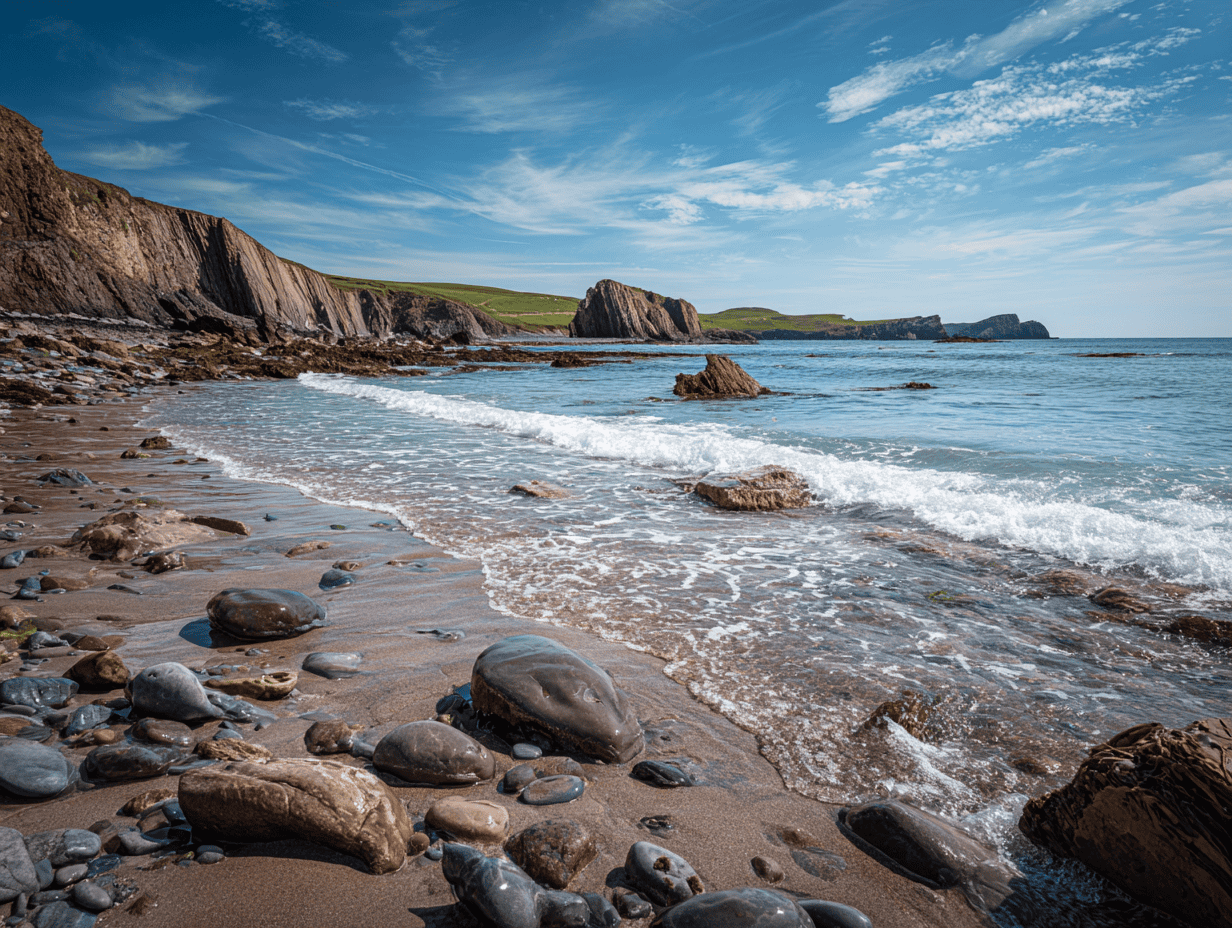
Dylan Thomas’s Town and a Victorian Shipbuilder’s Shore
New Quay is a fair but rewarding sea glass hunting beach, with Dolau Beach and the harbour-wall margins the best places to search. Green, brown, and white are the most common finds, with blue, aqua, amber, and turquoise appearing occasionally, and cobalt blue, black, and lavender among the rarer colours reported. The main Harbour Beach is predominantly sandy, so concentrate on pebble pockets, rocky margins and the smaller coves.
Where to hunt: Dolau Beach pebble pockets → harbour-wall base → pier-side crevices → Traethgwyn / Llanina end
- Rating: Fair Beach
- Terrain: Easy
- Level: Beginner
- Dog friendly: Seasonal (dogs banned at Harbour Beach between Pier and Penpolion 1 May–30 September; Dolau Beach and Traethgwyn unrestricted all year)
- Location: New Quay (Cei Newydd), Ceredigion, Mid Wales
- Sat Nav: SA45 9PB – Church Rd
- Common colours: Green, brown, white
- Rare colours: Cobalt Blue, Black, Lavender
Today at New Quay Beach
Check below for the latest ShoreSense Score and tide times. Scroll down for your full 7-day forecast
New Quay Beach sea glass conditions
New Quay Beach
Ceredigion — Sea settling
89/100 — Excellent, best window 12:01–15:01.
Best window is 12:01–15:01 with big seas in the last few days, now easing — glass should be washing in and spring tides (near full/new moon), so the chance of fresh finds is excellent today. Great combo of sea state and weather — worth the trip.
Rare excellent window at this spot
Ranked #13 in the UK ShoreSense leaderboard today.
| Tide | Time | Height |
|---|---|---|
| Low water | 01:15 | 0.9 m |
| High water | 06:44 | 4.7 m |
| Low water | 13:31 | 0.8 m |
| High water | 19:01 | 5.0 m |
Best For:
- Harbour finds
- Historic sea glass
- Beginners
- Rock pool searching
- Dog walkers
- Low-tide hunting
- Pebble beach searching
- Coastal day trips
Why New Quay – the town that launched two hundred ships and inspired a play
A line by Dylan Thomas has always felt like a description of New Quay. A cliff-perched toppling town. He wrote it about the place he lived in 1944 and 1945, high above the harbour in a draughty bungalow on Llanina Point, looking out over the full arc of Cardigan Bay with Snowdonia sitting on the horizon on clear days. Many believe New Quay inspired Llareggub, the fictional village of Under Milk Wood, in his play for voices about the dreams and secret lives of a small Welsh fishing town.
The sailors, the fishermen, the women watching from the terraced houses above the harbour. New Quay fits the description so precisely that the argument barely needs making.
What most visitors don’t know is that this charming, slightly out-of-time fishing village was once a serious industrial port. Until the early nineteenth century, New Quay consisted of a few thatched cottages surrounded by agricultural land, the natural harbour providing a safe mooring for fishing boats and a few small trading vessels.
Then the harbour was built. The New Quay Harbour Act passed in 1835; a stone pier went up at a cost of £7,000, and within a decade this was a serious shipbuilding town. Over two hundred ships were built here between 1779 and 1890. Two hundred ships, launched from the beach where your dog is now running.
New Quay’s yards constructed 99 schooners between 1848 and 1870 alone, contributing to a total exceeding 200 ships built locally between 1779 and 1890. Two hundred ships. Built on the beach where your dog is now running. The Wales Coast Path description puts it simply: walk along the beach where hundreds of sloops, schooners and large barques were built. That is the beach you are hunting on.
New Quay is a Fair Beach- honest about that. Harbour Beach is predominantly sandy and heavily managed in summer. The glass origin is genuine, but it doesn’t concentrate as freely as a harbour with a deeper pebble substrate. But the Dolau Beach pebble sections, the harbour wall margins at low tide, and the dog-friendly Traethgwyn stretch further along the bay produce regular finds for the patient hunter.
Come in October, come at low tide, and bring the standard expectation for a Fair Beach: interesting finds possible, prolific finds unlikely, the whole experience much better than the glass alone.
What you’ll find here
Colours commonly found: Green, brown, white
Occasional finds: Blue, Aqua, Amber, Turquoise, Sea pottery
Rare finds: Cobalt Blue, Black, Lavender
Bonus: Rock pool life in the cove margins, dolphin sightings from the harbour wall and beach (the resident Cardigan Bay bottlenose dolphin population is one of the best-known in Britain), occasional ceramic shards from the Victorian shipbuilding community
Find something special? Use our sea glass scanner, GlassLore, to find out rarity, value and history; then you can share to our finds gallery and, more importantly, earn points to climb our hunters leaderboard – are you ready to compete?
When to go
Low tide opens the productive sections of New Quay. Harbour Beach widens significantly as the tide drops. The sandy lower beach is less interesting than the pebble and rock margins at the base of the harbour wall and the Dolau cove end. Work those margins as the tide retreats, and you’ll cover the ground most likely to hold glass.
New Quay faces northeast across Cardigan Bay. Northerly and northeasterly weather is onshore, the kind of autumn and winter conditions that sort and refresh the strandline. The bay is well protected except from the north wind, which means northerly swells that would flatten other beaches are the productive conditions here. After a northerly blow in October or November, visit on the ebbing tide the following morning.
The town prospered particularly between about 1820 and 1860. That’s also the productive historical window for glass, when three hundred shipbuilders worked on the beach, and sixty schooners were registered at the port. The glass from that period has had nearly two centuries of Cardigan Bay swell working on it.
Summer is busy, and Harbour Beach has dog restrictions. For a hunting visit with your dog, the October to April window is when you want to be here: the restrictions are off, the beach is quiet, and the seasonal storms do their work.
Today’s ShoreSense Score & Best Hunting Window
New Quay sits on the eastern shore of Cardigan Bay, facing northeast, sheltered from the prevailing westerly weather by the Llŷn Peninsula to the north, with a spring tidal range of around 3 to 3.5 metres, modest for Wales but enough to expose the harbour margins and Dolau Cove sections that are productive at low water. The northeast-facing aspect means northerly and northeasterly weather is the onshore swell direction, less common than westerlies, but the conditions that sort this specific beach most effectively.
Start on Dolau Beach and work the pebble pockets and rocky margins beside the pier. As the tide falls, move onto the foreshore at the base of the harbour wall and check the shingle and gaps between the stones. If you want a longer hunt, continue along Traethgwyn towards Llanina Point, concentrating on the mixed pebble sections rather than the broad sand. Use today’s ShoreSense Best Window to choose when to arrive, then follow this Dolau → harbour wall → pier margins → Traethgwyn progression once you’re there.
The ShoreSense widget below combines recent marine conditions, tide timing and practical hunting weather to show today’s overall ShoreSense Score, Hunting Potential, Comfort and the best available hunting window for New Quay. It uses UKHO tide data alongside current marine and weather inputs to help you judge whether conditions look promising for a hunt.
New Quay Beach sea glass conditions
New Quay Beach
Ceredigion — Sea settling
89/100 — Excellent, best window 12:01–15:01.
Best window is 12:01–15:01 with big seas in the last few days, now easing — glass should be washing in and spring tides (near full/new moon), so the chance of fresh finds is excellent today. Great combo of sea state and weather — worth the trip.
Rare excellent window at this spot
Ranked #13 in the UK ShoreSense leaderboard today.
| Tide | Time | Height |
|---|---|---|
| Low water | 01:15 | 0.9 m |
| High water | 06:44 | 4.7 m |
| Low water | 13:31 | 0.8 m |
| High water | 19:01 | 5.0 m |
Compare your Beaches on our Hot Beaches page, updated daily with the best beaches for today, the next seven days, as well as the movers and shakers.
Where to look on the beach
Dolau Beach – this is your primary hunting ground. Dolau is the smaller, rockier beach on the western side of the pier, sheltered by the harbour wall. Dolau is New Quay’s smallest beach, pet-friendly all year and close to the car park.
The pebble and rock sections here concentrate glass more effectively than the open sandy Harbour Beach. Work the pebble pockets and rock margins carefully at low tide, crouch down, check the crevices at the base of the pier wall, and look for the frosted matte surface of glass among the rounded stones.
The harbour wall at low water. As the tide drops, the foreshore around the base of the harbour wall and pier becomes accessible. This is old ground with a genuine history; the stone pier has been here since 1835, and the harbour was active before that. Work slowly along the wall base, checking pockets between the stones.
Harbour Beach strandline – after northerly weather, walk the full strandline from the Dolau end toward Llanina Point. The beach is wide at low tide, and the freshly sorted strandline after a northerly blow can carry material the length of the beach. Not prolific, but worth a careful walk if conditions have been right.
Traethgwyn – the longer beach to the north of the harbour, between New Quay and Llanina Point, is dog-friendly all year and extends toward Cei Bach. Cei Bach is good for beachcombing and rock pooling at the Llanina end, a favourite for dog walkers. The shingle and pebble sections at the Llanina end are worth a look, and the walk along the beach toward Llanina Point, where Dylan Thomas actually lived and where the views back to the cliff-perched town are exactly as he described them, is worth doing for its own sake.
Key Tip
Head straight to Dolau Beach at low tide and work the base of the harbour wall and pier slowly. Glass often becomes trapped between rocks and pebbles here, and these sheltered pockets can be far more productive than the larger sandy beach nearby.
Difficulty Level -Beginner
- Main hunting areas are easy to reach from the harbour and car park
- Productive spots are concentrated in obvious locations around Dolau Beach
- Minimal walking is required to access the best ground
- No scrambling needed, although care is required on slippery rocks
- Suitable for first-time sea glass hunters and families
Hunting Style – The Harbour Hunter
New Quay rewards slow, methodical searching around historic structures. Focus on pebble pockets, harbour walls, pier foundations and rocky margins where glass becomes trapped. This is less about covering miles of beach and more about carefully investigating likely collection points.
Beach Personality
New Quay feels like the sort of harbour where history lingers beneath every stone. The sheltered waters, Victorian pier and centuries of maritime activity create exactly the kind of environment sea glass hunters love. Dolau Beach may be small, but it punches above its weight, offering rocky corners, pebble accumulations and hidden crevices that deserve careful attention. It’s a beach that rewards patience rather than distance, making every find feel earned.
Dog friendly?
Seasonal restrictions apply on Harbour Beach from 1 May to 30 September between the pier and Penpolion, beside the RNLI Lifeboat Station. Dolau Beach and Traethgwyn sit outside that named restricted section, making them the more useful dog-friendly hunting options. Dogs must also be kept on leads through the signed harbour/village area.
Dogs on leads are required in the harbour area and along the main road through the village, standard for a busy seaside resort.
The Black Lion pub on the main street is where Dylan Thomas famously drank and first sketched out Quite Early One Morning, the radio piece that developed into Under Milk Wood. It is dog-friendly and the natural endpoint for an autumn visit to New Quay.
Check our Yappy Places listing for New Quay for the full picture.
Practical information
Parking: Ceredigion County Council runs two car parks in New Quay: Church Road (SA45 9PE), the main one, and Rock Street. Church Road has plenty of space and public toilets, but it sits at the top of the hill, around five minutes’ walk down to the harbour and a steep climb back. Charges apply every day from 8am to 6pm, with the council’s standard tariff of roughly £4 for two hours, £5 for four and £7 for 24 hours.
There’s no pay-by-phone option here, so bring coins or a card, and note that the tariff increases for vans, motorhomes, and vehicles over 1.5 tonnes. Limited parking is available lower down near the harbour for a small fee, and two disabled bays are above the main beach. Parking as low as possible makes the visit considerably easier.
Toilets: The toilets at Paragon Car Park and Sandy Slip are currently closed. Public toilets are available at South John Street, where accessible facilities are open 24 hours, and at Ranmore Gardens seasonally from April to October. Check the current Ceredigion Council listing before travelling, as closures can change.
Food and drink: New Quay punches above its size for food. The harbour has cafés and fish-and-chip options with views over the bay. The Black Lion on the main street is dog-friendly and genuinely historic. The Mariner pub is also a reliable option. The village has a good spread of independent cafés and the general feel of a place that has fed visitors well for a long time.
Getting there without a car: New Quay has no railway station, but the Traws Cymru T5 serves the village on the Aberystwyth–Aberaeron–New Quay–Cardigan–Fishguard–Haverfordwest route. Check the current Transport for Wales timetable before travelling, as some journeys have different stopping patterns.
Accessibility: The harbour area is easier to reach than the steep upper streets of New Quay, but access around the town is not uniformly step-free. Dolau Beach has more limited access, and the pebble, rock and harbour-wall hunting ground is uneven underfoot. Anyone with reduced mobility should stick to the harbour-side viewpoints and check current access conditions before visiting.
What to bring
- Comfortable shoes – the harbour wall margins and Dolau cove rocks are uneven at low tide; the walk to Traethgwyn and Llanina Point is a straightforward coast path
- A bag or tin for finds – glass at New Quay is varied rather than prolific; the harbour history means older, well-tumbled pieces are possible
- A hand rake for the Dolau pebble sections and harbour wall margins
- Layers – New Quay faces northeast across Cardigan Bay, and the wind off a northerly blow is raw
- A tide table – the productive ground opens up properly only on a decent low tide
- Binoculars – the resident bottlenose dolphin population of Cardigan Bay is genuinely one of the best in Britain; they are often visible from the harbour wall and beach, particularly in summer and autumn
The history behind the glass
New Quay, before 1835, was barely a village. A handful of thatched cottages, a natural harbour that had been used informally for centuries, a few fishing boats. Then the harbour was built.
The New Quay Harbour Act was passed in 1835, and they built a stone pier. New Quay was a small fishing port until shipbuilding began there in the 18th century, peaking in the mid-19th century after the addition of the new pier and quay in 1835. Associated industries included sail and rope making, as well as a foundry. The area also had a number of schools specialising in navigation and trigonometry.
The scale of what followed is startling for a village of this size. New Quay had sixty schooners and thirty smaller vessels, averaging 20 to 200 tonnes burthen and employing about 390 men. Shipbuilding was extensively carried on. By the 1840s, more than three hundred workmen were employed in shipbuilding across three centres, New Quay itself, Traethgwyn, and Cei-bach.
Shipbuilding began at the close of the 18th century with the construction of the sloop Peggy and Betsy in 1787. By the peak years, New Quay’s yards had constructed 99 schooners between 1848 and 1870 alone, contributing to a total exceeding 200 ships built locally between 1779 and 1890.
Three hundred men are working on the beach. Sixty schooners registered at the port. A foundry, a rope walk, sail makers, and navigation schools. The terraced houses climbing the hill above the harbour were built for the workers and their families. Between the ropewalks, the town had narrow streets rising in terraces, between several of which were ropewalks for twisting rope in New Quay’s heyday as a shipbuilding centre.
Every household had bottles, jars, medicine glasses, and domestic glass. Every ship provisioned here for a voyage left its share of breakage. In the early 1800s, New Quay was also used for smuggling, as the natural harbour offered excellent cover and smugglers dealt primarily in spirits, which come in bottles, and bottles end up in harbours.
After the railways came to West Wales in the late nineteenth century, New Quay’s port declined, being replaced by tourism as the major economy. Then Dylan Thomas arrived in 1944, living in a modest bungalow perched high above the sea with views spanning the entirety of Cardigan Bay. He drank in the Black Lion, walked the harbour, knew the fishermen by name, and wrote the radio piece that became Under Milk Wood about a town that matched New Quay character by character.
The glass on the Dolau shingle is the accumulated domestic residue of the shipbuilding town, two hundred ships launched into Cardigan Bay over a century of industry, three hundred workers provisioned and housed in the terraced streets above the harbour, generations of fishing families making their living from the same water. Dylan Thomas would have recognised the harbour wall you’re hunting beside. The pier has barely changed since he leaned on it.
From beach to jewellery
Found something worth keeping at New Quay? At Mermaid Tears, every piece starts exactly where you’re standing, hand-hunted from UK beaches and handmade into something lasting. Browse the collection.
Disclaimer: Tide times, dog restrictions, parking charges and beach conditions change regularly. Always verify before visiting. Ceredigion’s seasonal dog restrictions are reviewed annually. Always check the current rules with Ceredigion County Council before visiting with a dog. The Cardigan Bay dolphin population is protected; always observe dolphins from a respectful distance.
Last updated: September 2026
Dog rules checked: September 2026 — Ceredigion County Council
Frequently asked questions
Is New Quay good for sea glass? It’s a Fair Beach – genuine finds are possible, particularly on Dolau Beach and the harbour wall margins at low tide, but this is not a high-volume hunt. The shipbuilding history is genuine and interesting: 200 ships were built on this beach between 1779 and 1890, but the sandy Harbour Beach concentrates glass less effectively than a deep pebble-substrate site. Target Dolau and the harbour margins at low tide to manage expectations, and the visit is rewarding for more reasons than the glass alone.
Which part of New Quay is best for sea glass? Dolau Beach is the smaller, rockier cove on the western side of the pier. It’s dog-friendly all year, less busy than the main Harbour Beach, and the pebble and rock sections here concentrate glass more effectively. The harbour wall margins at low water are a close second.
Are dogs allowed at New Quay beaches? Dolau Beach and Traethgwyn are unrestricted year-round, and your dog is welcome at both every month. Harbour Beach bans dogs between the Pier and Penpolion from 1 May to 30 September. Always verify current rules with Ceredigion County Council before visiting.
Did Dylan Thomas really live here? Yes, between 1944 and 1945, Thomas lived in a bungalow called Majoda on Llanina Point just north of the town, overlooking the full sweep of Cardigan Bay. He drank regularly in the Black Lion in the village. It is widely accepted that New Quay was the primary inspiration for Llareggub in Under Milk Wood; the fishermen, the cliff-perched terraced houses, the harbour and the bay all appear in barely disguised form in the play.
Can I see dolphins at New Quay? Yes, the resident bottlenose dolphin population of Cardigan Bay is one of the best-known in Britain, and they are regularly visible from the harbour wall, the beach, and on boat trips from the harbour. Summer and autumn are the most reliable seasons. The Cardigan Bay Marine Wildlife Centre on the harbour front is worth visiting for information on the population and sighting reports.
When is the best time to visit New Quay for sea glass? Low tide, ideally after northerly or northeasterly weather, October to April. The dog restrictions are off, the beach is quieter, the storms are more frequent, and the northerly swell that sorts this northeast-facing bay is most common in autumn and winter. The Black Lion and the harbour view on a November morning are genuinely good reasons to be there.
More Welsh Beaches
Check out our full Wales Beaches Guide or plan your trip with our UK Sea Glass Map.