The Durham Coast’s Dark Horse
Blackhall Rocks is a good sea glass hunting beach for more experienced hunters, especially around the cave mouths, rock pools and trapped shingle exposed at lower tides. Green, brown, and white are the most common finds, with blue, aqua, and rarer colours including cobalt, black, lavender, red, and yellow also reported. Blackhall Rocks is around 8 miles south of Seaham on the Durham Heritage Coast
- Rating: Good Beach
- Terrain: Tricky
- Level: Intermediate
- Dog-friendly: Seasonal- on lead on the clifftop nature reserve March–August (no beach ban)
- Location: Blackhall Rocks, County Durham
- Sat Nav: TS27 4AZ
- Common colours: Green, brown, white
- Rare colours: Cobalt Blue, Black, Lavender, Red, Yellow
Blackhall Rocks Beach Today
Here’s today’s ShoreSense score and tide times. Scroll down for your full 7-day forecast.
Blackhall Rocks sea glass conditions
Blackhall Rocks
County Durham
46/100 — Fair, best window 09:20–12:20.
Best window is 09:20–12:20 with spring tides (near full/new moon) and calm sea, so the chance of fresh finds is fair today.
Fair for a top spot — still worth a look
Ranked #55 in the UK ShoreSense leaderboard today.
| Tide | Time | Height |
|---|---|---|
| High water | 04:19 | 5.4 m |
| Low water | 10:50 | 0.2 m |
| High water | 16:47 | 5.1 m |
| Low water | 22:58 | 0.8 m |
Best For
- Intermediate hunters
- Rock pool hunting
- Well-frosted glass
- Low-tide exploring
- Quiet beaches
- Technical searching
- Post-storm hunting
Why Blackhall Rocks deserves your attention
Most people driving the Durham Heritage Coast are heading for Seaham. That’s understandable; Seaham is Seaham. But keep going south past the clifftop nature reserves and the dramatic magnesian limestone headlands, and you’ll reach a beach that gets significantly less attention than it deserves.
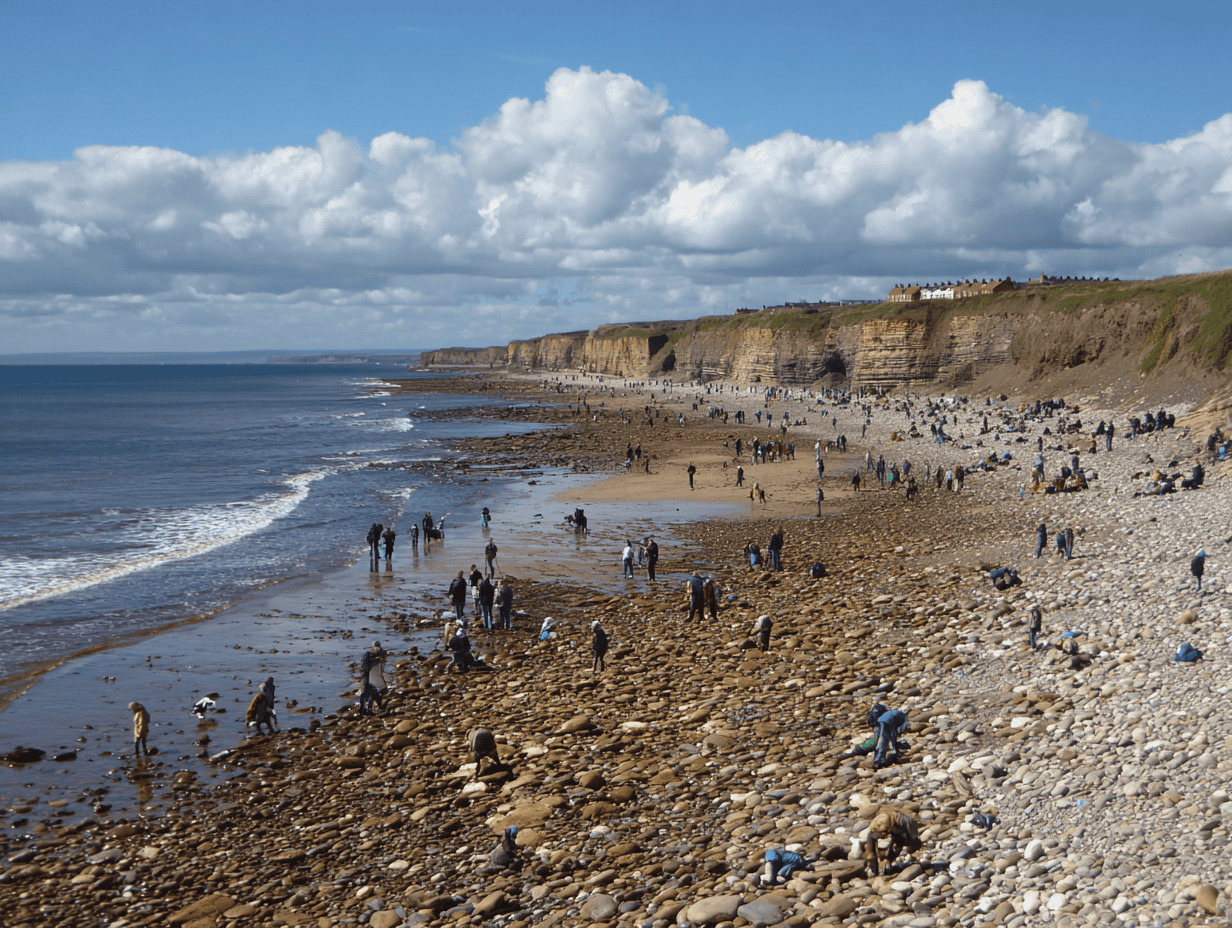
Blackhall Rocks is a wild, atmospheric stretch of coastline with caves carved into ancient limestone cliffs, rock pools teeming with life at low tide, and a foreshore that rewards hunters who are prepared to work for their finds. The sea glass here isn’t wall-to-wall the way it is at Seaham. But it’s real, it’s varied, and on the right day after a North Sea blow, the strandline can throw up some genuinely excellent pieces.
The beach also has one of the most dramatic industrial backstories on the entire Durham coast, which matters for sea glass hunters, because the history is exactly why the glass is here.
This is a beach for people who don’t mind a scramble, who want somewhere off the beaten track, and who’d rather share the foreshore with seals and skylarks than a crowd of fellow collectors.
What you’ll find here
Colours commonly found: Green, brown, white
Occasional finds: Blue, Aqua, Amber, Turquoise
Rare finds: Cobalt Blue, Black, Lavender, Red, Yellow, multi-coloured
Bonus: Fossils in the limestone, coal fragments, Victorian pottery shards, and occasional sea-tumbled ceramics
Find something special? Use our sea glass scanner, GlassLore, to find out rarity, value and history; then you can share to our finds gallery and, more importantly, earn points to climb our hunters leaderboard – are you ready to compete?
When to go
Come at low tide, ideally a big spring low around new or full moon. The foreshore at Blackhall opens up considerably when the tide drops, exposing rocky shelves and shingle ridges that simply don’t exist at high water. The rock pools trap and hold glass well, so the areas around the cave sections and the rocky outcrops at the southern end are worth thorough investigation.
Winter is the stronger season. Storm activity churns the seabed and drives fresh material onto the beach, and the site is quieter at busy times in summer, particularly on good-weather weekends. The car park fills up, and families flock to the rocks. The sea glass isn’t going anywhere, but you’ll hunt better with space to work.
The day after a significant North Sea storm is your sweet spot. Easterly winds and heavy swell push glass up into the crevices and onto the shingle above the waterline.
Check the forecast, check the tides, and get there as the water pulls back.
Hunting Style
“Low-Tide Rock Pool Hunting”
Meaning:
- Arrive on a falling tide
- search slowly
- Inspect pool edges carefully
- Check the trapped shingle between rocks
- Revisit exposed shelves as water retreats
This is not a fast scanning beach.
The good finds tend to come from:
- patience
- angle changes
- getting low
- checking pockets, others skip
Today’s ShoreSense Score & Best Hunting Window
Blackhall Rocks sits on the North Sea, with a tidal range of around 4.9 metres on a spring tide, a generous range that exposes substantial foreshore when the tide is fully out, pulling back to reveal rock platforms, shingle beds and cave-mouth debris that are completely submerged at high water.
Blackhall Rocks is strongly tide-dependent because the cave mouths, rocky shelves and trapped shingle disappear under higher water. As the tide falls, start around the upper shingle and cave sections, then work out across the rock pools and exposed platforms as more ground opens.
Bigger spring lows give you more of this technical foreshore to search. After stronger easterly or north-easterly conditions begin to settle, recheck the shingle pockets and strandline. Use today’s ShoreSense Best Window to decide when to arrive, then follow the beach’s cave-mouth → trapped-shingle → rock-pool progression once you’re there.
The ShoreSense widget below combines recent marine conditions, tide timing and practical hunting weather to show today’s overall ShoreSense Score, Hunting Potential, Comfort and the best available hunting window for Blackhall Rocks. ShoreSense doesn’t predict whether glass will definitely be present; it helps you judge whether current conditions look more or less promising for a hunt.
Compare your Beaches on our Hot Beaches page, updated daily with the best beaches for today, the next seven days, as well as the movers and shakers.
Where to look on the beach
Access to the beach is via steep steps from the car park, which is worth knowing before you go, as it rules out pushchairs and makes the descent a little awkward if you’ve loaded yourself down with kit. Once you’re down, the beach stretches north and south along the base of striking magnesian limestone cliffs.
The cave section is the most productive hunting ground. The caves at Blackhall are the largest in the Durham limestone coastline, and glass gets trapped in the debris that accumulates around cave mouths and in the boulder fields at the base of the cliffs. Work slowly here and check between rocks rather than just scanning the surface.
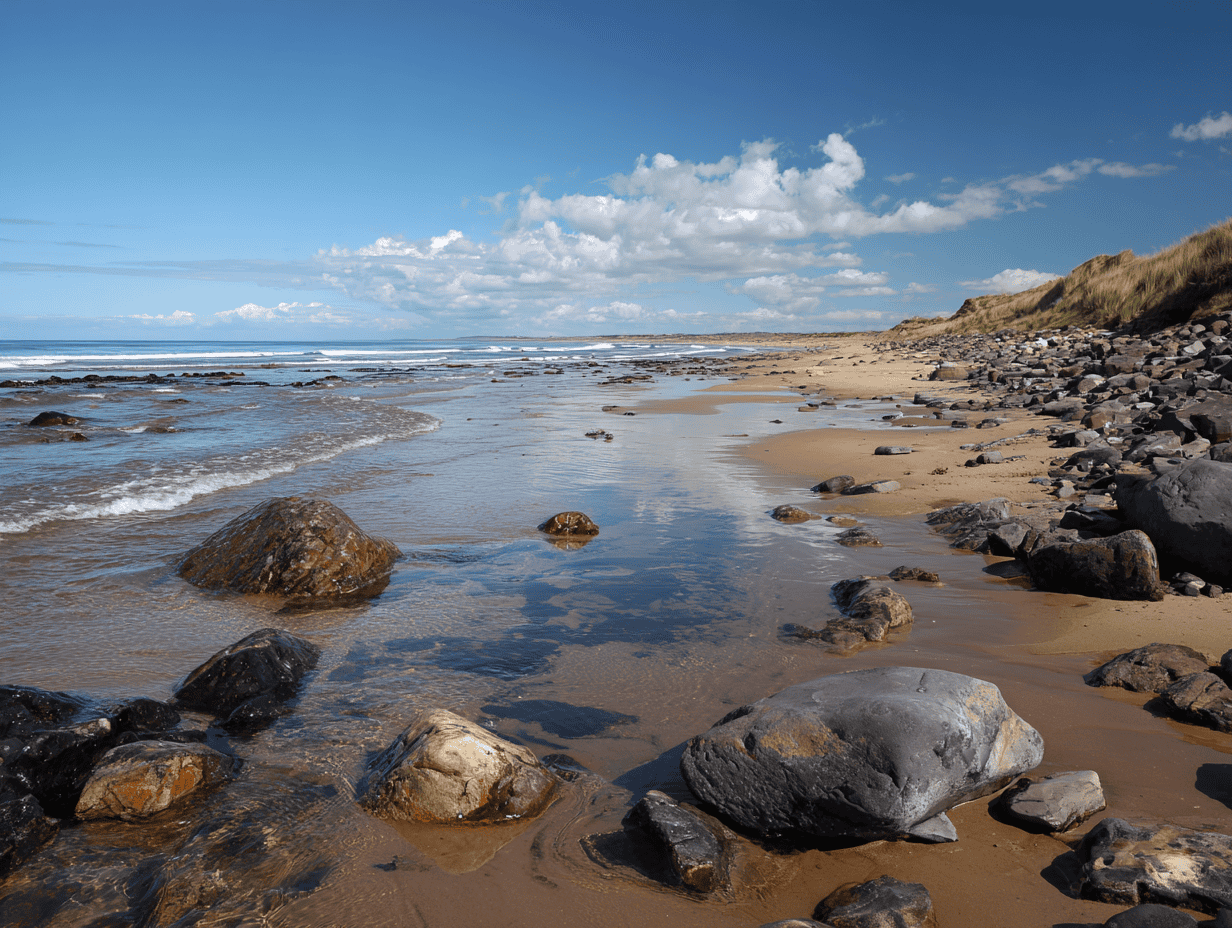
The rock pools and platforms at low tide are worth methodical searching. Glass sits in crevices and under pebble edges in pools, the kind of places you’d walk straight past if you weren’t crouching down and looking properly.
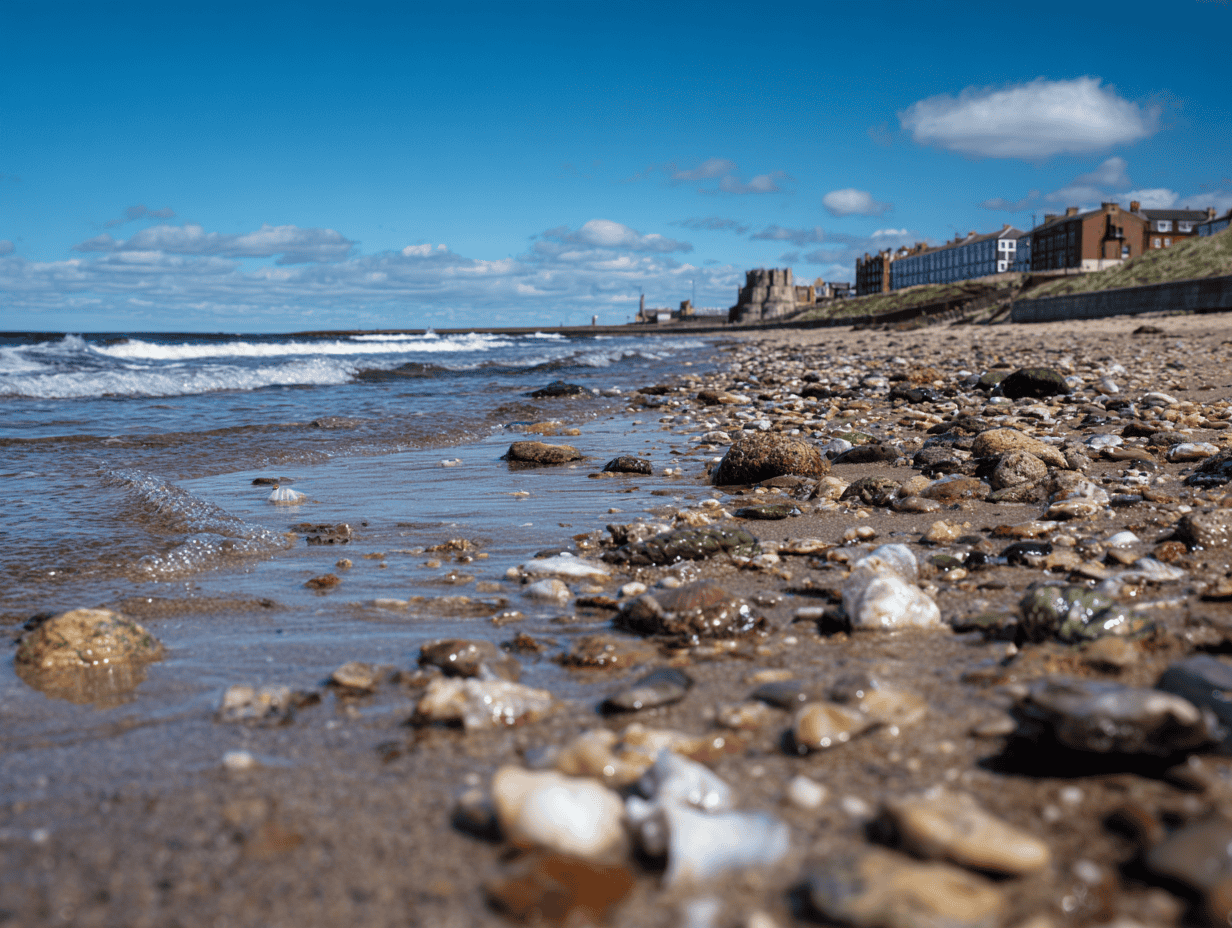
The strandline above the high-tide mark is always worth checking for lighter pieces carried up by storm surges. Look for the accumulations of pebbles, weed and shell debris; sea glass tends to cluster in the same places.
Stay aware of the tide coming back in, particularly around the cave areas and rock platforms. The beach is exposed, and the tide moves quickly. Always check the times before you head down.
Key Tip
Don’t rush straight to the waterline. At Blackhall, the best glass often sits higher in trapped shingle ridges and around the edges of rock pools exposed only during lower tides.
Dog friendly?
Yes, with one rule worth knowing before you go. There’s no dog ban on the beach itself at any time of year. But the clifftop above it is Blackhall Rocks Local Nature Reserve, and dogs must be on a lead there during bird nesting season, from March to August. Durham Wildlife Trust, which manages the reserve, list it as dogs-on-lead. That matters because the path from the car park to the beach steps runs straight through it.
The reason is the skylarks. This stretch of coast has one of the highest densities of breeding skylarks in County Durham, and they nest on the ground in the grassland you walk through. An off-lead dog in May can flatten a nest without you ever knowing it was there.
Once you’re down on the rocks, it’s a brilliant dog beach, with rock pools to investigate, caves to sniff and space to roam. If your dog is anything like Trigger, the cave mouths will be irresistible. Keep them close around the rock platforms, where the footing is slippery, and the tide comes back faster than you’d expect. The steep steps also need a bit of management with a keen terrier.
Please bag and bin on the clifftop. Dog mess raises soil nutrient levels and kills off the rare Magnesian Limestone grassland wildflowers the reserve exists to protect.
Looking for somewhere dog-friendly afterwards? Check our Yappy Places listings for the Hartlepool area for cafes and pubs that’ll welcome a sandy Jack Russell without judgement.
Practical information
Parking: Free car park at the end of Station Road, off the A1086 (sat nav TS27 4AT), with two disabled bays. It’s small and fills quickly on sunny weekends, so arrive early. A second, smaller parking area at Dead Man’s Point has no disabled bays.
Toilets: No facilities at the beach itself. The nearest public toilets are in Blackhall Colliery village, a short drive away.
Food and drink: No cafe or kiosk at the beach. Cod on the Rocks chip shop is nearby and well-regarded. Hartlepool town centre is around 10 minutes by car with a full range of options.
Getting there without a car: There are regular bus services from Sunderland and Hartlepool to Blackhall, with a short walk to the beach from the village. The car park and beach access point are well signposted from the main road (A1086).
Accessibility: The clifftop circular route is accessible and gently undulating, with a sealed 2-metre-wide surface suitable for wheelchair users, with one short, steeper section. However, beach access itself is via steep, uneven steps and is not suitable for wheelchairs or pushchairs. The beach terrain is rocky and uneven underfoot once you’re down.
What to bring
- Sturdy boots or wellies – the rocks and cave areas are slippery and uneven underfoot
- A small container for your finds -glass gets tucked into pockets and lost
- Layers and a windproof – the Durham coast is exposed, and the clifftop particularly so
- A torch if you’re exploring cave mouths – useful for spotting glass in dark crevices
- Tide times checked before you leave – the rocky platforms flood fast
- A lead for the steps down and the cave areas
The history behind the glass
To understand the glass at Blackhall Rocks, you have to understand what this coastline used to look like.
Blackhall Colliery opened in 1909, sunk by Horden Collieries Ltd. and drew its first coal in 1914. At its peak in 1950, the colliery employed nearly 2,500 workers, cutting coal from seams running out beneath the North Sea. The waste from all that extraction had to go somewhere, and for decades, it went straight to the beach.
An aerial ropeway system carried colliery refuse from the pit head and tipped it directly into the sea. Day after day, year after year, for the better part of seventy years.
By the time the colliery closed on 16 April 1981, the beach had been transformed into something almost unrecognisable. The director of Get Carter chose Blackhall Rocks as the climactic location for his 1971 film because it looked, in his own words, like “an absolute vision of hell”, the beach black with coal spoilings, the sea discoloured, the landscape stripped of life. Alien 3 used it for similar reasons in 1992 at Blast Beach: it looked like another world because, effectively, it was.
What the colliery dumped wasn’t only coal waste. The communities along this coast, the villages, the colliery workers, and the households generated their own glass waste across the same decades. Bottles, jars, window glass, domestic vessels: all of it found its way into the sea and onto this foreshore, mixed in with the industrial spoil. Since the colliery’s closure, the North Sea has spent decades breaking it down, frosting it, and rolling it smooth.
The transformation has been remarkable. The £10 million Turning the Tide regeneration project, running intensively from 1997 to 2002, removed 1.3 million tonnes of debris from across the Durham coast, restored habitats, and reclaimed 80 hectares for nature. Blackhall Rocks is now a designated Local Nature Reserve and SSSI, part of the Durham Heritage Coast.
The caves are the largest on the Magnesian limestone coast. Seals haul out on the rocks. Skylarks breed on the clifftops at one of the highest densities in County Durham.
The glass is what remains of all that human activity refrosted, re-tumbled, and slowly working its way back up the beach.
From beach to jewellery
Find something beautiful at Blackhall Rocks? At Mermaid Tears, every piece starts exactly where you’re standing, hand-hunted from UK beaches and handmade into jewellery you’ll keep forever. Browse the collection
Disclaimer: Tide times, dog restrictions, parking charges and beach conditions change regularly. Always verify before visiting. Beach byelaws are updated annually. Check with the local council or beach authority for the most current rules.
Last updated: Sept 2026
Frequently asked questions
Is Blackhall Rocks good for sea glass hunting? Yes – it’s a reliable Good Beach, particularly after storms. It won’t produce the volume of Seaham, but the range of colours can be excellent, and the setting is dramatic. Worth the trip on its own merits, especially if you’re already exploring the Durham Heritage Coast.
What’s the best time to hunt for sea glass at Blackhall Rocks? Low tide on a spring tide, ideally the morning after a significant North Sea storm. The rock platforms and cave areas are only accessible when the tide drops significantly. Don’t try to hunt the interesting sections at high water.
Are dogs allowed at Blackhall Rocks beach? Yes. There’s no dog ban on the beach at any time of year. But you cross a clifftop nature reserve to reach it, and dogs must be on a lead there during bird nesting season (March to August). Durham Wildlife Trust lists the reserve as dogs-on-lead.
How far is Blackhall Rocks from Seaham? Around 8 miles south of Seaham by road, roughly 20 minutes. If you’re planning a Durham Heritage Coast sea glass day, the two work well together: Seaham for volume, Blackhall for atmosphere and the chance of something different.
Why does Blackhall Rocks appear in films? Before the coastline was cleaned up, the beach was blackened by decades of coal waste dumped by Blackhall Colliery’s aerial ropeway system. The director of Get Carter (1971) used it as a location because it looked like an apocalyptic wasteland. Alien 3 (1992) did the same. It looks quite different today.
Is the beach accessible? The clifftop path has an accessible circular route with a sealed surface, but beach access itself is via steep, uneven steps. The beach terrain is rocky and uneven. Not suitable for wheelchairs or pushchairs once you’re below the cliff.
More Beaches
Check out the Northumberland and Durham Full Guide or our interactive map to find more beaches; you can even filter by colour.