It’s the colour that stops experienced hunters mid-stride. The one that makes you look twice, then pick it up slowly, like you’re not quite sure it’s real.
Some sea glass colours are technically rarer than cobalt blue. Orange, for instance. True red. But none of them has quite the same effect on a beach as a piece of deep, vivid cobalt catching the light against wet grey pebbles.
Maybe it’s the contrast. Maybe it’s the depth of colour in that particular blue, which seems to hold light inside it rather than just reflect it. Maybe it’s the history, once you know it.
Whatever it is, cobalt blue sea glass is the piece most hunters picture when they imagine their perfect find. And unlike some of the rarest colours, orange, genuine red, it’s uncommon enough to feel special but not so vanishingly rare that you’ll never find one. On the right beach, at the right time, you can find cobalt blue.
I have been known to say I am not going home until I have found a blue! There’s something special about it, and this is why we do this amazing hobby. The rare colours and multicolours make it so much more exciting. This is real treasure hunting at its best, and it’s all free!
Here’s everything you need to know about it.
Where does cobalt blue sea glass come from?
The colour comes from cobalt oxide added to glass during manufacture. Cobalt produces a rich, saturated blue that ranges from deep navy to vivid royal blue, depending on concentration. It was never cheap to produce, so it was reserved for specific products rather than everyday packaging.
The main sources of cobalt blue glass that ended up in British seas are:
Poison and medicine bottles. This is the big one. From the Victorian era onwards, cobalt blue glass was the standard colour for poison bottles, because the distinctive colour would prevent accidental ingestion in the dark, or by children who couldn’t read. Pharmacists and households across the country used cobalt blue bottles for everything from laudanum to household cleaning chemicals. The shape often gives them away. Too many Victorian poison bottles were deliberately textured with ridges or unusual shapes for the same reason.
Milk of Magnesia bottles. Phillips’ Milk of Magnesia came in a distinctive cobalt blue glass bottle from the late 19th century right through to the mid-20th century. These are one of the most common sources of cobalt sea glass and are particularly associated with beaches near coastal towns with pharmacy histories.
Ink bottles. Victorian and Edwardian ink bottles were frequently made in cobalt blue glass. The colour helped distinguish ink from other liquids, and the glass itself was thick and durable, which is why cobalt pieces from this source tend to be chunky and well-frosted.
Vick’s VapoRub jars. The original Vicks came in a cobalt blue glass jar. Enormous quantities were produced and used, and a proportion of those jars ended up contributing to the sea glass supply.
Decorative glassware. Cobalt blue was a popular colour for Victorian decorative glass vases, bowls, and bottles. These occasionally find their way into the sea glass record via household waste routes, producing thinner, lighter pieces than the medicinal sources.
Old glass telephone and telegraph insulators. The distinctive dome-shaped insulators used on telegraph poles and early telephone lines were sometimes made in cobalt blue glass. These produce chunky, unusual pieces with a distinctive curved surface.
As a result, cobalt blue sea glass has a Victorian and Edwardian concentration, most of which entered the sea during that era, meaning the best pieces have been tumbling for well over a century. Genuinely well-frosted cobalt blue, the kind with deep pitting and perfectly rounded edges, is a piece of history in your hand.
What does cobalt blue sea glass look like?
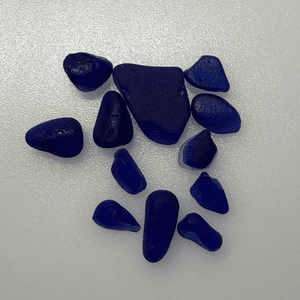
The colour range is narrower than red, but it still varies. True cobalt is a deep, saturated blue, vivid and rich, with a warmth to it that distinguishes it from lighter aqua or pale blue pieces. Held up to the light, it glows.
The depth of colour varies by source. Poison bottle glass tends to be deeper and darker. Ink bottle glass can be slightly more vivid. Decorative glassware sometimes produces a softer, slightly purple-tinged blue.
Thickness is a useful indicator. Medicinal and chemical bottles produced thick, heavy, chunky pieces with good weight. Decorative pieces tend to be thinner and lighter. Both are desirable, but serious collectors look for chunky medicinal pieces, especially if they’re well-frosted with obvious age.
The wet test works well on cobalt blue; wetting the piece immediately intensifies the colour and makes identification straightforward. Dry cobalt can sometimes look darker and slightly dull; wet cobalt is unmistakable.
Could it be something else?
Aqua sea glass. This is the most common mix-up. Aqua, a soft blue-green, is far more common than cobalt and comes mainly from old mineral water bottles and early glass production. The difference is saturation: cobalt is vivid and deep, while aqua is softer and has a greenish tint. Wet both, and the difference is obvious at once.
Pale blue. Soft, washed-out blue pieces come from mid-20th-century glass production jar lids, food packaging, and household glass. These are uncommon but not rare. Cobalt is in a different league for depth and richness of colour.
Purple glass. In a certain light, heavily frosted cobalt can look slightly purple. Genuine purple sea glass from manganese glass that’s changed colour with sun exposure tends to have a warmer, more lavender tone. Hold both to a light source, and the difference is clear.
If you’ve found something and you’re not certain what you’ve got, GlassLore can identify it from a photo. Worth using before you get too excited or too dismissive. Some aqua pieces are genuinely lovely in their own right, even if they’re not cobalt.
Where to find cobalt blue sea glass in the UK
Cobalt blue is more evenly distributed around UK coastlines than some rare colours because its sources- medicine bottles, ink bottles, and household glass- were used everywhere. Any beach with the right history and conditions can be a cobalt beach.
Check out our map below to see where you have your best chance of finding red. The score on the right is the Seaglass score; it takes current conditions, churn, wind, recent storms and moon phases to give you a score. Check out my interactive map for more colours and scores, or check the top 15 glass beaches right now.
Above is a static list of the most common places to find Blue Sea Glass in perfect conditions, but if you want to know the best place to find blue right now.
That said, a few factors improve the odds significantly:
Beaches near Victorian coastal towns. The high concentration of medicinal cobalt glass in the sea glass record reflects Victorian-era disposal. Beaches near towns that were established and populated in the 1850-1920 period are more likely to have cobalt in the mix. Old resort towns, fishing ports, coastal industrial towns.
Beaches with good wreck history. Ships carried medicine chests, including cobalt poison bottles. Wreck sites add to the supply on beaches already productive for other glass.
Post-storm hunting. As with all rare colours, significant wave action turns up cobalt pieces buried in shingle for decades. Timing a visit in the days after a good storm consistently produces better results for rarer finds.
The tideline and beyond. Cobalt pieces, being heavier than water, tend to deposit at the tideline rather than being carried high up the beach. Work the tideline carefully, particularly where pebble ridges have formed.
For the best beaches and current conditions, check the Sea Glass Score before you go, and use the colour-filtered map to find beaches where cobalt blue has been reported.
How to spot cobalt blue on the beach
Trust the flash of colour. Cobalt blue is vivid enough that it registers as “wrong” against the natural grey-brown-green palette of a pebble beach before you’ve consciously identified it. The eye catches it first. Don’t second-guess that instinct; stop and look properly.
Hunt in morning light. Low-angled morning light after a tide has washed the beach is when sea glass colour is most visible. Flat midday light flattens everything. The hour after high tide on a bright morning is the classic sweet spot.
Check the rock pools. Cobalt pieces sometimes get trapped in rock pools where they’re visible through the water. The colour through water is even more vivid than on the surface.
Go slowly near pebble ridges. The junction between a pebble ridge and the flat beach is where heavier glass tends to concentrate. Work these areas carefully rather than skimming across them.
What is cobalt blue sea glass worth?
Cobalt is one of the most commercially desirable sea glass colours for jewellery makers and collectors. Good pieces, well-frosted, reasonable size, and strong colour sell consistently and command prices that common glass doesn’t approach.
Small, well-frosted cobalt pieces typically sell for a few pounds each. Larger pieces, particularly thick chunky ones from medicinal sources, or pieces with an identifiable original shape (the distinctive ridged profile of a Victorian poison bottle, for instance), attract more from serious collectors.
For jewellery, cobalt blue sea glass in silver settings works almost universally. The depth of colour pairs beautifully with both oxidised and bright silver. A piece of thick Victorian cobalt blue, properly set, carries both visual impact and a genuine story. It was almost certainly a poison bottle, disposed of in the sea well over a century ago, and the sea has been working on it ever since.
The poison bottle connection
It’s worth dwelling on this for a moment because it’s genuinely fascinating.
Victorian pharmacies stocked an extraordinary range of toxic substances for medicinal and household use, such as arsenic, strychnine, chloroform, and mercury compounds. The cobalt blue bottle was a safety measure: universally understood to mean danger, distinctive by touch in the dark, impossible to mistake for an ordinary bottle.
The ridged and faceted shapes of many Victorian poison bottles were an additional safety feature; a textured bottle was identifiable by touch alone, even half-asleep, even by a child.
When you hold a piece of thick, chunky cobalt sea glass with a slightly curved surface and traces of a moulded ridge, there’s a reasonable chance you’re holding what remains of exactly one of these bottles. Something that sat in a Victorian pharmacy was sold across a wooden counter, sat in a household for years, and eventually made its way to the sea, where it’s been slowly becoming what it is now.
A hundred years later, frosted and rounded, it ends up in your palm on a beach in Yorkshire or Cornwall.
That’s the thing about sea glass. The object is gone. The material remains. The sea changes what it was into what it is.
Found something blue and not sure if it’s cobalt? Try GlassLore for photo identification. Ready to go looking? Check which beaches are reporting cobalt blue finds on the interactive map or see this week’s top-rated beaches on the Sea Glass Score.
