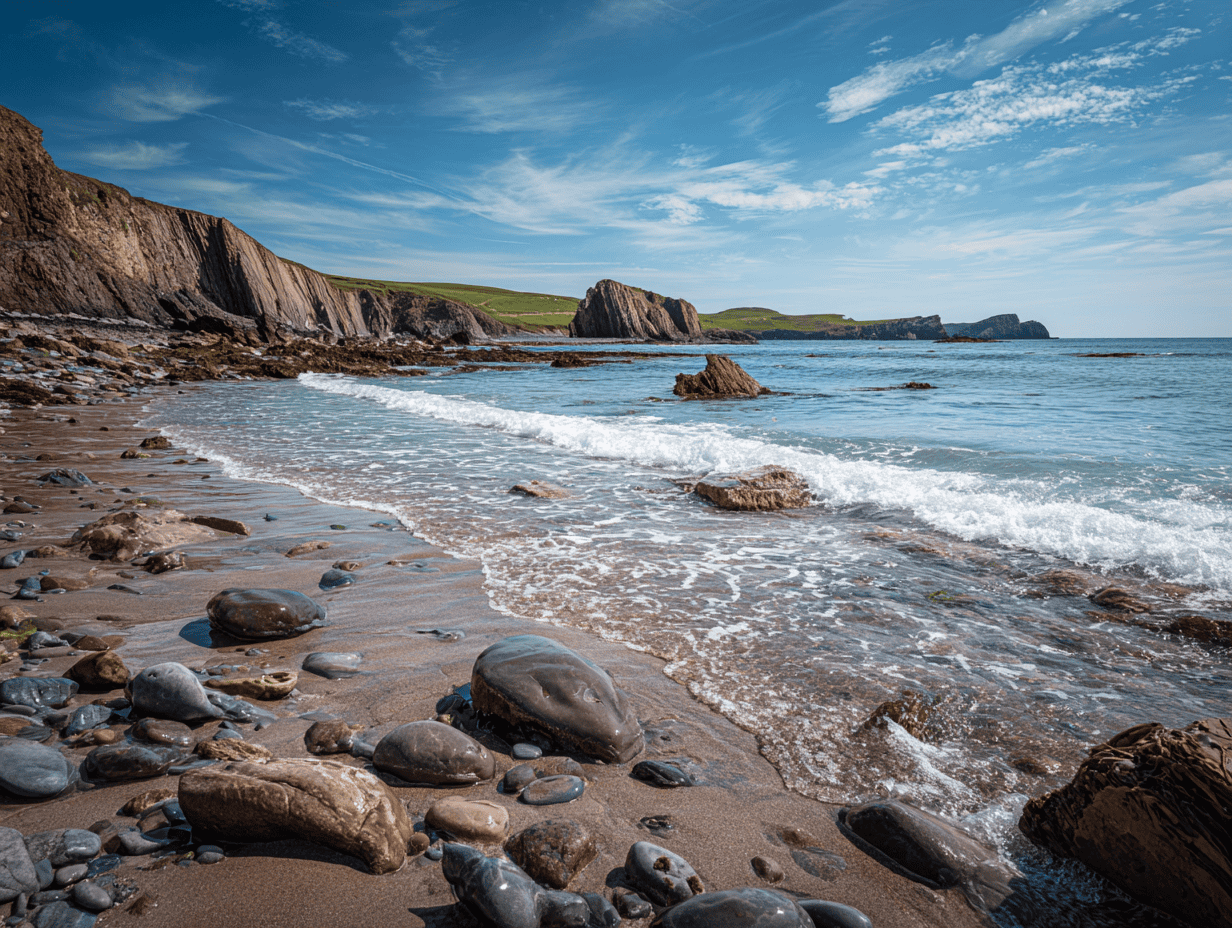
Wales’s Victorian Tip Beach
Morfa Beach in Conwy is a good sea glass hunting beach, especially along the shingle band and strandline below the old municipal tip. Green, brown, white and aqua are the most common finds, with blue, amber, turquoise, cobalt, black, lavender, pink and yellow also reported. It’s a more challenging hunt than a simple sandy beach, but the mix of Victorian glass, pottery and storm-exposed material makes it one of North Wales’s most interesting collecting spots.
- Rating: Good Beach
- Terrain: Tricky
- Level: Intermediate
- Dog friendly: Yes, dogs welcome all year round
- Location: Conwy, North Wales Sat Nav: LL32 8GJ (Beacons car park) or LL32 8GA (Oval car park)
- Common colours: Green, brown, white
- Rare colours: Cobalt Blue, Black, Lavender, Pink, Yellow
Today at Morfa Beach
See below for your ShoreSense score and tide times. Scroll down for your full 7-day forecast
Morfa Beach sea glass conditions
Morfa Beach
Wales
55/100 — Fair, best window 17:14–20:14.
Best window is 17:14–20:14 with spring tides (near full/new moon) and calm sea, so the chance of fresh finds is fair today.
Fair — a decent beach in the right window
Ranked #27 in the UK ShoreSense leaderboard today.
| Tide | Time | Height |
|---|---|---|
| Low water | 06:37 | 0.9 m |
| High water | 11:53 | 7.9 m |
| Low water | 18:44 | 1.1 m |
Best For:
- Sea glass hunting
- Rare aqua finds
- Storm hunting
- Well-tumbled glass
- Long beach walks
- Victorian glass
- Patient collectors
- Low-tide exploration
Why Morfa Beach – the beach that keeps giving back
There are very few beaches in the UK where you can genuinely trace every piece of sea glass back to a single source. Morfa Beach in Conwy is one of them.
Just to the south of the River Conwy estuary, backed by sand dunes, golf course and the rugged shoulder of Conwy Mountain, Morfa is a large, open, north-facing beach that draws dog walkers, birdwatchers and long-distance sea gazers in equal measure.
What most visitors don’t know and what sea glass hunters absolutely do is that the ground beneath those dunes was Conwy’s municipal tip for the best part of a century. As the sand dunes shift and move, the old Victorian tip releases its contents into the sea.
Every winter storm nudges those dunes a little further. Every spring tide washing across the shingle line brings another generation of bottles, jars, and domestic glassware back up from the dark.
The glass and pottery at Conwy Morfa almost certainly originate from this old Victorian dump, and there are some genuinely lovely examples of aqua blues here, the kind collectors call Mermaid’s Tears. That colour, that name, it felt personal when I first read about this beach.
The site itself matters beyond the glass. Storm damage in 2013 and 2014 caused the former municipal tip to become significantly exposed, with large quantities of broken glass and pottery strewn across the beach over a very wide area. That event accelerated what had been a slow, steady trickle into something much more abundant.
Hunters who visit regularly report the beach as consistently productive, not the lightning-strike volume of somewhere like Seaham, but reliable, varied, and genuinely surprising in its colours.
One word of honest preparation: not all glass here is fully tumbled. Some pieces are well-frosted and smooth; others are thicker and rougher-edged, clearly more recently exposed. The aquas in particular tend to be beautiful. Bring your eye for detail and don’t expect every piece to be jewellery-ready, but do expect to find some that are.
What you’ll find here
Colours commonly found: Green, brown, white, aqua
Occasional finds: Blue, Aqua, Amber, Turquoise
Rare finds: Cobalt Blue, Black, Lavender, Pink, Yellow
Bonus: Victorian pottery shards, stoneware bottle fragments, occasionally intact Victorian bottles emerging from the dune face after storms, old ceramics with transfer-print patterns
Found something unusual? Try GlassLore, our free sea glass scanner, to explore what it could be and log your find to the gallery and, more importantly, earn points and climb the leaderboard.
When to go
Low tide is essential. Morfa is a big, open beach that expands considerably as the water retreats. The productive shingle band at the back of the beach only becomes fully accessible on a decent low, and the further out the tide goes, the more new ground opens up.
On a spring low tide around new or full moon, the beach links up with the wider sands of Conwy Bay, and you have an extraordinary amount of foreshore to work.
Storm timing is the key variable here. The Victorian tip sits within the dune system, and it’s the rough weather that does the excavating. After a significant northwesterly blow, the kind that comes off the Irish Sea and hits this north-facing beach square on, the strandline is freshly sorted, and newly exposed material will be up on the shingle. A visit within a day or two of a storm is the most productive timing you can plan for.
The council’s own guidance notes that after storms, you may see old glass bottles and broken glass exposed from the former tip site at the front of the dunes, which tells you two things. One, the glass is still actively emerging. Two, come prepared for a mix of well-tumbled and sharper pieces, particularly directly in front of the dune face. Work the shingle band and strandline rather than the dune foot itself for the best-frosted material.
Winter and early spring are the strongest seasons. The beach is quieter, the storms are more frequent, and the views across to the Great Orme and Puffin Island on a clear January morning with your dog charging through the foam are, frankly, exceptional. Summer brings families and kite-flyers, and the beach fills up, still worth visiting, but the best hunting is off-season.
Today’s ShoreSense Score & Best Hunting Window
Morfa Beach sits on the southern side of the Conwy estuary, facing north into Conwy Bay and the Irish Sea, with a spring tidal range of around 7 to 7.5 metres, a significant range that exposes a broad sweep of foreshore as the tide retreats. This is not a beach that gives you a narrow window; a two-hour-either-side-of-low-tide approach will reward you with several hours of productive ground as the shingle band and lower beach open up progressively.
The ShoreSense widget below combines recent marine conditions, tide timing and practical hunting weather to show today’s overall ShoreSense Score, Hunting Potential, Comfort and the best available hunting window for Morfa. It uses UKHO tide data alongside current marine and weather inputs to help you judge whether conditions look promising for a hunt.
Lower tides are especially useful at Morfa because they expose more of the shingle and mixed foreshore. Rougher north-westerly conditions can also expose material from the former tip, so the period after the sea begins to settle can be particularly interesting. Check today’s ShoreSense Best Window before travelling, then use the shingle band and fresh strandlines as your main hunting zones.
Morfa Beach sea glass conditions
Morfa Beach
Wales
55/100 — Fair, best window 17:14–20:14.
Best window is 17:14–20:14 with spring tides (near full/new moon) and calm sea, so the chance of fresh finds is fair today.
Fair — a decent beach in the right window
Ranked #27 in the UK ShoreSense leaderboard today.
| Tide | Time | Height |
|---|---|---|
| Low water | 06:37 | 0.9 m |
| High water | 11:53 | 7.9 m |
| Low water | 18:44 | 1.1 m |
Where to look on the beach
Morfa is a bigger beach than it first appears. The sandy main expanse at high tide gives way to an extensive shingle and mixed-sand foreshore at low water, and it’s that transition zone and the areas behind it that hold the glass.
The shingle band behind the main beach is your primary hunting ground. A band of pebbles and coarser material runs along the back of the beach, sitting between the open sand and the dune edge. This is where the Victorian tip material concentrates after it has been washed out and redeposited.
Work slowly along this band, crouching low, looking for the frosted matte surface of glass among the rounded stones. Aqua and pale blue pieces tend to stand out once your eye is trained; greens and browns require more patience.
The strandline after storms, when a big northwesterly has sorted the beach in the previous day or two, the strandline carries freshly deposited material. Work along it from the estuary end toward the golf course boundary, checking anything that looks out of place in the pebble mix.
The lower foreshore at spring low tide, as the tide retreats fully on a big low, the outer beach opens up considerably. This ground gets covered again quickly, so work outward with the tide and retreat with it. Pieces that have been rolling out here for longer tend to be better tumbled.
A practical note: some material at the base of the dune face can be sharper and less frosted than the main strandline finds. This is more recently exposed material that hasn’t had enough time in the water. It’s fine for your eyes, but watch your dog’s paws in this section; the council’s guidance is clear that fresh storm exposures can include broken glass directly from the tip face. The well-tumbled pieces are out on the beach itself.
Difficulty Level: Intermediate
- Productive areas shift depending on recent weather and tides
- Success often depends on understanding where material has been sorted and deposited
- The best hunting can require covering long stretches of beach
- Spring low tides reveal additional hunting ground that isn’t always accessible
- A more methodical approach is rewarded than at typical beginner beaches
Hunting Style: The Tide Follower
Morfa rewards hunters who move with the beach rather than against it. Search the shingle band behind the main beach, follow fresh storm-deposited strandlines, and take advantage of spring low tides to reach newly exposed ground. The most productive areas can change from one visit to the next depending on conditions.
Dog friendly?
Yes – Morfa Beach has no seasonal restrictions. They are welcome here every month of the year, and this is genuinely one of the better dog beaches in North Wales for space and freedom. The beach is huge. There’s almost always room to let a dog run, and the birdwatching community who use the estuary end tend to be sensible about where they set up. Just keep an eye on the tidal edge if you’re working the estuary margin, as the sandbanks can be cut off quickly by the incoming tide.
The one honest note: after storms, be aware of freshly exposed glass from the dune face. It’s not something that would stop a visit, but it’s worth keeping dogs clear of the dune toe, where very recent exposures can include sharper material. The open beach and strandline are perfectly fine.
For dog-friendly food and a pint after the hunt, Conwy town is a fifteen-minute walk from the Beacons car park. Check our Yappy Places listing for Conwy for the best spots to take a wet dog off the beach.
Practical information
Parking: Two car parks. The Beacons car park (LL32 8GJ) is the closest to Conwy town and is pay-and-display from May to September; free in winter.
The Oval car park (LL32 8GA) is free year-round, but note a 1.9 metre height restriction. No roof boxes or higher vehicles. Both are a short walk from the beach. National Cycle Route 5 passes the Oval car park if you’re arriving by bike.
Toilets: No toilet facilities at either car park. The nearest facilities are in Conwy town, around fifteen minutes’ walk from the Beacons car park. Worth planning for before you head down to the beach, particularly on a longer hunting visit.
Food and drink: Nothing on the beach itself beyond a seasonal pizza van (Franco’s, near the Oval car park end) that operates in summer. For proper food, Conwy town is your destination, a short walk along the estuary path, and you’re into one of the most characterful small towns in Wales. The town has a good range of cafés, pubs and restaurants. The Mulberry on Chapel Street is dog-friendly and a solid post-hunt option.
Getting there without a car: Conwy railway station is on the North Wales Coast Line with services between Chester and Holyhead. The station is around 1.5 miles from the beach, a straightforward walk along the estuary path that passes the castle walls and quay. Buses also serve Conwy from Llandudno and Bangor; check Lloyds Coaches and Arriva Wales for current timetables.
Accessibility: The beach access involves a steep descent from the car parks down to the beach level, not suitable for wheelchairs or pushchairs. The beach itself is flat and open once you are down, with firm sand underfoot at low tide. The dune and shingle areas are uneven.
What to bring
- Wellies or sturdy waterproof shoes – the shingle band can be wet and uneven, and the lower foreshore at spring low tide involves damp ground
- A bag or tin for finds – glass at Morfa varies enormously in size, from tiny shards to substantial Victorian bottle fragments
- A hand rake or trowel for working the shingle pieces sit just below the surface of the pebble band
- Layers and a windproof – this is a north-facing, exposed beach, and the Irish Sea wind is real; the views across to the Great Orme are better when you’re not freezing
- A tide table – the tidal range here is significant, and the sandbanks at the estuary mouth can cut off quickly on the flood. Know your window
- Something to clean your dog’s paws at the car – freshly exposed material from the dune face after storms can occasionally be sharp
The history behind the glass
Conwy has been a fortified port since the late thirteenth century. When Edward I completed his conquest of Wales in 1283, he built his great castle here and planted an English garrison town behind massive stone walls that still stand today. The town was built under royal order by King Edward I, and Conwy Quay was formed in 1833, used for fishing and to export goods.
For over five hundred years, everything that came in and went out of this remote corner of North Wales passed through the quay at the bottom of the castle walls.
But the deeper history at Morfa Beach is not the quay, it is the mussel beds. Mussels have been fished from the Conwy estuary for thousands of years. The Romans noted them for the quality of the pearls found inside some of the shells. By the early nineteenth century, Conwy had grown into one of the most important pearl fisheries in Britain.
In the early 19th century, Conwy was sending over four kilograms of pearls to London jewellers every week. Legend holds that a Conwy pearl found its way into a crown for the Royal Family. The mussel industry meant a working waterfront community for centuries, with fishing families, processing operations, boats, provisions, and domestic glass in quantity, all feeding into an estuary that opened out directly onto Morfa Beach.
Then came the dump. Victorian Wales was growing fast. The railway arrived at Conwy in 1848, and the town’s population expanded steadily through the second half of the nineteenth century. Conwy’s municipal authorities, like local councils all over Britain, needed somewhere to put their rubbish. The sand dunes at Morfa, outside the town walls and conveniently close to the estuary, became the town’s tip. Decades of household waste, bottles, jars, stoneware, ceramics, medicine bottles, ink bottles, and food jars were deposited into the dune system and built up there over generations.
It sat undisturbed for most of the twentieth century, held in place by the roots of the dune grasses. Then the storms came. The severe winter storms of 2013 and 2014 caused the former municipal tip to become significantly exposed, with large quantities of broken glass and pottery strewn across the beach over a very wide area. What had been a slow trickle became a steady release.
The sea began the long work of tumbling those fragments- medicine bottles from the 1880s, ink bottles from the Edwardian era, preserving jars from the 1930s into the frosted pieces that wash up along the shingle band today.
The aqua blues that Morfa is known for almost certainly come from Victorian bottle glass, a colour that was common in the late nineteenth century and is now one of the most sought-after shades in sea glass collecting. Every piece you find here has a century or more of North Wales domestic life behind it.
That ink bottle might have sat in a schoolroom. That medicine jar could have stood on a fisherman’s mantelpiece. The dump gave them back to the sea, and the sea is still deciding what to do with them.
From beach to jewellery
Found something worth keeping on the Morfa shingle? At Mermaid Tears, every piece of jewellery starts exactly where you’re standing, hand-hunted from UK beaches and handmade into something you’ll keep. The aquas from beaches like this one are some of my favourite pieces to work with. Browse the Sea Glass collection.
Disclaimer: Tide times, dog restrictions, parking charges and beach conditions change regularly. Always verify before visiting. The Morfa dune system is actively eroding in places. After storms, use caution near the dune face, where fresh exposures can include sharp glass. Beach byelaws are updated annually; check with Conwy County Borough Council for the most current rules.
Last updated: Aug 2026
Frequently asked questions
Is Morfa Beach good for sea glass? Yes – consistently so. The Victorian tip buried in the dune system here is the source of the glass, and as the dunes erode and storms expose new material, it keeps releasing finds onto the strandline. The aqua blues that Morfa is known for are particularly sought after and can be genuinely beautiful. It’s not a high-volume beach in the Seaham sense – you won’t fill a bucket in an afternoon, but on a good low spring tide after a blow, you’ll come away with a solid find of varied, interesting glass.
When is the best time to visit Morfa Beach for sea glass? Two hours before low water on a spring tide, ideally the day after a northwesterly storm. Winter is the best season; the beach is quieter, the storms are more frequent, and the dune system releases material more actively after rough weather. Summer works, but the beach is busier, and the hunting is more picked over.
Are dogs allowed at Morfa Beach? Yes, dogs are welcome all year round with no seasonal restrictions. The beach is large and open, and dog walkers are a significant part of the regular visitor community here. After storms, keep dogs away from the dune toe where freshly exposed material can occasionally include sharper glass.
What makes the glass at Morfa Beach different from other beaches? The Victorian municipal tip buried in the dune system means the glass here comes from a specific, localised historical source, household waste from Conwy’s growing population in the late nineteenth and early twentieth centuries. This gives it a character distinct from harbour beaches or industrial sites: smaller domestic items, medicine and ink bottles, stoneware fragments, and the aqua blues associated with Victorian bottle glass. It’s personal history rather than industrial history.
Can I walk to Conwy from Morfa Beach? Yes, the estuary path from the Beacons car park takes you into Conwy town in around fifteen minutes, passing below the castle walls and along the quay. It’s a genuinely beautiful walk, and the town has good food, a fascinating mussel museum, and medieval architecture that makes the whole trip more than just a sea glass hunt.
Is the glass at Morfa Beach safe to handle? Most of the glass on the open beach and strandline is well-tumbled and frost-edged, the rounded, smooth pieces that sea glass hunters look for. Material directly at the dune face after storms can be less tumbled and occasionally sharper. Use judgment, and if a piece has fresh edges, leave it a season or two to finish tumbling. The council’s own guidance flags this after significant storms.
More Welsh Beaches
Check out our Full Wales Beaches Guide or plan your trip with our Sea Glass Map.