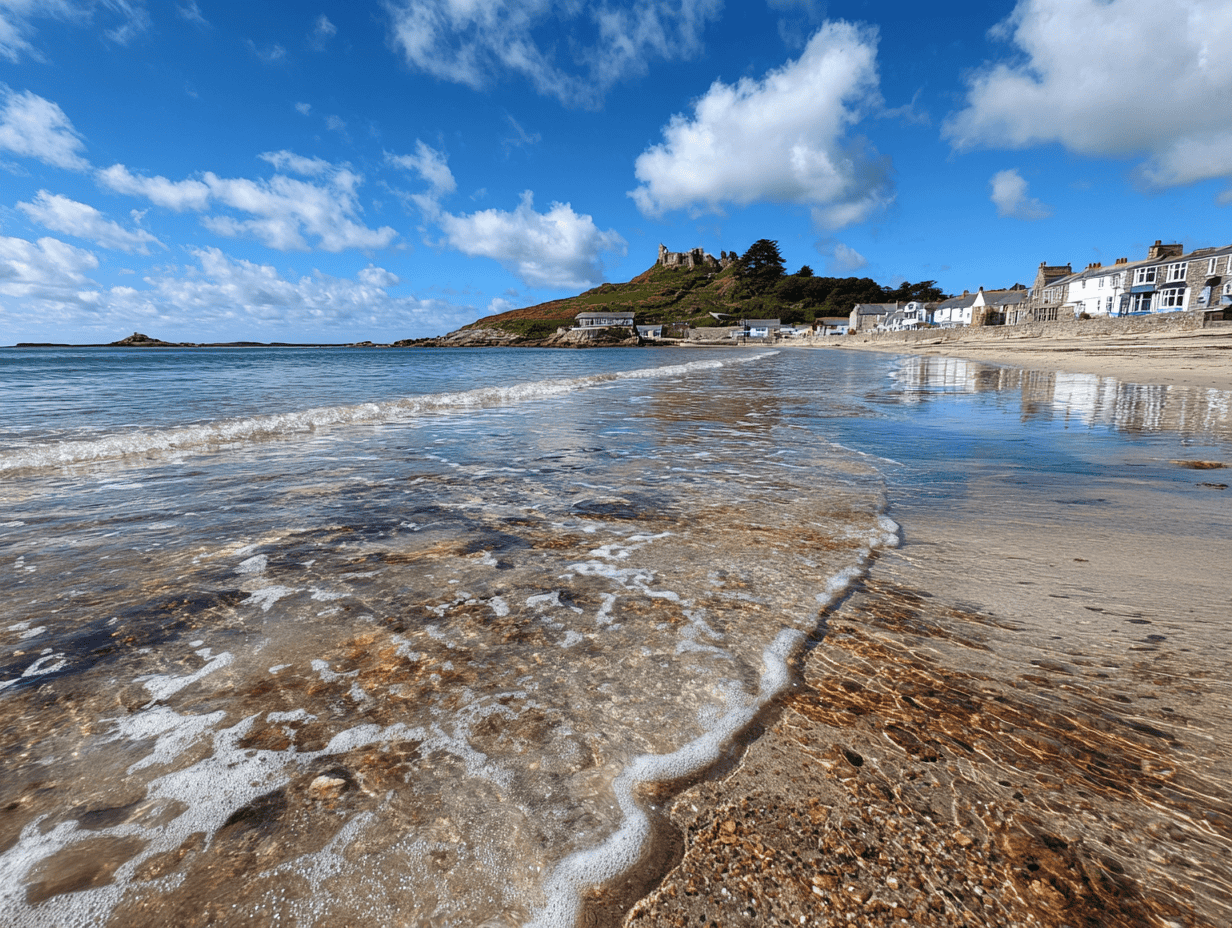
A Medieval Harbour with Six Centuries of Trade in the Shingle
Port Isaac is a fair but atmospheric sea glass hunting spot, especially around the harbour-side shingle, slipway edges and rocky pockets exposed as the tide falls. Green, brown, and white are the most common finds, with blue, aqua, and amber appearing occasionally, and cobalt blue, turquoise, black, and lavender among the rarer colours reported. It’s a compact hunt where careful searching around the harbour and rocky margins matters more than covering lots of beach.
Where to hunt: Harbour-side shingle → slipway edges → rocky pockets beneath the cliffs → quieter outer-cove ground on lower water
- Rating: Good Beach
- Terrain: Tricky
- Level: Intermediate
- Dog friendly: Yes, dogs welcome all year round
- Location: Port Isaac, North Cornwall
- Sat Nav: PL29 3SB (New Road car park)
- Common colours: Green, brown, white
- Rare colours: Cobalt Blue, Black, Lavender, Pink, Yellow
Today at Port Isaac
Check below for the latest ShoreSense Score; scroll down for the full 7-day forecast.
Port Isaac sea glass conditions
Port Isaac
Cornwall — Sea settling
72/100 — Good, best window 10:15–13:15.
Best window is 10:15–13:15 with spring tides (near full/new moon) and building W swell, so the chance of fresh finds is good today.
Good day at a reliable beach
Ranked #20 in the UK ShoreSense leaderboard today.
| Tide | Time | Height |
|---|---|---|
| High water | 05:26 | 7.7 m |
| Low water | 11:45 | 0.9 m |
| High water | 17:47 | 7.8 m |
Best For:
- Harbour finds
- Historic sea glass
- Rock pool searching
- Coastal day trips
- Photography
- Well-tumbled glass
- Exploring multiple beaches
- Cornwall adventures
Why Port Isaac- the most photogenic sea glass hunt in Cornwall
Port Isaac needs little introduction. If you’ve watched Doc Martin, you’ve seen the harbour. The whitewashed cottages stacked up the steep valley sides, the twin stone piers, the cobbled slipway down to the beach. It is, by most measures, the most perfectly preserved medieval fishing harbour on the north Cornish coast.
What’s less talked about is that the beach tucked inside that harbour is a genuine sea glass beach, and that the history of what came in and out of those piers over six centuries goes a long way to explaining why.
By the Middle Ages this was a working port, taking in stone, limestone, salt, coal, timber and pottery, and shipping out Delabole slate. Every one of those cargoes came packaged in glass and stoneware. Coal from Wales, wine and spirits from the Continent, provisions for the fishing fleet, centuries of breakage and harbour waste, all feeding into a compact, sheltered bay with good pebble substrate.
The beach itself sits inside the harbour and is a mix of sand, shingle and rock pools. It’s not vast. But it concentrates glass well, and the village’s history as a working port from the medieval period through to the twentieth century means the material has been accumulating here for a very long time.
One visitor report describes children filling their hands with sea glass in a single afternoon on the harbour beach, the kind of find rate that doesn’t happen on beaches with a thin history.
Port Isaac is best done as a half-day hunt combined with a walk along the South West Coast Path toward Port Gaverne, the quiet cove a mile to the east. Both beaches reward a low-tide search. The walk between them is exceptional, and there’s good food in the village when you’re done.
What you’ll find here
Colours commonly found: Green, brown, white
Occasional finds: Blue, Aqua, Amber, Turquoise
Rare finds: Cobalt Blue, Black, Lavender, Pink, Yellow
Bonus: Sea pottery, Victorian ceramic shards, smooth Cornish pebbles, rock pool life at low tide
Find something a bit special? Use our Sea Glass Scanner to discover rarity, value and history. Add it to our Finds Gallery and, best of all, score points and join our Hunting Leaderboard. Can you compete with the best?
Check out our Sea Glass Colour guide to find out the history and rarity of pieces, as well as where to visit for your best chance of finding them.
When to go
Low tide is essential. The harbour beach at Port Isaac contracts significantly at high water; the sand, shingle and productive rock pool margins only open up properly as the tide drops. On a big spring low, the beach expands noticeably, and it’s worth working the full extent of the foreshore from the slipway out toward the pier ends.
Post-storm is worth targeting. Port Isaac Bay faces northwest across the Celtic Sea and picks up Atlantic swell after westerly and northwesterly weather. The day after a blow, the strandline is freshly sorted, and new material is up on the beach. Winter storms here can be dramatic. The harbour takes the weather full on, and the glass they deposit rewards a visit in the days that follow.
Winter and early spring are the best seasons overall. The village is quieter, the beach is less picked-over, and the walk along the coast path toward Port Gaverne on a clear February morning, with the full length of Port Isaac Bay opening out ahead of you, is one of the better short walks in Cornwall.
The Fishermen’s Friends perform on the beach in summer, worth timing a visit around if you’re there in the warmer months, but for hunting, avoid peak season when the harbour is at its busiest.
Today’s ShoreSense Score & Best Hunting Window
Port Isaac sits on the north Cornish coast facing northwest into the Celtic Sea, with a tidal range of around 5.5 metres on a spring tide. The harbour location means the beach is sheltered from the worst of the swell, but that northwest-facing aspect means westerly and northwesterly winds are onshore conditions- the productive ones that freshen the strandline and push glass up the beach.
The widget below uses Port Isaac tide data (UKHO station), the nearest standard port for this section of coast, to show today’s ShoreSense Score, tide curve and best hunting window. Aim to arrive around two hours before low water and work the harbour beach as the tide drops, then walk east along the coast path to Port Gaverne for the second half of the low-tide window.
Port Isaac sea glass conditions
Port Isaac
Cornwall — Sea settling
72/100 — Good, best window 10:15–13:15.
Best window is 10:15–13:15 with spring tides (near full/new moon) and building W swell, so the chance of fresh finds is good today.
Good day at a reliable beach
Ranked #20 in the UK ShoreSense leaderboard today.
| Tide | Time | Height |
|---|---|---|
| High water | 05:26 | 7.7 m |
| Low water | 11:45 | 0.9 m |
| High water | 17:47 | 7.8 m |
Find out how this compares to our Top Beaches this week and our movers and shakers board.
Where to look on the beach
The harbour beach at Port Isaac is compact, and that’s part of what makes it productive. Glass doesn’t spread out across miles of sand; it concentrates in a relatively small area with good pebble and rock pool substrate.
The harbour beach and slipway – work down from the slipway at The Platt and search the shingle and pebble patches on either side of the sand. The transition zones between sand and pebble are where the glass sits. The rock pools at the base of the harbour walls are worth checking carefully. Pieces accumulate in the crevices and sit undisturbed between tides. Crouch down and look into the gaps rather than scanning from above.
The pier ends at low water – as the tide drops, the outer foreshore around the pier bases opens up. Work outward as the tide retreats, and you’ll find ground that’s rarely seen at anything above low water springs. The pebble patches around the pier footings are particularly productive.
Port Gaverne – a mile east along the South West Coast Path, Port Gaverne is a sheltered sandy cove with rock pools and a fishing history of its own. Dogs are welcome all year; it’s quieter than Port Isaac, and it adds a second productive beach to the same visit. The coast path walk between the two, with the cliffs dropping to the sea below and the bay opening out to the west, is the best thing about the trip.
A note on timing: Port Isaac harbour is a working harbour. At high water, the fishing boats are afloat, and the slipway is in use. Plan your visit around the low tide window, and you’ll have the beach to yourself.
Key Tip:
Arrive a couple of hours before low tide and follow the water out. Start around the slipway and harbour walls, then work the pebble patches around the pier bases as more ground is exposed. Before heading home, make the short walk to Port Gaverne for a second hunt in a quieter and often overlooked cove.
Difficulty Level- Intermediate
- The most productive hunting areas are exposed only at lower tides
- Rocky foreshore sections require careful footing
- Productive glass is often hidden in crevices and pebble pockets rather than lying in the open
- Understanding how the harbour concentrates material improves success
- Combining Port Isaac with nearby Port Gaverne rewards hunters willing to explore
Hunting Style- The Hunting Forager
Port Isaac rewards careful, close-range searching rather than covering lots of ground. Focus on harbour walls, pier footings, rock pools and pebble pockets where material becomes trapped. Success comes from investigating every crevice and transition zone, not walking long distances.
Beach Personality
Port Isaac feels like a sea glass hunter’s treasure box. The compact harbour, historic fishing heritage, stone piers and sheltered foreshore create countless little hiding places where glass can settle and remain undisturbed. Unlike sprawling beaches where the hunt is about distance, Port Isaac is all about detail. Every rock pool, harbour wall and pebble patch feels worth investigating. Add the stunning walk to Port Gaverne, and you’ve got a destination that offers far more than just sea glass
Dog friendly?
Yes – Port Isaac Beach has no seasonal restrictions. Your dog is welcome on the harbour beach all year round, and the coast path east toward Port Gaverne is dog-friendly throughout. Port Gaverne itself is also unrestricted all year.
The harbour is a working port, so keep dogs clear of the fishing boats and away from the slipway when vessels are in use.
Check our Yappy Places listing for Port Isaac for dog-friendly cafés and pubs in the village. The Golden Lion Inn on The Platt, built in 1715, is one of the most characterful dog-friendly pubs in Cornwall and a natural end point for the visit.
Practical information
Parking: Two car parks serve the village. New Road (PL29 3SB) is Cornwall Council’s, five to ten minutes’ walk from the harbour and sitting directly on the coastal path. It’s on the council’s summer and winter tariff bands, so winter rates drop significantly, and Blue Badge holders registered with Cornwall Council park free. It fills early in season.
The Main car park on Trewetha Lane (PL29 3TR) is larger, with 139 spaces plus a 40-space overflow and five disabled bays, and it’s about a ten-minute walk in. The parish council owns it and enforces it privately, which means a fixed daily fee, a higher rate for vehicles over 5 metres, and no Blue Badge concession. Coin-operated toilets, a café, and a play area are on site, and it’s open 24 hours.
There’s no parking at the harbour itself, which floods completely at high water. Arrive early in summer; the village is extremely popular, and both car parks fill quickly.
Toilets: Public toilets in the village near the harbour.
Food and drink: Port Isaac punches well above its weight for food. The Golden Lion on The Platt is dog-friendly and right on the harbour. There are several cafés and restaurants in the village, and Michelin-starred Nathan Outlaw’s restaurant is up the hill for a special occasion. The Port Gaverne Hotel at the adjacent cove allows dogs in its bar and outdoor seating areas.
Getting there without a car: No direct rail service to Port Isaac. The nearest station is Bodmin Parkway, around 17 miles away. Bus services connect Wadebridge to Port Isaac; check First Kernow for current timetables. Wadebridge is served by rail from Bodmin.
Accessibility: The village streets are steep, narrow, and cobbled, making them genuinely difficult for wheelchairs and pushchairs. The harbour beach is accessed via the slipway at The Platt. The coast path to Port Gaverne involves cliff walking and is not suitable for wheelchairs.
What to bring
- Sturdy shoes or wellies- the cobbled streets, slipway and rock pool sections all require good grip, and the foreshore is slippery when wet
- A bag or tin for finds – glass at Port Isaac tends to be well-tumbled and varied
- A hand rake for working the shingle and pebble patches around the pier bases
- Layers and a windproof jacket – the north Cornish coast faces the Atlantic, and the harbour funnels the wind
- A tide table or app – the harbour fills completely at high water, so checking the tide window before you leave is essential
- A packed lunch or some cash – the village has excellent food options, but they’re popular, especially in summer
The history behind the glass
Port Isaac has been a harbour since the Saxon period, but it was the medieval centuries that shaped the port that produced most of the glass on this beach. First recorded in 1338, Port Isaac was founded as a fishing and coastal trading village. It was considered one of the most remote settlements in Britain, and the safest and most practical harbour along the treacherous north Cornish coast.
The trade that passed through these piers over the following five centuries was significant. By the Middle Ages, Port Isaac had developed into a busy port handling various imports and exports: cargoes of stone, limestone, salt, coal, timber, pottery and local Delabole slate all loaded and unloaded in Port Isaac’s little harbour.
The name itself tells part of the story -Port Isaac derives from the Cornish Porth Izzick, meaning the corn port. Coal was shipped in from Wales. Slate from the vast Delabole quarry, just five miles inland, was shipped out to Bristol and beyond. Every inward cargo brought glass. Every outward voyage left its share of breakage and domestic waste in the harbour.
The pilchard fishing industry layered more history on top. By 1850, the village supported 49 registered fishing boats and four dedicated fish cellars for processing the catch. A fishing fleet of that size, operating out of a small harbour for centuries, generated enormous quantities of domestic glass, spirit bottles, medicine bottles, and food jars entering the water over generations.
The Delabole slate trade peaked in the Victorian era. In the 1880s, Victorian England’s rapidly growing population created an insatiable market for building materials. Local quarries, including the 400-foot deep pit at Delabole, produced more than 1,000 tons of slate daily. The harbour was at full industrial capacity, with constant vessel movements and all the waste that comes with them.
The railways ended Port Isaac’s role as a trading port in the early twentieth century. The pilchard industry collapsed around the same time. The village shifted to tourism, which has sustained it ever since. But the harbour beach still holds what six centuries of trade and fishing put into the water. The glass here is old, well-tumbled, and genuinely varied, a direct legacy of a port that was once one of the most important on the north Cornish coast.
From beach to jewellery
Found something worth keeping on the Port Isaac shingle? At Mermaid Tears, every Sea Glass piece starts exactly where you’re standing, hand-hunted from UK beaches and handmade into something lasting. Browse the collection.
Disclaimer: Tide times, dog restrictions, parking charges and beach conditions change regularly. Always verify before visiting. Port Isaac is a working harbour, the beach floods completely at high water, and the slipway is in active use. Always check tide times before visiting. Dog restriction byelaws are reviewed annually- verify current rules with Cornwall Council before visiting with a dog.
Last updated: September 2026
Dog rules checked: September 2026, Cornwall Council (Port Isaac and Port Gaverne not on the seasonal restriction list)
Frequently asked questions
Is Port Isaac beach good for sea glass? Yes – the harbour location concentrates glass well, and the combination of medieval trading port, centuries of pilchard fishing and Victorian slate trade means there’s genuine historical material on this beach. It’s not a high-volume beach in the Seaham sense, but the variety is good, and it rewards a careful low-tide search.
When is the best time to visit Port Isaac for sea glass? Two hours before low water on a spring tide, ideally the day after westerly or northwesterly weather. Winter and early spring are the best seasons; the beach is quieter, storms are more frequent, and the low-tide windows are more accessible.
Are dogs allowed at Port Isaac Beach? Yes, year-round with no seasonal restrictions on the harbour beach or the coast path to Port Gaverne.
Is Port Isaac worth visiting beyond the sea glass? Absolutely. It’s one of the most complete and best-preserved medieval fishing villages in England. The Fishermen’s Friends perform sea shanties on the beach in summer. The food is exceptional for a village of its size. The coast path walk to Port Gaverne is one of the best short walks in Cornwall. Even if you come away with an empty bag, you’ll have had a good day.
Can I walk from Port Isaac to Port Gaverne? Yes – the South West Coast Path connects the two beaches in around twenty minutes of cliff walking, with excellent views throughout. Port Gaverne is dog-friendly all year and adds a second beach to the same visit.
How busy does Port Isaac get in summer? Very. The Doc Martin connection and the Fishermen’s Friends have made it one of the most visited villages in Cornwall. Arrive early, park before the car parks fill, and visit on a weekday if possible. For sea glass hunting, winter is far preferable: a quieter beach, better storm conditions, and no competition for the foreshore.
Other Beaches
You can use our Interactive Sea Glass Map to figure out what’s near you, beach ratings, dog-friendly beaches, and where to find colours.
Our full Cornwall Guide will help you if you decide to take a sea glass road trip around one of the most beautiful places in the UK.