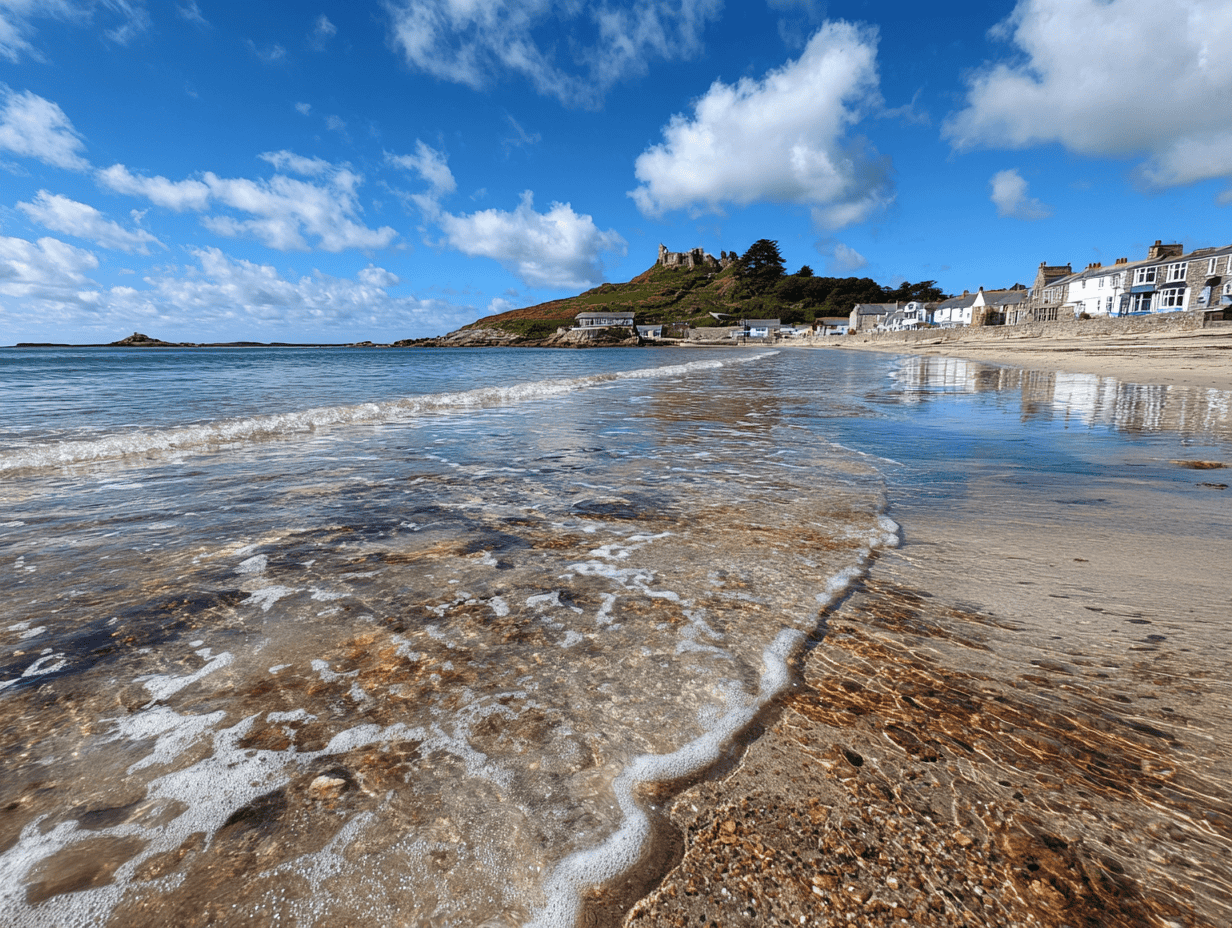
Hunting in the Shadow of St Michael’s Mount
Marazion is a good sea glass hunting beach, especially around East Beach, Chapel Rock, the harbour-side rock pools and the pebble sections exposed towards lower tide. Green, white and brown are the most common finds, with blue, aqua, amber and turquoise appearing occasionally and cobalt blue, black, lavender and red among the rarer colours reported. The open sandy centre is less useful than the rockier margins, so start east of the causeway and work the mixed ground rather than covering the whole bay.
- Rating: Good Beach
- Terrain: Easy
- Level: Beginner
- Dog friendly: Seasonal – dogs banned 1 July to 31 August, 10am–6pm
- Location: Marazion, Cornwall
- Sat Nav: TR17 0EG — St Michael’s Mount / Follyfield Long Stay car park
- Common colours: Green, white, brown
- Rare colours: Cobalt Blue, Black, Lavender, Red
Today at Marazion Beach
Check the latest ShoreSense score and tide times. Scroll down for the full 7-day forecast
Marazion Beach sea glass conditions
Marazion Beach
Cornwall — Building swell
66/100 — Good, best window 10:05–13:05.
Best window is 10:05–13:05 with spring tides (near full/new moon) and building SW swell, so the chance of fresh finds is good today.
Good day at a reliable beach
Ranked #29 in the UK ShoreSense leaderboard today.
| Tide | Time | Height |
|---|---|---|
| High water | 04:49 | 5.7 m |
| Low water | 11:35 | 0.8 m |
| High water | 17:09 | 5.7 m |
| Low water | 23:53 | 0.8 m |
Best For
- Sea glass hunting
- Long Best For
- Rock pool hunting
- Spectacular scenery
- Beginners
- Low-tide beach walks
The most beautiful backdrop for a sea glass hunt in England
There are sea glass beaches, and there are sea glass experiences. Marazion is one of the rare ones that is both.
Situated opposite the iconic St Michael’s Mount, Marazion Beach is a must-visit for sea glass hunters and history lovers alike. The beach’s mix of sand and pebbles makes it a promising spot for finding beautifully frosted sea glass, especially near the high-tide line. The coastal area has been an important maritime hub for centuries, so some of the glass washed ashore could date back hundreds of years.
That’s the understatement of the Cornish coast. St Michael’s Mount was known as a port and trading post for tin and copper from as early as 350 BC. The waters of Mount’s Bay have been busy with shipping for over two thousand years. Roman merchants, medieval pilgrims, Tudor traders, fishing fleets, Royal Navy vessels, wartime convoys- all of them have left their material mark on the seabed of this bay, and the tides have been returning fragments of that history to the beach at Marazion for as long as there has been a beach here.
The glass finds at Marazion are not Seaham-level. This is Cornwall, not County Durham, and the volume reflects that. But the setting, a mile of sand and pebble with a medieval castle on a tidal island half a mile offshore, makes this one of the most visually extraordinary places on this entire site to spend a morning hunting. Even a modest haul feels special when the causeway to St Michael’s Mount appears from the retreating tide in front of you.
What you’ll find here
Marazion’s mixture of sand and pebbles creates a good setting for sea glass to settle, as the sweeping tides of Mount’s Bay bring in material from across the bay.
The East Beach, quieter and rockier than the main beach, is the better bet for hunters. Access is via Leys Lane, which leads down steep steps to a beach that’s brilliant for exploring, as dogs and people alike cannot escape onto roads or private property. Rock pools here trap glass that the sandy main beach lets slip away.
One of the best spots to look for sea glass in Marazion is to the left of the beach by the rock pools, where you can find a wide variety of colours, including rare purple and sometimes orange pieces.
Colours commonly found: Green, white, brown
Occasional finds: Blue, Aqua, Amber, Turquoise
Rare finds: Cobalt Blue, Black, Lavender, Red
Bonus: The walk west toward Longrock at low tide extends your hunting ground considerably. The bay continues for about another two miles, becoming Longrock Beach.
Find something special? Scan it with GlassLore, our free sea glass identifier, to explore what it could be and how rare it is. Then share it to our finds gallery and earn points to climb our hunters leaderboard. Are you ready to compete?
When to go
Low tide is essential here. At low tide, the beach stretches west all the way toward Penzance, exposing a much wider hunting ground than you’d expect from looking at the map. This is when the rock pool sections around Chapel Rock and Marazion Harbour are fully accessible.
Westerly and south-westerly Atlantic swell reaches into Mount’s Bay, and the days after a blow are the best time to come. The swell churns up buried glass and lands fresh material along the tide line.
Lower and falling tides are particularly useful at Marazion because they expose more of the rock pools, pebble sections and shoreline around the causeway. The most useful window varies with the day’s tidal range and recent marine conditions, so check the current ShoreSense Best Window before travelling.
The rock pool sections to the west of the main beach, around the area where the causeway to St Michael’s Mount meets the shore, are consistently cited as the most productive section.
Avoid the main beach in peak summer when it’s busy with families and swimmers. East Beach stays quieter year-round and is always the better hunting ground.
Today’s ShoreSense Score & Best Hunting Window
Marazion sits on the south coast of Cornwall in Mount’s Bay, facing south into the English Channel. The tidal range here can vary by up to around 5 metres between low and high tide, generous for this part of Cornwall and enough to expose a substantial strip of mixed sand and pebble at low water. The semi-diurnal tidal pattern produces two highs and two lows per day, and the causeway to St Michael’s Mount itself serves as a useful natural tide gauge when it’s fully exposed, you’re approaching low water, and the beach is at its most accessible.
As the tide falls, start on East Beach and work the rock pools, pebble pockets and quieter strandline before moving towards Chapel Rock and the harbour-side margins. As more foreshore opens, check the mixed sand-and-pebble sections around the causeway rather than the broad open sand. On lower water, you can extend the hunt west towards Longrock, where the beach becomes much wider. Use today’s ShoreSense Best Window to choose when to arrive, then follow this East Beach → Chapel Rock → causeway → Longrock progression once you’re there.
The widget below uses Penzance (Newlyn) tide data, the standard UKHO port for Mount’s Bay, to show today’s ShoreSense Score, tide curve and best hunting window.
Marazion Beach sea glass conditions
Marazion Beach
Cornwall — Building swell
66/100 — Good, best window 10:05–13:05.
Best window is 10:05–13:05 with spring tides (near full/new moon) and building SW swell, so the chance of fresh finds is good today.
Good day at a reliable beach
Ranked #29 in the UK ShoreSense leaderboard today.
| Tide | Time | Height |
|---|---|---|
| High water | 04:49 | 5.7 m |
| Low water | 11:35 | 0.8 m |
| High water | 17:09 | 5.7 m |
| Low water | 23:53 | 0.8 m |
Compare your Beaches on our Hot Beaches page, updated daily with the best beaches for today, the next seven days, as well as the movers and shakers.
Where to look on the beach
East Beach: Your primary target. Access via Leys Lane, walk up the hill past the shops and church, turn right into Leys Lane just before the cafe called Delicious, and at the end of the lane, turn left down the steps to the beach.
Quieter than the main beach, rockier, better for glass. Work the rock pools carefully and look along the high tide strandline.
Chapel Rock and Marazion Harbour area: Rock pools around Chapel Rock are worth exploring at low tide. Glass accumulates in the rocky sections where the sandy beach gives way to stone.
Longrock Beach extension: At low tide, walk west toward Longrock, and the beach widens dramatically. Longrock Beach is dog-friendly year-round and receives far less attention from hunters.
The causeway area: At low tide, St Michael’s Mount is accessible via a granite causeway once walked by pilgrims. The tidal areas around the causeway are worth a look; the movement of water around the island creates interesting glass deposits.
Key Tip:
Skip the busiest section of the main beach and head straight for East Beach. The rock pools, rocky margins and quieter shoreline here consistently produce better hunting than the open sands around the centre of Marazion.
Difficulty Level – Beginner
- Easy access from multiple points around the bay
- Productive hunting zones are straightforward to locate
- No scrambling required for the main areas
- Extensive beach exposed at lower tides
- Suitable for beginners, families and casual hunters
Hunting Style – The Rock Pool Rover
Marazion rewards hunters who move between different habitats. Search the East Beach rock pools, follow the strandline along the quieter sections of shore, then explore the rocky margins around Chapel Rock and the causeway. At low tide, extending your walk towards Longrock opens up even more productive ground.
Beach Personality
Marazion feels magical before you’ve even found a piece of glass. With St Michael’s Mount rising from the bay, tidal causeways appearing and disappearing, and sweeping views across Mount’s Bay, it is one of Cornwall’s most atmospheric hunting locations. The glass may not appear in huge quantities, but the combination of rock pools, historic shoreline and spectacular scenery makes every hunt feel like an adventure.
Desperate to find that certain colour? Check out the colours and rarity guide, and see where you can find that elusive red, orange or even lavender
Dog friendly?
Mostly yes, with seasonal restrictions on the main beach.
The main Marazion Beach has a seasonal restriction from 1 July to 31 August, 10am–6pm. East Beach, accessed from Leys Lane, is dog-friendly year-round. The adjoining Longrock section also has a seasonal daytime restriction, so check current signage before extending the walk west.
For sea glass hunters, this is not a problem; East Beach is your target anyway, and it’s dog-friendly all day, year-round. Longrock Beach, which joins Marazion to the west, is also dog-friendly all year round, giving you a good long walk with your dog if the tide is right.
Looking for dog-friendly stops in the area? Check our Yappy Places listing for Marazion and Penzance →
Practical information
Parking: The main car parks at Marazion are run by the St Michael’s Mount estate rather than the council. Folly Field, also signed as the St Michael’s Mount & Long Stay car park (TR17 0EG), is the one to use for a proper hunt. It’s ANPR, so you pay at the end of your stay by cash, card, app or phone, and there’s an overflow car park opposite on busy days. The two smaller car parks either side of the slipway have a three-hour maximum stay, which isn’t long enough if you’re planning the low-tide walk west. Cornwall Council’s Marazion Station car park (TR17 0AA) sits about half a mile towards Long Rock and is handy for the Longrock end. Check current charges before you travel, as the estate sets its own.
Toilets: Public toilets are situated along the promenade area close to beach access points. Marazion town has all the facilities you need within a short walk.
Food and drink: Marazion is well served, with cafes, restaurants and The Godolphin Arms overlooking the beach in front of the Mount at one end, and the Station House at the other. Cream tea after a hunt is non-negotiable in Cornwall.
Getting there without a car: Marazion is served by regular buses from Penzance, a short and easy connection from the main line railway station. The coastal bus from Helston also stops here. If you’re travelling by train to Penzance, Marazion is genuinely accessible without a car.
Accessibility Level: Access from the promenade along the seafront makes it easy to reach the main beach. At Folly Field and Kings Road car parks, there are wheelchair-accessible slipways. East Beach features steep steps down from Leys Lane and is not suitable for wheelchairs or buggies.
What to bring
- Sturdy shoes – the East Beach is rocky and uneven underfoot
- A small container for finds – the sandy sections mean glass can be smaller and harder to handle
- Layers – Mount’s Bay is exposed, and the wind off the Atlantic can be sharp
- Low tide timing – essential for the full beach and causeway area
- Camera – the views of St Michael’s Mount deserve more than a phone snap
The history behind the glass
St Michael’s Mount was known as a port and trading post for tin and copper from as early as 350 BC. The island is believed by many historians to be Ictis, the tin trading port mentioned in classical Greek and Roman texts. It was a prehistoric trading centre to which skilfully worked tin was brought from Cornish mines to be sold to foreign merchants. The waters of Mount’s Bay were busy with Phoenician, Greek and Roman merchant vessels before the Christian era even began.
By the medieval period, a monastery had been established on the Mount, and it became a major place of pilgrimage. Pilgrims arrived by sea from across Britain and Europe, their vessels anchoring in the shelter of Mount’s Bay, contributing to the steady accumulation of maritime debris that would eventually become Marazion’s sea glass. The St Aubyn family, who have occupied the castle since 1650, maintained a harbour on the island for centuries of incoming and outgoing trade.
But perhaps the most unexpected chapter in Marazion’s maritime history belongs to the Second World War. At the end of the Second World War, a number of naval vessels, the most famous of which was the battleship HMS Warspite, were broken up on the beaches at Marazion. HMS Warspite was beached and broken up in 1947.
HMS Warspite was one of the most decorated warships in Royal Navy history, a veteran of Jutland, the Norwegian campaign, D-Day and the Italian landings. When her breaking began at Marazion, material from the ship entered the bay. The glass you find on this beach might be old tin trade fragments, Victorian harbour waste, or something that last saw daylight aboard a famous battleship. Marazion’s glass has layers to it that few other beaches in this guide can match
Disclaimer: Tide times, dog restrictions, parking charges and beach conditions change regularly. Always verify before visiting. Dog restriction zones and dates are subject to annual review. Check the current byelaws with Cornwall Council before visiting with a dog. Always check sea conditions before visiting.
Last updated: September 2026
Dog rules checked: September 2026 — Cornwall Council PSPO (1 July–31 August band)
From beach to jewellery
Found something beautiful looking out at the Mount? At Mermaid Tears,
every piece of jewellery starts on a beach just like this one, hand-hunted and handmade into something you’ll keep forever. Browse the seaglass collection.
Frequently asked questions
Is Marazion Beach good for sea glass? Yes, it’s a reliable Good Beach with consistent finds around the rock pools to the western end and along the pebble sections near the causeway. Volume won’t match the industrial beaches of the north, but the setting and the history make it one of the most enjoyable hunts in Cornwall.
When is the best time to visit for sea glass? Low tide or just after high water, following the southwest Channel weather. Spring tides expose the most beach. Autumn and winter are less busy, and the dog restriction has lifted -October through June is the ideal window.
Are dogs allowed at Marazion Beach? Seasonal restriction: dogs are banned from 1 July to 31 August between 10am and 6pm. Outside those dates and hours, dogs are welcome. The restriction is reviewed annually -check with Cornwall Council before visiting.
Can I walk to St Michael’s Mount from Marazion? Yes – the granite causeway is passable on foot between mid-tide and low water. At high tide, a ferry service runs from the beach. Always check tide times before attempting to cross; the causeway floods quickly as the tide turns.
What is the connection between HMS Warspite and Marazion? HMS Warspite, one of the most decorated Royal Navy battleships of the Second World War, was beached and broken up at Marazion in 1947. The breaking of a large naval vessel in the bay released material into the water that has been tumbling as sea glass ever since. It’s one of the more extraordinary footnotes in any beach on this site.
How do I get to Marazion without a car? The First Kernow bus service 2/2A connects Penzance with Marazion in around 15 minutes. Penzance railway station is the nearest rail terminus, with direct trains from London Paddington. From Penzance, the bus runs regularly throughout the day.
More Sea Glass Beaches in Cornwall
Check out our interactive map to find more beaches; you can even filter by colour.
Our Full Cornwall Guide has you covered if you fancy a Sea Glass Road Trip.