The North East’s Underrated Glass Beach
Whitley Bay is a good sea glass hunting beach, particularly around the rocky sections towards St Mary’s Island and Cullercoats rather than the central sandy bay. White, green, brown and amber are the most common finds, with blue, aqua, cobalt, black, lavender and occasional red also reported. It’s an accessible, beginner-friendly beach that can be surprisingly productive when conditions line up.
- Rating: Good Beach
- Terrain: Easy
- Level: Beginner
- Dog friendly: Seasonal- dogs banned from Cullercoats Bay and the southern end of Whitley Bay beach, 1 May–30 September; north of Panama Gardens is dog-friendly all year
- Location: Whitley Bay, North Tyneside, Tyne and Wear
- Sat Nav: NE26 1AL (Links car park, northern end)
- Common colours: White, green, brown, amber
- Rare colours: Cobalt Blue, Black, Lavender, Red, Grey
Today at Whitley Bay
Check the latest ShoreSense Score and tide times. Scroll down for the full 7-day forecast
Whitley Bay sea glass conditions
Whitley Bay
Tyne and Wear
58/100 — Fair, best window 08:24–11:24.
Best window is 08:24–11:24 with spring tides (near full/new moon) and calm sea, so the chance of fresh finds is fair today. Sea is likely calm and picked-over — go early.
Fair — a decent beach in the right window
Ranked #58 in the UK ShoreSense leaderboard today.
| Tide | Time | Height |
|---|---|---|
| High water | 03:22 | 5.4 m |
| Low water | 09:54 | 0.6 m |
| High water | 15:52 | 5.2 m |
| Low water | 22:10 | 0.8 m |
Best For:
- Sea glass hunting
- Beginners
- Long beach walks
- Family visits
Why Whitley Bay keeps getting overlooked and why it shouldn’t
Every sea glass hunter in the North East knows about Seaham. Far fewer think of Whitley Bay. That’s a mistake.
Whitley Bay is two miles of North Sea shoreline, a Metro ride from Newcastle city centre, the restored white dome of the Spanish City gleaming behind the promenade, and if you know where to look, more sea glass per hour than most hunters expect. One jewellery maker who visited both on the same trip found more glass at Whitley Bay in twenty minutes than she found at Seaham in a couple of hours. The Seaham glass was rounder, and more tumbled, she noted, but the volume at Whitley Bay was striking.
That’s not a reason to skip Seaham. It is a reason to take Whitley Bay seriously.
The glass here is flatter and slightly less polished than the famous Seaham pieces. This is a long sandy beach with rocky sections rather than the predominantly pebble-and-shingle foreshore of the Durham coast. But the North Sea currents that sweep this stretch of coastline are strong, the industrial history of the Tyne is long and glass-rich, and the rocky sections around Cullercoats and below St Mary’s Island are significantly more productive than the open sandy stretches.
Learn to work those sections at the right state of tide, and Whitley Bay earns its place in any North East sea glass itinerary, particularly if you’re based in Newcastle and looking for somewhere reachable without a car.
What you’ll find here
Colours commonly found: White, green, brown
Occasional finds: Blue, Aqua, Amber, Turquoise
Rare finds: Cobalt Blue, Black, Lavender, Red, Grey
Bonus: Sea coal is common on this stretch, from the seams in the cliffs north of St Mary’s Island, and pottery sherds turn up alongside the glass. Keep an eye out for Codd marbles, the glass stoppers from Victorian fizzy drink bottles.
Find something special? Use our sea glass scanner, GlassLore, to find out rarity, value and history; then you can share to our finds gallery and, more importantly, earn points to climb our hunters leaderboard – are you ready to compete?
When to go
Whitley Bay faces directly east into the North Sea, which means it catches every swell that comes in from the north and east. After a period of north-easterly weather, the beach turns over properly, and glass that hasn’t been seen for months surfaces in the rocky sections and along the strandline. This is the moment to be here.
Low tide is your window. The rocky sections north of Panama Gardens and around the Cullercoats headland to the south open up significantly at low water, revealing the shingle pockets and rock channels where glass accumulates. Work these sections carefully rather than the open sandy beach, which is where most casual visitors walk and where productive glass is less concentrated.
Autumn and winter are the best seasons; the beach is quieter, the North Sea storms are more frequent, and you’re unlikely to be competing with anyone for finds. A grey weekday morning in October, wind off the sea, nobody else on the rocky section north of the lighthouse causeway- that’s the ideal Whitley Bay hunt.
Today’s ShoreSense Score & Best Hunting Window
Whitley Bay sits on the North Sea coast of North Tyneside, with a tidal range of around 4.5 metres on a spring tide, a generous range that exposes a useful stretch of rocky foreshore north of Panama Gardens and around the Cullercoats end at low water.
The ShoreSense widget below combines recent marine conditions, tide timing and practical hunting weather to show today’s overall ShoreSense Score, Hunting Potential, Comfort and the best available hunting window for Whitley Bay Sea Glass. It uses UKHO tide data alongside current marine and weather inputs to help you judge whether conditions look promising for a hunt.
Whitley Bay sea glass conditions
Whitley Bay
Tyne and Wear
58/100 — Fair, best window 08:24–11:24.
Best window is 08:24–11:24 with spring tides (near full/new moon) and calm sea, so the chance of fresh finds is fair today. Sea is likely calm and picked-over — go early.
Fair — a decent beach in the right window
Ranked #58 in the UK ShoreSense leaderboard today.
| Tide | Time | Height |
|---|---|---|
| High water | 03:22 | 5.4 m |
| Low water | 09:54 | 0.6 m |
| High water | 15:52 | 5.2 m |
| Low water | 22:10 | 0.8 m |
Compare today’s scores on Hot Beaches
Where to look on the beach
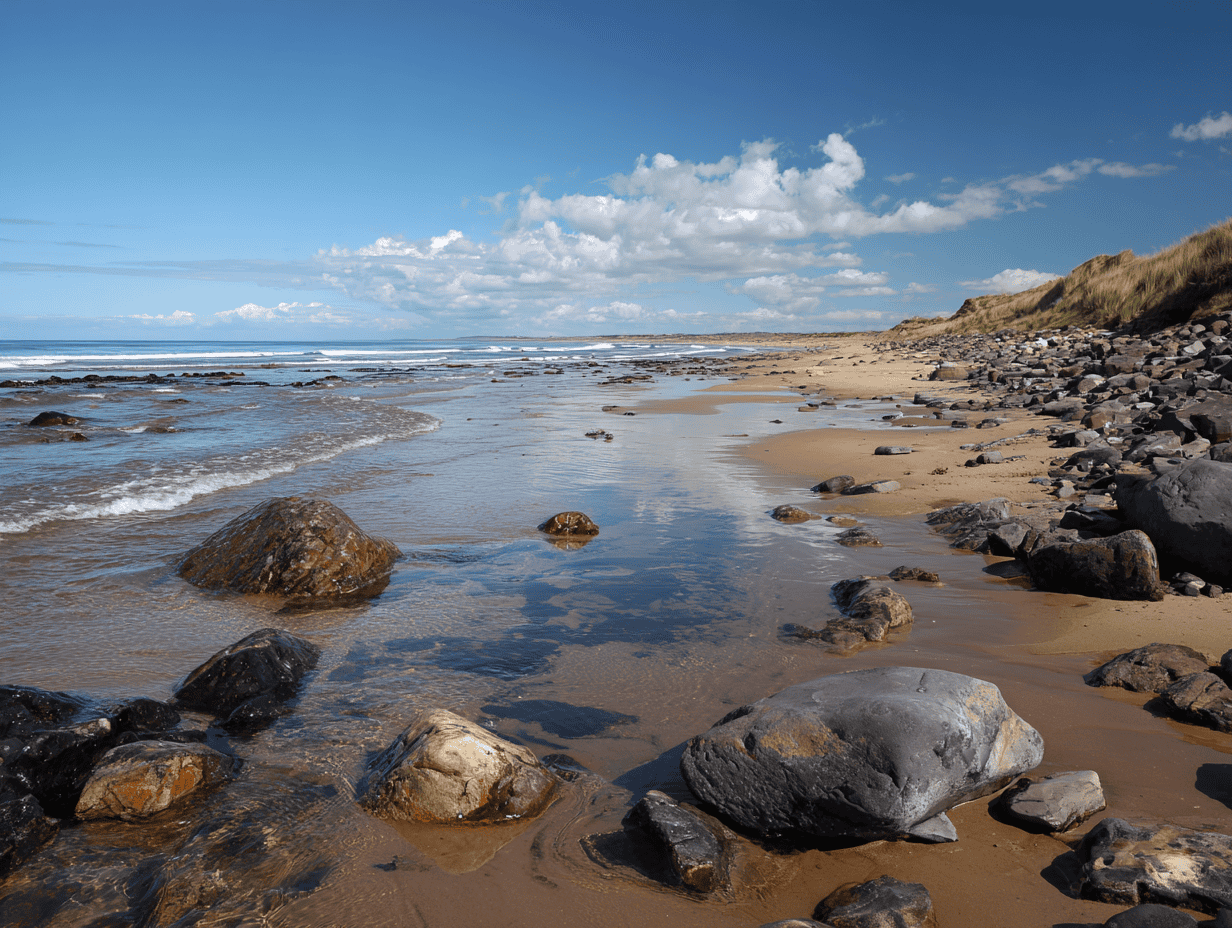
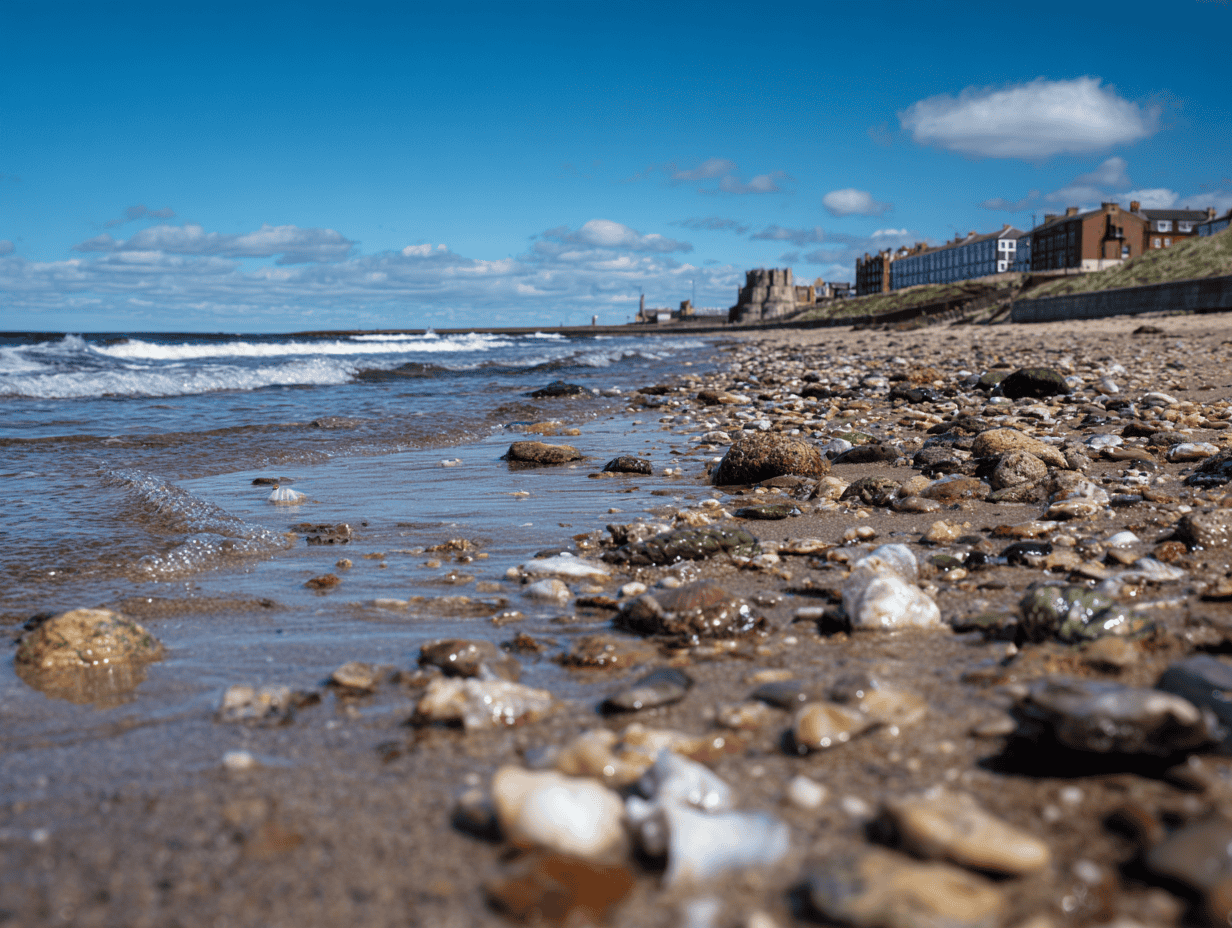
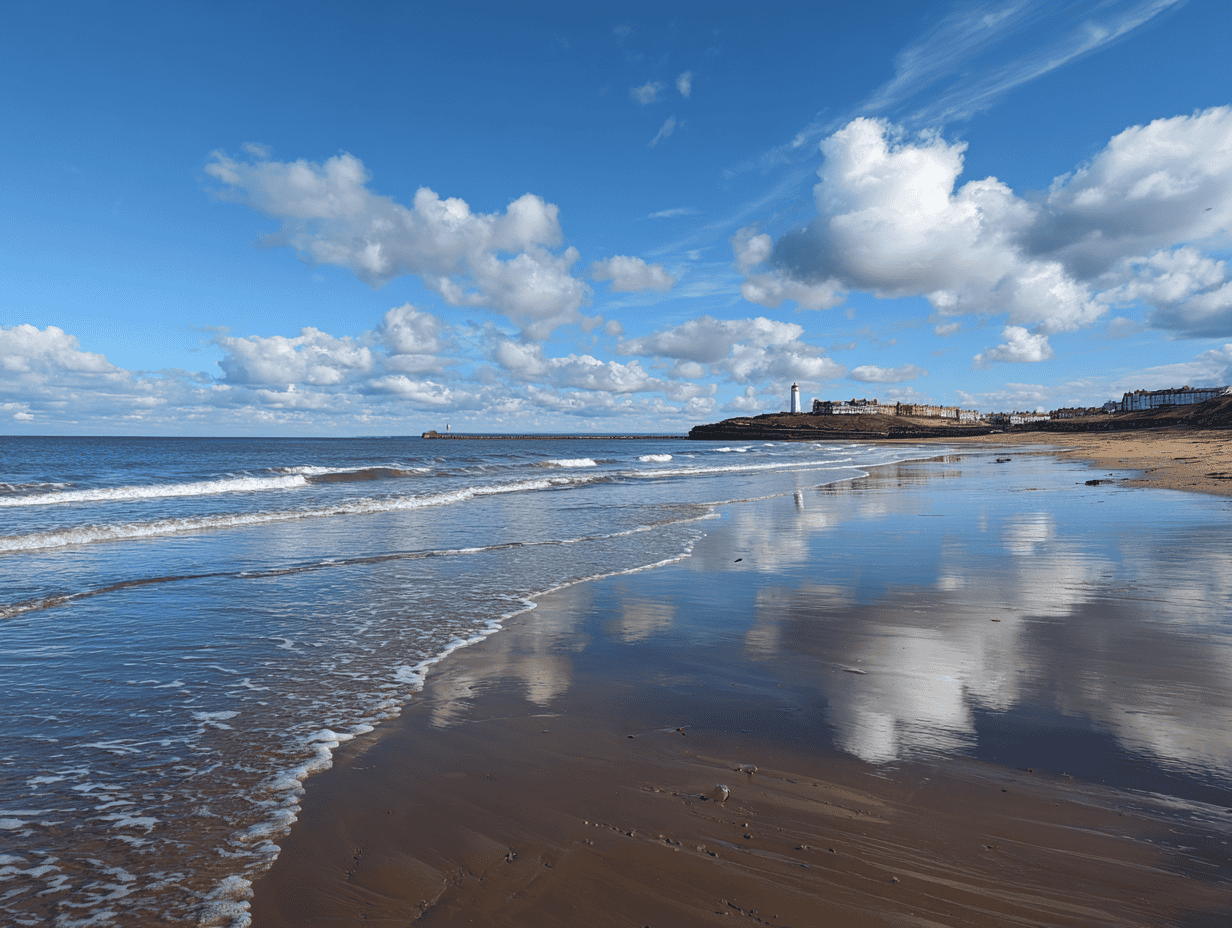
Whitley Bay beach runs for two miles from Cullercoats in the south to St Mary’s Island and its causeway in the north. The sandy central section is the most visited and the least productive for glass. The interest is at either end.
The northern section – St Mary’s Island and beyond is the most consistently productive area. North of Panama Gardens, the beach becomes rockier, visitor numbers drop, and the shingle pockets between the rock outcroppings collect glass pushed in by the North Sea. Coal seams are exposed in the cliffs just north of St Mary’s Island, and it is possible to pick up sea coal from the beach at low tide. The coal seams in the cliffs extend all the way to Seaton Sluice. Work the rocky sections carefully here at low tide, checking every crevice and shingle pocket. The area around the St Mary’s Island causeway itself is worth a careful look, as glass tends to concentrate around rocky obstacles.
Cullercoats at the southern end is a small bay separated from the main Whitley Bay beach by a headland. The rocky foreshore here at low tide is particularly productive, with a sheltered aspect and rocky terrain that traps glass that the open beach doesn’t hold. It’s a short walk south from the main beach and significantly less picked over.
The central promenade stretch between Spanish City and Panama Gardens is worth a strandline check after storms. Glass washed in by a big swell appears here, but it’s the ends of the beach that consistently deliver.
The terrain is easy. The main beach and promenade are flat and accessible, and the rocky northern section requires only sensible footwear, not any real scrambling. It’s one of the most accessible hunting beaches on the North East coast.
Key Tip:
Ignore the temptation to spend all your time on the main sandy beach. Head straight for the rocky sections around St Mary’s Island or Cullercoats, where glass becomes trapped in crevices and shingle pockets that the central beach simply doesn’t have.
Difficulty Level – Beginner
- Easy access along the entire length of the bay
- Flat promenade and beach make navigation straightforward
- Productive rocky areas require only sensible footwear
- No scrambling or difficult terrain involved
- Suitable for beginners, families and experienced hunters alike
Hunting Style – The Headland Hunter
Whitley Bay rewards hunters who focus on the edges rather than the centre. Search the rocky foreshore around St Mary’s Island at low tide, checking every shingle pocket and crevice, then explore the sheltered bay at Cullercoats where glass often accumulates undisturbed. The central strandline is worth a look after storms, but the real rewards are found at either end.
Beach Personality
Whitley Bay feels welcoming, spacious and full of possibilities. The iconic Spanish City, long promenade and sweeping sandy bay attract most visitors, but sea glass hunters quickly learn that the treasures lie away from the crowds. Between the rocky shores of St Mary’s Island and the sheltered character of Cullercoats, this stretch of coastline offers some of the most accessible and enjoyable hunting on the North East coast, with enough variety to keep you exploring long after your first visit.
Dog friendly?
Seasonal. From 1 May to 30 September, North Tyneside Council bans dogs from the southern end of Whitley Bay beach and from the whole of Cullercoats Bay. Breaches carry a fixed penalty of up to £100. North of Panama Gardens, the beach is dog-friendly all year, and that’s the stretch running up to St Mary’s Island, the most productive hunting ground here anyway. Turn left from the Links car park and you’re straight into year-round dog territory heading towards the lighthouse.
Cullercoats is the catch. It’s one of the two best hunting spots on this beach, and in summer it’s completely off-limits to dogs. If your dog’s with you between May and September, spend the day at the St Mary’s Island end and save Cullercoats for an autumn or winter visit. The same summer ban covers King Edward’s Bay and the southern end of Tynemouth Longsands if you carry on down the coast.
From October to April, the full two miles is open to dogs. The promenade is flat, the rocky northern section has plenty of space, and the Links behind the beach give you a good run on grass.
Check our Yappy Places listing for Whitley Bay for dog-friendly cafés and pubs after your hunt.
Practical information
Parking: The Links car park (NE26 1AL) at the northern end of the promenade is the best base for sea glass hunting; it puts you immediately adjacent to the most productive rocky section and north of the seasonal dog restriction. Pay and display. Additional parking is available near the Spanish City and along the promenade. The Metro is genuinely the better option from Newcastle; see Getting there.
Toilets: Public facilities are available on the promenade near the Spanish City and at the northern end near the Links car park.
Food and drink: The restored Spanish City opened in July 2018 and now houses a range of dining options, including fish and chips at Trenchers, a Champagne Bar and traditional tea rooms. The Rendezvous café on the Links is a classic seaside stop. Independent cafes and restaurants line the town centre streets, a short walk from the front. Whitley Bay has genuinely improved its food scene in recent years; it’s no longer a chips-only proposition.
Getting there without a car: The Tyne and Wear Metro Yellow line runs through the town, with Whitley Bay and Cullercoats stations both serving the beach. Journey time from Newcastle city centre is around 25 minutes. The Metro is frequent, cheap and drops you almost directly onto the promenade. It’s one of the easiest sea glass beaches in England to reach by public transport.
Accessibility: The promenade running the full length of the beach is flat and fully accessible. The rocky northern section is uneven underfoot, manageable with care, but not suitable for wheelchairs or buggies. The Links car park has good level access directly to the promenade.
What to bring
- Sturdy shoes or wellies – the rocky sections north of Panama Gardens can be slippery at low tide
- A small container or zip-lock bag for your finds
- A hand rake or trowel for working shingle pockets between the rocks
- Layers and a windproof jacket -Whitley Bay faces directly into the North Sea, and the wind can be sharp even on sunny days
- A Pop card or contactless card if you’re coming by Metro from Newcastle. It’s the easiest way in
- A lead for your dog and awareness of the Panama Gardens boundary during the summer months
The history behind the glass
The glass at Whitley Bay comes from the Tyne. That’s the short answer – and the Tyne has been one of the most industrially productive rivers in the world.
Coal was certainly being extracted from seams at Whitley Bay and Cullercoats in the 17th century, and wooden wagon ways were being used to haul it down to the pier at Cullercoats. Some of the coal was used to stoke the salt pans, which provided Cullercoats with a second important string to its industrial bow. Salt panning, coal, and fishing, the industries of this coast have been putting material into the North Sea for centuries.
The bigger glass story is the Tyne itself. The North East’s chemical industry centred on Tyneside in the 18th and 19th centuries, with alkali production closely linked to glass manufacture. Mixed with lime and sand, it produced glass, and the industry lined both banks of the river. Lemington Glass Works opened in 1787, just west of Newcastle, one of several major glass manufacturers operating on the Tyne whose waste found its way into the river and eventually the sea. North Shields and South Shields, just a few miles south, had around 200 salt pans by 1767 and a maritime trade that continuously put bottles, jars, and glass of every kind into these waters throughout the industrial era.
Whitley Bay itself transformed in the late Victorian period. From the late 19th century, the decline of local coal mining and dependent industries was ameliorated by the emergence of Whitley as a seaside holiday resort, with the opening of the North Tyne Loop railway line in 1882 connecting the coastal villages to Newcastle.
The resort era brought its own glass bottles, entertainment, and the funfair. The Spanish City dome opened in 1910 as the largest freestanding dome in Britain outside St Paul’s Cathedral, hosting rollercoasters, ballroom dancers, and concert parties throughout its Edwardian heyday. Mark Knopfler of Dire Straits wrote about the Spanish City in Tunnel of Love; Sting spent his afternoons there instead of studying for his A levels. The glass from those decades of seaside life is in the North Sea too.
What you find at Whitley Bay is the accumulated deposit of centuries of Tyneside industry, filtered by the North Sea and returned one piece at a time to the rocky sections of a beach that most people just walk straight past.
From beach to jewellery
Find something worth keeping: a cobalt blue from the North Sea, a Codd marble worn smooth by decades in the water, a piece of amber that traces back to a Tyneside bottle works. At Mermaid Tears, every piece of jewellery begins exactly where you’re standing, hand-hunted from UK beaches and handmade into something you’ll keep forever. Browse the Mermaid Tears collection.
Disclaimer: Tide times, dog restrictions, parking charges and beach conditions change regularly. Always verify before visiting. The seasonal dog ban on the southern section of Whitley Bay beach runs from 1 May to 30 September -check the North Tyneside Council website for current enforcement boundaries before travelling with your dog. Beach byelaws are updated annually.
Last updated: Sept 2026
Frequently asked questions
Is Whitley Bay good for sea glass hunting? Yes, it’s one of the most underrated sea glass beaches on the Northeast coast. The volume of glass can be surprisingly high, particularly in the rocky sections north of Panama Gardens and around Cullercoats at low tide. Rated Good, worth a dedicated trip, and especially convenient from Newcastle by Metro.
Where exactly should I look for sea glass at Whitley Bay? Concentrate on the rocky northern section north of Panama Gardens, heading towards St Mary’s Island. Work the shingle pockets between the rock outcroppings at low tide and check around the causeway area carefully. Cullercoats at the southern end is also productive at low tide and less visited than the main beach.
What colours of sea glass can I find at Whitley Bay? White, green, brown and amber are the everyday finds, with blue, aqua and turquoise turning up occasionally. We haven’t confirmed any rarer colours here yet, so if you find one, add it to the gallery.
Is Whitley Bay dog-friendly? Partly. North of Panama Gardens, the beach is dog-friendly all year, and it’s the best hunting ground. From 1 May to 30 September, dogs are banned from the southern end of the beach and from the whole of Cullercoats Bay.
How do I get to Whitley Bay from Newcastle? The Metro Yellow line runs directly to Whitley Bay station, with a journey time of around 25 minutes from Newcastle city centre. The station is a short walk from the promenade. By car, use NE26 1AL for the Links car park at the northern end.
How does Whitley Bay compare to Seaham for sea glass? Different rather than better or worse. Seaham produces more rounded, heavily tumbled glass from its specific industrial history. Whitley Bay glass tends to be flatter and varies more in frosting quality, but the volume can be impressive, and the range of colours reflects the broader industrial history of the Tyne. Seaham is the pilgrimage; Whitley Bay is the rewarding local discovery.
More Beaches
Check out the full North East Guide or our interactive map to find more beaches; you can even filter by colour.