Dinosaurs, Shipwrecks and a Wild Channel Shore
Compton Bay is a fair but fascinating sea glass hunting beach, with the pebble interruptions and sandstone ledges around Hanover Point the main target and the pebblier stretch towards Compton Chine worth checking as a second zone. Green, white, and brown are the most common finds, with blue, aqua, and amber appearing occasionally, and turquoise, cobalt blue, black, and lavender among the rarer colours reported. The real appeal is the combination of sea glass, dinosaur fossils, exposed Cretaceous geology and one of the Isle of Wight’s wildest Channel coastlines.
Where to hunt: Hanover Point strandline → pebble interruptions → sandstone-ledged pockets → Compton Chine pebblier stretch
- Rating: Fair Beach
- Terrain: Tricky
- Level: Beginner -Intermediate
- Dog friendly: Seasonal (dogs banned 15 May–15 September west of Compton Bay car park; dogs welcome year-round between Hanover Point and Brook Chine)
- Common colours: Green, white, brown
- Rare colours: Turquoise, Cobalt Blue, Black, Lavender
- Location: Compton, Isle of Wight
- Sat Nav: PO30 4HB
Today at Compton Bay
Check below for the latest ShoreSense score. Scroll down for your full 7-day forecast
Compton Bay sea glass conditions
Compton Bay
Isle of Wight — Fresh swell
87/100 — Excellent, best window 13:00–16:00.
Best window is 13:00–16:00 with strong recent seas delivering glass and spring tides (near full/new moon), so the chance of fresh finds is excellent today. Great combo of sea state and weather — worth the trip.
Rare excellent window at this spot
Ranked #17 in the UK ShoreSense leaderboard today.
| Tide | Time | Height |
|---|---|---|
| Low water | 02:04 | 0.6 m |
| High water | 08:16 | 2.2 m |
| Low water | 14:30 | 0.6 m |
| High water | 20:09 | 2.3 m |
Best For:
- Fossil + sea glass hunting
- Beginners
- Long beach walks
- Pebble pocket hunting
- National Trust coastal trips
- Storm-following visits
- Families
- Wide open beach exploring
Why Compton Bay – where 125 million years of history meet the Channel
There are beaches where sea glass is the whole story. Compton Bay is not one of them, and that’s the point. This is one of the most extraordinary stretches of coastline in southern England, and sea glass is the least of what it has to offer.
Come here as a beachcomber, and you are hunting on a beach where dinosaur footprints appear in the sandstone at low tide. The Isle of Wight is Europe’s richest source of dinosaur remains, and Compton’s eroding Cretaceous cliffs have yielded fossils from over twenty species for as long as collectors have been looking.
After storms, fresh bone, teeth, and fossilised wood wash down from the cliff and fall onto the same foreshore where the glass turns up. You can pick up a piece of sea glass and a piece of iguanodon in the same afternoon.
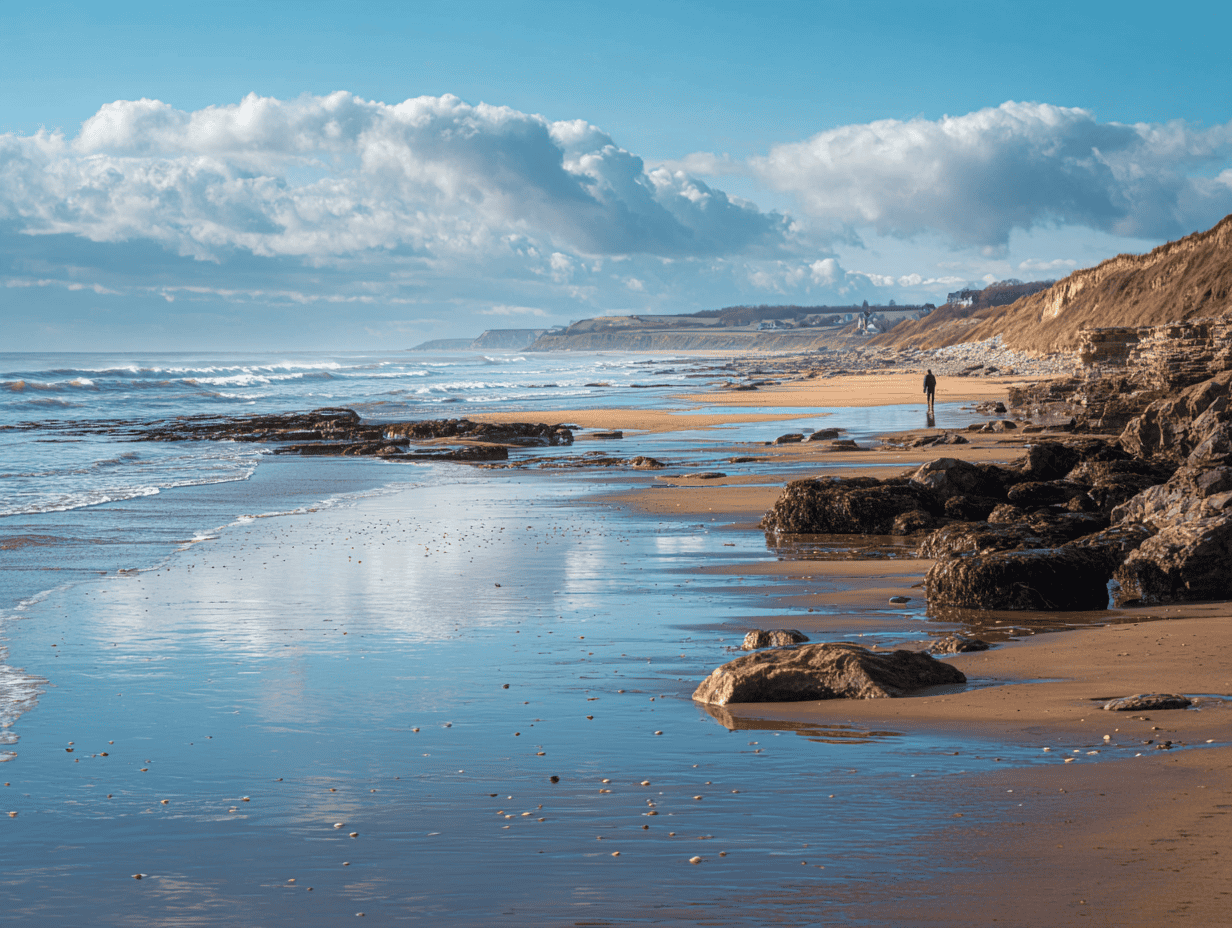
Come here as someone who wants a wild, dramatic, genuinely unspoilt beach on the south-western Isle of Wight, and Compton delivers that in abundance. Two miles of exposed south-facing shore backed by crumbling multi-coloured sandstone cliffs.
Atlantic swell breaking on the reef at Hanover Point. Surfers in the water when the conditions are right. Paragliders drifting along the cliff line above. It looks, in certain lights, like something from the west coast of America rather than ten miles from Newport.
The glass here is green and white, with the occasional dark piece found in the pebbles and sand, confirmed by IoW hunters who work this beach regularly. It won’t fill a bag, but any piece you find here has been tumbled by Channel swell on one of the most exposed coasts in the south of England, and it comes with one of the finest settings of any beach in this guide.
Pack the fossil bag alongside the glass container. You won’t regret it.
What you’ll find here
Colours commonly found: Green, white, brown
Occasional finds: Blue, Aqua, Amber
Rare finds: Turquoise, Cobalt Blue, Black, Lavender
Bonus: Dinosaur fossils, bone fragments, teeth, fossilised wood and the famous three-toed iguanodon foot casts at Hanover Point are visible at low tide. Fossilised oyster shells and ammonites are also present. This is one of the UK’s most productive dinosaur beaches.
Find something special? Use our sea glass scanner, GlassLore, to find out rarity, value and history; then you can share to our finds gallery and, more importantly, earn points to climb our hunters leaderboard – are you ready to compete?
When to go
Low to mid-tide is essential for both glass and fossils. The Hanover Point sandstone ledges, where the dinosaur trackways are preserved, emerge only as the tide drops, and the foreshore is most productive when it’s draining. After storms, the timing is best: cliff falls bring fresh fossil material down, and the strandline is renewed with whatever the Channel has turned over.
Autumn and winter are the prime seasons. The surfers and fossil-tour groups thin out, the south-westerly weather is more active, and the beach is yours. The cliff erosion accelerates after wet weather, which means fresh finds on the foreshore in the days that follow.
Be aware of the seasonal dog restriction (15 May–15 September west of the car park) if you’re coming with a dog; either plan for the Hanover Point to Brook Chine section, which is dog-friendly all year, or come out of season when the whole beach is open.
Today’s ShoreSense Score & Best Hunting Window
Compton Bay faces south-south-west on the Isle of Wight’s most exposed stretch of coast, open to Atlantic swell rolling in from the English Channel, with nothing to break it between here and the French coast. The spring tidal range is around 3.5 metres, enough to substantially change the beach’s character as the tide drops, revealing the sandstone ledges at Hanover Point and widening the foreshore considerably.
Start around Hanover Point and work the latest strandline and pebble patches that interrupt the long sandy stretches. As more foreshore opens, move onto the sandstone-ledged areas and check the shingle-filled depressions and rock pockets rather than spending time on uninterrupted sand.
Continue west towards Compton Chine if you have time, where the beach becomes pebblier and gives you more pockets to inspect. After stronger south-westerly conditions begin to settle, recheck the rearranged strandline and newly sorted pebble patches, but stay well clear of the actively eroding cliff base.
Use today’s ShoreSense Best Window to choose when to arrive, then follow this Hanover Point → pebble patches → sandstone pockets → Compton Chine progression once you’re there.
The ShoreSense widget below combines recent marine conditions, tide timing and practical hunting weather to show today’s overall ShoreSense Score, Hunting Potential, Comfort and the best available hunting window for this beach. It uses UKHO tide data alongside current marine and weather inputs to help you judge whether conditions look promising for a hunt.
Compton Bay sea glass conditions
Compton Bay
Isle of Wight — Fresh swell
87/100 — Excellent, best window 13:00–16:00.
Best window is 13:00–16:00 with strong recent seas delivering glass and spring tides (near full/new moon), so the chance of fresh finds is excellent today. Great combo of sea state and weather — worth the trip.
Rare excellent window at this spot
Ranked #17 in the UK ShoreSense leaderboard today.
| Tide | Time | Height |
|---|---|---|
| Low water | 02:04 | 0.6 m |
| High water | 08:16 | 2.2 m |
| Low water | 14:30 | 0.6 m |
| High water | 20:09 | 2.3 m |
Compare your Beaches on our Hot Beaches page, updated daily with the best beaches for today, the next seven days, as well as the movers and shakers.
Where to look on the beach
The beach runs from Hanover Point in the east to Compton Chine in the west, with Brook Chine further east again. Three National Trust car parks, Brook, Hanover and Compton, give access to different sections of the shore.
For glass, work the strandline and the pebble patches between the sandstone ledge areas. The section around Compton Chine tends to be pebblier than the sandier stretches further east, more productive for glass hunting. Glass gathers in the same rock pockets and depressions that trap fossil fragments, so anywhere you’d look for one, look for both.
At Hanover Point, the reef break creates turbulence that sorts and concentrates material on the beach to the east of the point. It’s worth working this section carefully on the ebb.
Key Tip:
At Compton Bay, don’t waste time on long uninterrupted sand. Focus on the pebble interruptions, sandstone ledges, and reef turbulence zones where heavier material naturally settles and becomes trapped.
The cliff face is actively eroding, and falls happen without warning. Do not stand below the cliffs, do not approach fresh cliff falls, and never attempt to climb the slippages. Stay on the foreshore. The National Trust wardens take this seriously, and so should you.
Hunting Style: The Storm Chaser
Compton Bay is often at its best after rough weather. Work fresh strandlines, pebble accumulations and areas where recent wave action has exposed new material.
Beach Personality
Compton Bay feels wild and untamed compared with many resort beaches. The dramatic cliffs, huge open shoreline and constantly changing conditions mean every visit can be different. It rewards hunters who pay attention to the weather and tides, and who are willing to walk a little further than everyone else.
Dog friendly?
It’s workable with a little planning. The section between Hanover Point and Brook Chine is dog-friendly year-round. This covers the eastern part of the beach, including the fossil-rich Hanover Point area. The seasonal ban (15 May–15 September) applies west of the Compton Bay car park.
Out of season, the whole beach is open to dogs, and the clifftop walk across Compton Down and Brook Down behind the bay is some of the finest dog walking on the island, with wide-open chalk downland and views in every direction. Check our Yappy Places listing for Freshwater for nearby dog-friendly options.
Practical information
Parking: No overnight parking. No coach parking, and the surrounding area is a designated clearway, so parking on the verge is an offence. Coaches can use the designated spot at Brook Bay.
Three National Trust pay-and-display car parks managed via the JustPark app: Brook Chine (code 80526), Hanover Point (80545) and Compton Chine (also 80545).
Free for National Trust members, but you must register your membership card in the JustPark app to get it.
Signal is patchy here. If you can’t pay on the day, note the code and pay within 48 hours, including from home. In summer you can also pay at the food and beverage van, on site five days a week.
Toilets: Toilets are available at Hanover Point car park, including baby-changing facilities, an accessible toilet and a Changing Places cubicle.
Food and drink: No permanent café on the beach. A mobile catering van operates seasonally. The nearest town facilities are in Freshwater or Yarmouth, a short drive away.
Getting there without a car: Southern Vectis buses run along the Military Road (A3055) above the beach; services are limited; check current timetables. The Round the Island cycle path passes along the A3055.
Accessibility: Blue Badge parking and accessible toilets are available at Hanover Point, and parts of the clifftop coast path are relatively level. Beach access itself is not wheelchair- or pushchair-friendly: Hanover Point and Brook have short flights of wooden steps with handrails, while Compton Chine has a much longer stepped descent. The hunting beach also includes soft sand, uneven rock ledges and loose pebbles.
What to bring
- Sturdy footwear – steep steps, uneven wet rock ledges and soft sand that shifts underfoot
- Two bags: one for glass, one for fossil fragments – you will want both
- Tide times checked carefully in advance – the reef and ledges at Hanover Point are only accessible at low water
- Wind protection – this is a fully exposed south-facing shore with no shelter whatever
- National Trust membership card loaded onto the JustPark app if you have one
The history behind the glass
Compton Bay has no bottle works, no industrial harbour, no single dramatic source for its glass. Instead, it has centuries of shipwrecks and a stretch of coast so dangerous it earned a grim reputation long before the leisure industry discovered it.
The Brook and Brighstone Ledges, a six-mile series of rocks and clay extending up to a mile and a half offshore from Compton Bay, claimed ships in every century from the medieval period onwards. A 14th-century vessel out of Calais went down in Compton Bay in 1301.
An English treasure ship, the Bird Phoenix, was wrecked here in 1636. At spring tides at Compton Beach today, you can still see the ribs of the SS Carbon, a tugboat that hit the rocks in 1947 while being towed from Portland to Southampton, abandoned as not worth salvaging and left to rust on the reef. Every wreck brought its cargo: bottles, domestic goods, the glass carried by every vessel that ever crossed the Channel.
The Military Road running above the cliffs adds its own layer. Built in the 1840s to allow rapid troop movement along the island’s vulnerable south coast, it cuts along the clifftop for miles above the beach, one of the most dramatic coastal drives in England, and a direct reminder that this exposed western shore was considered a genuine invasion risk right into the 20th century.
The clifftop farms and cottages above Compton have been occupied continuously for centuries, and as the cliffs erode- and they do, steadily, with every winter storm- whatever was up there eventually comes down.
The deepest history, though, is in the cliffs themselves. The Cretaceous mudstone was deposited 125 million years ago in a series of warm coastal lagoons. Iguanodons left their three-toed prints in the mud, and those prints are still there, emerging from the sandstone ledge at Hanover Point twice a day when the tide drops.
Any glass you find at Compton has been tumbled alongside those prints for however long it’s been in the water. There are many worse places to put a piece of sea glass.
From beach to jewellery
Found something in the Compton shingle? At Mermaid Tears, sea glass from wild British coastlines like this one becomes handmade jewellery with a real provenance and a real story. Browse the collection.
Disclaimer: Tide times, dog restrictions, parking charges and beach conditions change regularly. Always verify before visiting. Beach byelaws are updated annually. Check with the local council or beach authority for the most current rules. The cliffs at Compton Bay are actively eroding; never stand below the cliff face or approach fresh cliff falls. Cliff conditions can change rapidly after rain. Always follow National Trust safety guidance on the day.
Last updated: September 2026
Dog rules checked: September 2026 – National Trust (Hanover Point to Brook Chine unrestricted; west of Compton Bay car park banned 15 May–15 September)
Frequently asked questions
Is Compton Bay good for sea glass? It’s a fair-rated beach, where glass has been found consistently, including green, white and dark pieces, but it isn’t a high-volume location. The real draw is the dual hunt: come for fossils and glass together, and you’ll rarely leave disappointed.
Can you find dinosaur fossils at Compton Bay? Yes, it’s one of the UK’s best dinosaur beaches. Fossilised bone, teeth, wood and the three-toed iguanodon foot casts at Hanover Point are all findable, particularly after storms bring fresh cliff material down. The best searching is between Brook Bay and Compton Bay at low tide.
Are dogs allowed at Compton Bay? Year-round between Hanover Point and Brook Chine. The ban (15 May–15 September) covers only the section west of the Compton Bay car park. Out of season, the whole beach is open to dogs.
When is Compton Bay at its best for beachcombing? Autumn and winter at low tide, after Channel storms. The swell refreshes the strandline, the cliff erosion produces fresh fossil material, and the beach is quiet.
Is it safe to walk below the cliffs at Compton Bay? The cliffs are actively eroding, and falls can happen without warning, particularly after rain. Stay on the foreshore away from the cliff base and follow any National Trust safety notices on the day. Fresh cliff falls are not an opportunity to get closer; they’re a signal to move away.
Can you see the shipwreck at Compton Beach? Yes, at low spring tides, the ribs of the SS Carbon, a tugboat wrecked in 1947, are visible on the beach near Hanover Point. They’re becoming less visible every year as the sea continues its work.
More Beaches
Check out our Full Isle of Wight Guide or plan your trip with our UK Sea Glass Map.