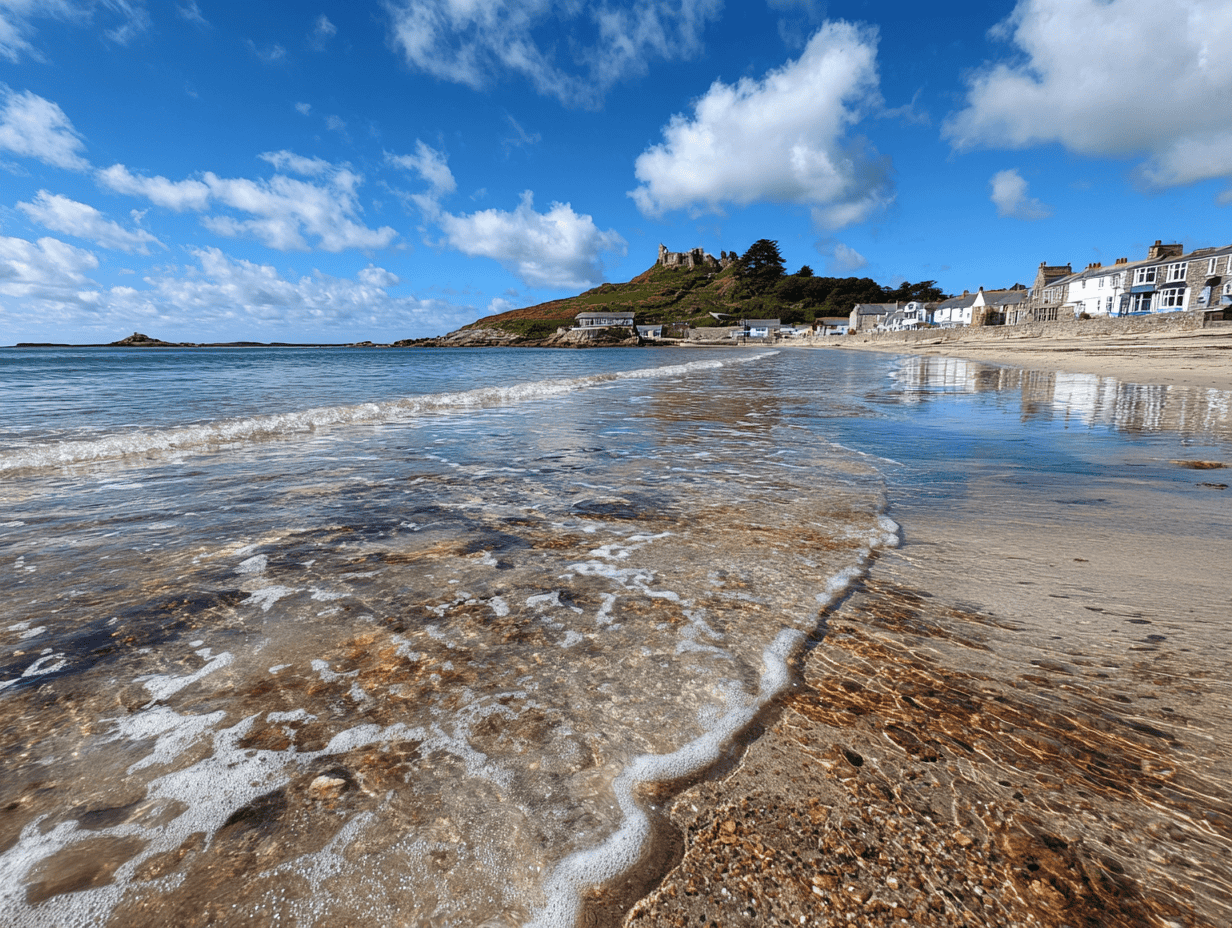
Slate Cliffs, a Vanishing Beach and Glass from a Working Heritage Coast
Trebarwith Strand is a good sea glass hunting beach for experienced hunters, especially around the slate rock platforms, crevices and rock-pool edges exposed at lower water. Green, brown and white are the most common finds, with blue, aqua, amber, turquoise, cobalt, black and lavender also reported. The sandy centre is worth a quick strandline scan, but the rocky sections at either end are the areas I’d prioritise.
- Rating: Good Beach
- Terrain: Tricky
- Level: Advanced
- Dog friendly: Yes, all year round, no restrictions
- Location: Trebarwith Strand, near Tintagel, North Cornwall
- Sat Nav: PL34 0HB (Trebarwith Strand car park)
- Common colours: Green, brown, white
- Rare colours: Cobalt Blue, Black, Lavender
Today at Trebarwith Strand
Check the latest ShoreSense Score and tide times. Scroll down for the full 7-day forecast.
Trebarwith Strand sea glass conditions
Trebarwith Strand
Cornwall — Building swell
78/100 — Excellent, best window 10:19–13:19.
Best window is 10:19–13:19 with spring tides (near full/new moon) and building W swell, so the chance of fresh finds is excellent today.
Strong window at a solid beach
Ranked #7 in the UK ShoreSense leaderboard today.
| Tide | Time | Height |
|---|---|---|
| High water | 06:34 | 7.5 m |
| Low water | 11:49 | 0.6 m |
| High water | 18:51 | 7.7 m |
Best For:
- Sea glass hunting
- Storm hunting
- Sea pottery
- Long beach walks
Why Trebarwith Strand – a beach that disappears completely, and glass that rewards the well-timed visit
Trebarwith Strand has a quality that no other beach in this guide shares quite so dramatically: at high tide, it ceases to exist. The beach is completely covered by the high tide for several hours. What at low water is a mile of golden sand backed by slate cliff caves becomes nothing but grey rock and white water. Get the timing wrong, and there is no beach.
Get it right, and you arrive at one of the most striking stretches of coast on the north Cornwall Heritage coastline, backed by enormous slate cliffs scarred by five centuries of quarrying, flanked by Gull Rock three hundred metres offshore, with the caves that give the cliffs their drama and the rock pools that make the glass hunting worthwhile.
Trebarwith Strand experiences strong tidal shifts, consistently exposing new areas of sand and rocks and providing fresh opportunities for sea glass locations. Every low water is a fresh reveal.
The cliffs themselves hold the history. The cliff quarry workings were in operation in this area from the 15th century up to the beginning of the Second World War- four hundred years of slate quarrying along this stretch of coast, with the harbour at Port William just around the headland used to ship the slate out by sea.
That industrial maritime activity, combined with the coastal trade and fishing communities that ran the length of this Heritage Coast, is what feeds the glass into the beach. Two miles south of Tintagel, a National Trust beach, all-year dog-friendly, and genuinely dramatic: Trebarwith earns its place in the Cornwall list.
What you’ll find here
Colours commonly found: Green, brown, white
Occasional finds: Blue, Aqua, Amber, Turquoise
Rare finds: Cobalt Blue, Black, Lavender
Bonus: Sea pottery, smooth slate fragments, occasional driftwood, gull feathers from the rock colony offshore
Find something extra special? Scan it with GlassLore to explore what it could be and how rare it is. Then upload your finds to the gallery and earn points to climb the hunter leaderboard. Are you ready to compete?
Check out the Colour Rarity Guide and find out the best beaches to find the unusual sea glass colours.
When to go
Tide timing is more critical at Trebarwith than almost any other beach in this guide. At low tide, the beach extends almost a mile. As the tide pushes in, it all but disappears, leaving just the rocks at the base of the cliffs. You need to arrive on the ebb and be clear of the beach before the tide traps you against the cliff. Check the tide table before every visit -this is not an optional step at Trebarwith.
Post-storm is the other key trigger. Trebarwith faces northwest into the Atlantic, and the strong tidal shifts that expose fresh foreshore on every low tide also churn glass up from the sand and rock below the waterline. The day after a sustained northwesterly swell, the beach is freshly stocked.
The spring tidal range here is around 6–6.5 metres, referenced to Padstow. Low water on a spring tide exposes the maximum foreshore, including the rock pool sections at the base of the cliffs that are only accessible on the biggest drops.
As the tide falls, start on the upper strandline and check any coarse shingle or debris lines before moving onto the slate platforms at the northern and southern ends. Work the crevices, gravel-filled pockets and rock-pool edges slowly as more foreshore opens, then continue towards the Port William side if the tide and footing allow. The sandy centre is useful for a quick scan, but the real value is in the broken slate terrain. Use today’s ShoreSense Best Window to choose when to arrive, then follow this strandline → slate-platform → crevice → Port William progression once you’re there.
ShoreSense Score & Best Hunting Window
Trebarwith Strand faces northwest into the Atlantic on Cornwall’s north Heritage Coast, with a tidal range of around 6–6.5 metres on a spring tide. The beach vanishes completely at high water and opens to almost a mile at low tide. Timing your visit correctly is essential.
The widget below uses UKHO tide data alongside recent marine conditions and practical hunting weather to show today’s overall ShoreSense Score, Hunting Potential, Comfort and the best available hunting window for Trebarwith Strand.
ShoreSense does not predict whether sea glass will definitely be present. It helps you judge whether conditions are more or less promising for a hunt. At Trebarwith, always plan your exit before you start hunting; the tide comes in fast.
Trebarwith Strand sea glass conditions
Trebarwith Strand
Cornwall — Building swell
78/100 — Excellent, best window 10:19–13:19.
Best window is 10:19–13:19 with spring tides (near full/new moon) and building W swell, so the chance of fresh finds is excellent today.
Strong window at a solid beach
Ranked #7 in the UK ShoreSense leaderboard today.
| Tide | Time | Height |
|---|---|---|
| High water | 06:34 | 7.5 m |
| Low water | 11:49 | 0.6 m |
| High water | 18:51 | 7.7 m |
See Today’s best ShoreSense beaches, including our movers and shakers this week
Where to look on the beach
Trebarwith’s terrain requires some thought. Access to the beach involves scrambling down over rocks, and the hunting zones reward methodical searching rather than casual walking.
The rock pool sections at the base of the cliffs are the priority. The slate cliffs on both the northern and southern ends of the beach have rocky outcrops and platforms at their base, accessible only at lower states of the tide. Glass concentrates in the crevices and pools of the slate. Work slowly and look carefully, particularly in the deeper pockets that hold material through multiple tides.
The flat rock section on the southern side near Port William, the small harbour cove just around the headland, is worth working at low water. Port William to the south was a small harbour formerly used in the export of slate, and the rocky foreshore immediately around it has centuries of harbour-adjacent maritime activity feeding into it.
The strandline across the sandy mid-beach is productive after a storm; walk it in full before dropping to the rock sections. Glass washed in by the swell sits in the wrack at the top of the tide.
The cave entrances at the northern cliff end are accessible at low water, and the rocky approaches to them concentrate material. Along the length of the beach are several caves set in the high cliffs, particularly towards the village end. Don’t enter the caves themselves; the tidal windows are tight, and the cave floors are slippery.
Note: each year a number of people need rescuing after becoming cut off by the tide at Trebarwith. Keep one eye on the water at all times and don’t let the hunting distract you from monitoring the tide state.
Key Tip:
Time your visit around a falling or low tide and head straight for the slate rock platforms at either end of the beach. The sandy centre is worth a quick strandline scan, but the rock pools, crevices and cliff-base ledges are where most of the glass becomes trapped.
Difficulty Level – Advanced
- Access involves scrambling over uneven terrain
- The best hunting areas are only available at lower tides
- Rocky platforms can be slippery when wet
- Tide awareness is essential around caves and cliff sections
- Productive glass is often hidden in crevices rather than lying in the open
Hunting Style – The Rock Pool Explorer
Trebarwith rewards hunters who enjoy searching slowly and thoroughly. Work every rock pool, slate crevice and sheltered pocket along the cliff bases, paying particular attention to areas where material can remain trapped between tides. The strandline is worth checking after storms, but the real treasures are usually found amongst the rocks.
Beach Personality
Trebarwith feels rugged, dramatic and unmistakably Cornish. Towering slate cliffs, sea caves and powerful Atlantic swell create a coastline that demands respect and rewards effort. This is not a beach for a quick stroll and a casual scan of the sand. It is a place for explorers willing to time the tides, navigate the rocks and search patiently amongst the natural traps where glass has been hidden and polished by the sea for years.
Dog friendly?
Yes, all year round, with no seasonal restrictions. Trebarwith Strand isn’t on Cornwall Council’s restriction list, so your dog is welcome whatever the month. The valley walk down from the car park to the beach is a pleasant approach on a lead, and the beach itself at low water gives plenty of space.
The South West Coast Path runs above the beach on both sides, offering excellent cliff-top walking with dogs, north toward Tintagel and south toward Port Gaverne. Both directions are exceptional on a clear winter morning.
Check our Yappy Places listing for Trebarwith and nearby Tintagel for dog-friendly options after the hunt. The Port William Inn above the beach is the obvious post-hunt stop.
Practical information
Parking: Cornwall Council car park at Trebarwith Strand (PL34 0HB). The main car park sits a little way up the valley with around 130 spaces, postcode PL33 9DF, about a five-minute walk down to the beach, and there’s a smaller car park closer to the shore plus a handful of roadside spaces. Pay and display. The valley road is narrow, and the car parks fill fast in summer, so arrive early.
Toilets: Public toilets right by the beach.
Food and drink: The Port William Inn is perched above the beach with panoramic views and offers hearty Cornish classics, fresh seafood and local ales. The Strand Café provides drinks and snacks through the main holiday season. For a winter visit, check current opening times; the café may be closed out of season.
Getting there without a car: No direct bus access to Trebarwith Strand. The nearest bus stop is in Treknow, about a mile’s walk down the valley. Tintagel village, two and a half miles away, has better bus connections from Camelford and Wadebridge. A car is strongly recommended for timed low-water visits.
Accessibility: Final access to the beach is by walking down over rocks, which is not suitable for wheelchairs. The valley walk from the main car park is sloping but manageable. The beach itself is flat sand at low water once you’re down.
What to bring
- Sturdy shoes or wellies – the rock scramble to the beach and the rock pool hunting sections require grip and ankle support
- A bag or tin for finds – slate cliff glass tends to be well-frosted and varied
- A hand rake for working shingle in the rock pool sections
- Layers and a serious windproof – Trebarwith is fully exposed to the Atlantic, and the cliffs create interesting wind patterns
- A tide table or app – non-negotiable at this beach; plan your exit before you arrive
- A torch for exploring the cave approaches at low water
The history behind the glass
The Tintagel Slate Quarries along this stretch of coast include around eight cliff-edge quarries and two wharfs, all now disused. The first quarry to be worked appears to have been Lanterdan at some point in the 15th century, while the last of the coastal quarries, Long Grass, ceased operations in 1937. Four hundred years of industrial quarrying along a two-mile stretch of north Cornwall cliffline, with the finished slate shipped out by sea through whatever harbour the coast offered.
The footpath along the cliffs passes boreholes and other remnants of the cliff quarry workings, the scarred cliff faces, the cut paths, and the disused quarry floors. The road down the valley from Treknow to the beach tells the same story: known as the Sanding Road, it was originally built around 1825 to allow the collection of sand from the beach for agricultural use, and later used by the quarry workers whose hob-nailed boots polished the stone paving to a high shine over generations.
At Port William, just around the headland to the south of the main beach, a small harbour was used in the export of slate. In 1886, the Sarah Anderson was wrecked here, and all aboard perished. That wreck, and the centuries of coastal traffic that came before it, feeds directly into the foreshore at Trebarwith.
The glass history here doesn’t come from a single industrial source; it comes from the accumulated maritime waste of a working Heritage Coast: quarry workers, coastal traders, fishing boats from Port Gaverne and Port Isaac, and the general occupation of a stretch of coast that has been intensively worked since the 15th century. The slate cliffs above you are the visible evidence. The glass at your feet is the rest of the story.
Tintagel itself, two and a half miles north along the coast path, adds another dimension. The castle ruins on the headland, associated with Arthurian legend since the 12th century, were a significant medieval site. King Arthur or not, the promontory was occupied from the Roman period through the post-Roman era, and excavations have found imported Mediterranean pottery dating from the 5th and 6th centuries AD. This is one of the most deeply layered stretches of coastline in Britain.
From beach to jewellery
Found something in the Trebarwith rock pools? At Mermaid Tears, every piece starts exactly where you’re standing, hand-hunted from UK beaches and handmade into something lasting. Browse the collection.
Disclaimer: Tide times, dog restrictions, parking charges and beach conditions change regularly. Always verify before visiting. Trebarwith Strand beach is completely covered at high tide. Always check tide times before visiting and plan your exit well before the tide rises.
The cliffs above the beach are unstable in places; stay away from the cliff base and do not enter the caves. Strong undercurrents and large breaking waves are present; only swim when lifeguards are on duty. Several people require rescue each year after being cut off by the tide at this beach.
Last updated: September 2026
Dog rules checked: September 2026 — Cornwall Council (Trebarwith Strand not on the seasonal restriction list)
Frequently asked questions
Is Trebarwith Strand good for sea glass? Yes – a consistently Good Beach, particularly in the rock pool sections at the base of the cliffs and around the Port William harbour cove to the south. The strong tidal shift exposes fresh foreshore on every low water, and post-storm visits are particularly productive. Timing is essential; the beach vanishes at high tide.
What time should I visit Trebarwith Strand for sea glass? Arrive ninety minutes before low water, work through to an hour after low water, then leave as the tide begins to rise. On a spring low tide, the maximum foreshore is exposed, including sections only accessible on the biggest drops. Check the tide table before every visit; the tide comes in fast, and several people require rescue each year at this beach.
Are dogs allowed at Trebarwith Strand? Yes, all year round with no seasonal restrictions. One of the most genuinely dog-friendly beaches on the North Cornwall Heritage Coast, with excellent cliff-top coast path walking on both sides.
What is Port William at Trebarwith Strand? A small cove immediately south of the main beach, formerly used as a harbour for exporting slate from the Tintagel cliff quarries. The Port William Inn takes its name from the cove. In 1886, the sailing vessel Sarah Anderson was wrecked here with the loss of all aboard. The rocky foreshore around the cove is one of the better hunting zones on the beach.
How close is Tintagel to Trebarwith Strand? About two and a half miles by the South West Coast Path, or a slightly longer route by road. The coast path walk north from Trebarwith to Tintagel Castle passes the disused cliff quarries, the castle headland, and Merlin’s Cave, one of the finest short cliff walks on the north Cornwall coast.
What is the tidal range at Trebarwith Strand? Around 6 to 6.5 metres on a spring tide. The beach changes dramatically between high and low water: at high tide it disappears completely, and at low tide it opens to almost a mile of sand and rock. It’s one of the most extreme tidal transformations of any beach in this guide.
Others Beaches
Looking for more beaches? Check out our interactive map to find your nearest beach. You can even filter by colour.
Our full Cornwall Guide will help you if you decide to take a sea glass road trip around one of the most beautiful places in the UK.