The Granite City’s Coastal Secret
Yes. Aberdeen Beach is a good sea glass hunting beach, especially around the southern groynes near Footdee and the harbour, where pebble pockets and strandlines can trap well-tumbled glass. White, green, brown and aqua are the most common finds, with blue, amber, turquoise, cobalt, black, lavender and grey also reported. It’s a beginner-friendly city beach where working each groyne bay methodically can be more rewarding than simply walking the open sand.
- Rating: Good Beach
- Terrain: Easy- long, flat sandy beach with groyne sections, promenade access throughout
- Dog friendly: Yes – seasonal restrictions
- Level: Beginner
- Common colours: White, Green, Brown, Aqua
- Rare colours: Cobalt Blue, Black, Lavender, Grey
- Location: Aberdeen, North East Scotland
- Sat Nav: AB24 5NS (Queens Links / Esplanade) or AB24 5EN (Queens Links Leisure Park free car park)
Today at Aberdeen
Check below for your ShoreSense score and tide times. Scroll down for your full 7-day forecast
Aberdeen Beach sea glass conditions
Aberdeen Beach
Scotland
50/100 — Fair, best window 06:56–09:56.
Best window is 06:56–09:56 with spring tides (near full/new moon) and calm sea, so the chance of fresh finds is fair today.
Fair — a decent beach in the right window
Ranked #40 in the UK ShoreSense leaderboard today.
| Tide | Time | Height |
|---|---|---|
| High water | 02:09 | 4.6 m |
| Low water | 08:26 | 0.4 m |
| High water | 14:39 | 4.2 m |
| Low water | 20:31 | 0.8 m |
Best For
- Sea glass hunting
- Harbour finds
- Long beach walks
- Storm hunting
Why Aberdeen Beach is worth the journey
Aberdeen doesn’t immediately come to mind when people think of sea glass beaches, and that’s exactly why it’s worth knowing about. Most hunters are heading further south to Seaham or Robin Hood’s Bay, leaving this two-mile stretch of Scottish coastline quietly productive and, for much of the year, very uncrowded.
The beach runs from Footdee, known locally as “Fittie,” the historic fishing village at the harbour mouth, all the way north to the River Don. What makes it interesting for hunters isn’t one dramatic source story like Seaham’s bottleworks, but layers of history washing in from multiple directions at once. Aberdeen is a serious working port with over 800 years of documented maritime activity.
The city has been brewing, distilling, fishing, and trading since medieval times, and it sits at the confluence of two rivers – the Dee and the Don, both of which carry their own freight of historical glass into the North Sea. Add the groynes that section the beach into distinct pockets, and you have a setup that traps and concentrates finds in predictable spots.
The North Sea does good work here. The same relentless swell that batters the Aberdeenshire coast polishes glass thoroughly, and finds tend to be well-frosted and nicely rounded, not the fresh-edged stuff you sometimes see on more sheltered beaches.
This isn’t a beach where you’ll fill a bucket on every visit, but if you time it right, hunt the right sections, and bring a bit of patience, Aberdeen rewards properly. It also happens to be one of the few sea glass beaches where you can finish the hunt, walk five minutes, and be sitting in a dog-friendly café with a flat white and a view of the sea. That’s not nothing.
What you’ll find here
The glass here reflects Aberdeen’s industrial and maritime past: plenty of practical glass from a working city, with occasional surprises from the harbour trade. Pieces tend to be small to medium-sized and well-tumbled.
Colours commonly found: White, Green, Brown, Aqua
Occasional finds: Blue, Amber, Turquoise
Rare finds: Cobalt Blue, Black, Lavender, Grey
Bonus: Pottery shards (some with blue and white glazing), occasional clay pipe fragments, sea-worn ceramic from the harbour trade.
Find something special? Use our sea glass scanner, GlassLore, to find out rarity, value and history; then you can share to our finds gallery and, more importantly, earn points to climb our hunters leaderboard – are you ready to compete?
When to go
Aberdeen’s tidal range is moderate, around 3.5 to 4 metres on spring tides, which is enough to expose a decent working area of beach as the tide drops. The best hunting is in the two hours either side of low water, ideally on a dropping tide so you’re following the water out and working fresh-exposed ground.
Winter is the better season. North Sea storms between October and March churn material up from the seabed and drive it onto the beach with force. The beach is quiet, the light is low and good for spotting frosted glass against wet sand, and you’re not navigating around families and kite surfers. Post-storm visits, ideally 24 to 48 hours after heavy weather, are your best bet.
Spring tides around new and full moon expose significantly more beach, particularly in the groyne bays. These are the days to prioritise. Summer visits are possible, but the beach is busier, the sea calmer, and fresh material replenishment is slower.
Today’s ShoreSense Score & Best Hunting Window
Aberdeen Beach faces east into the North Sea on the Aberdeenshire coast, with a tidal range of around 3.5–4 metres on a spring tide, enough to expose the lower groyne sections and Footdee end of the beach, where glass concentrates most reliably. The semi-diurnal pattern produces two highs and two lows per day, and the variation between spring and neap tides is pronounced.
The groynes at Aberdeen are the key feature. Arrive on an ebbing tide and work each groyne bay systematically as the water drops, focusing on the pebble pockets that build up against the wooden structures between tides.
The ShoreSense widget below combines recent marine conditions, tide timing and practical hunting weather to show today’s overall ShoreSense Score, Hunting Potential, Comfort and the best available hunting window for Aberdeen Beach. It uses UKHO tide data alongside current marine and weather inputs to help you judge whether conditions look promising for a hunt.
Aberdeen Beach sea glass conditions
Aberdeen Beach
Scotland
50/100 — Fair, best window 06:56–09:56.
Best window is 06:56–09:56 with spring tides (near full/new moon) and calm sea, so the chance of fresh finds is fair today.
Fair — a decent beach in the right window
Ranked #40 in the UK ShoreSense leaderboard today.
| Tide | Time | Height |
|---|---|---|
| High water | 02:09 | 4.6 m |
| Low water | 08:26 | 0.4 m |
| High water | 14:39 | 4.2 m |
| Low water | 20:31 | 0.8 m |
Compare today’s scores on Hot Beaches.
Where to look on the beach
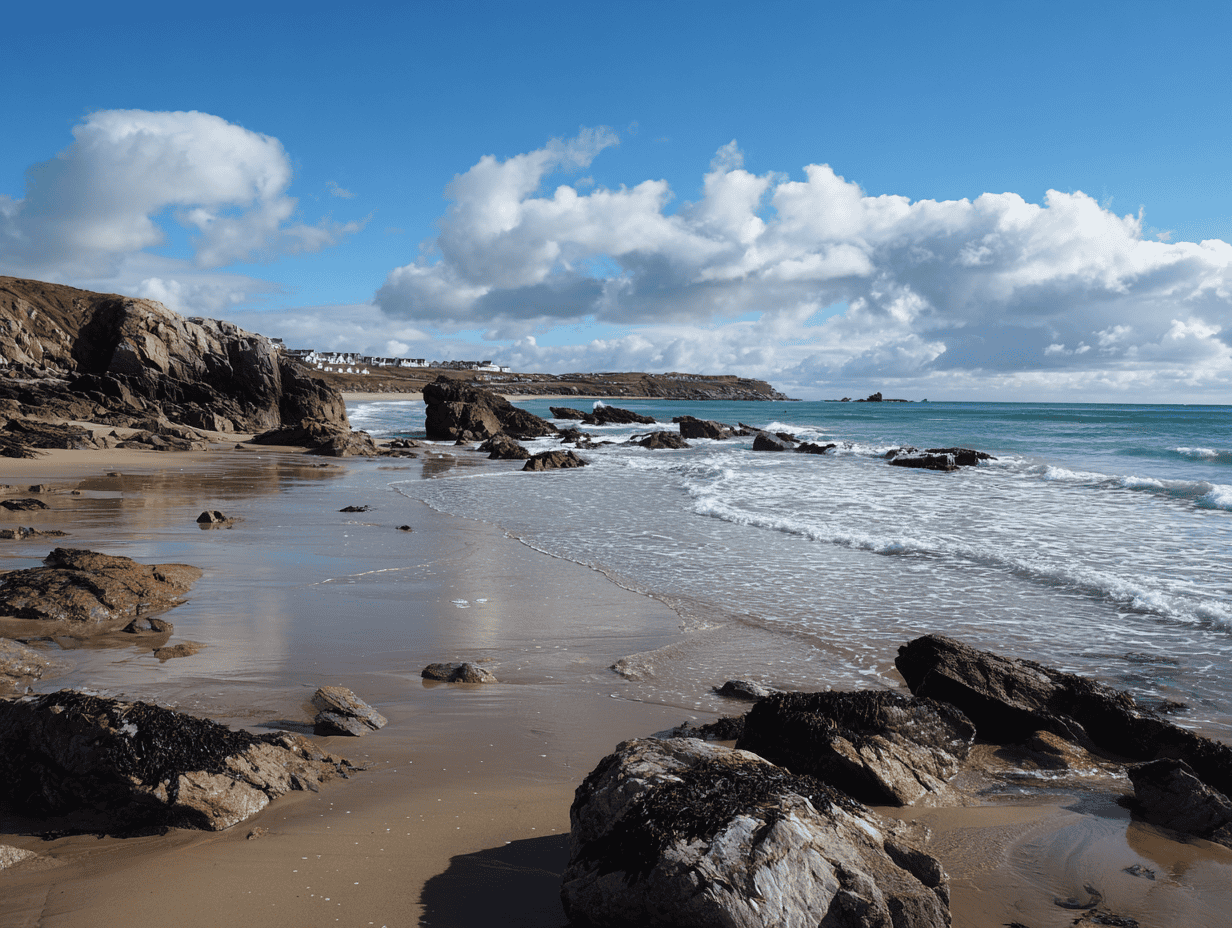
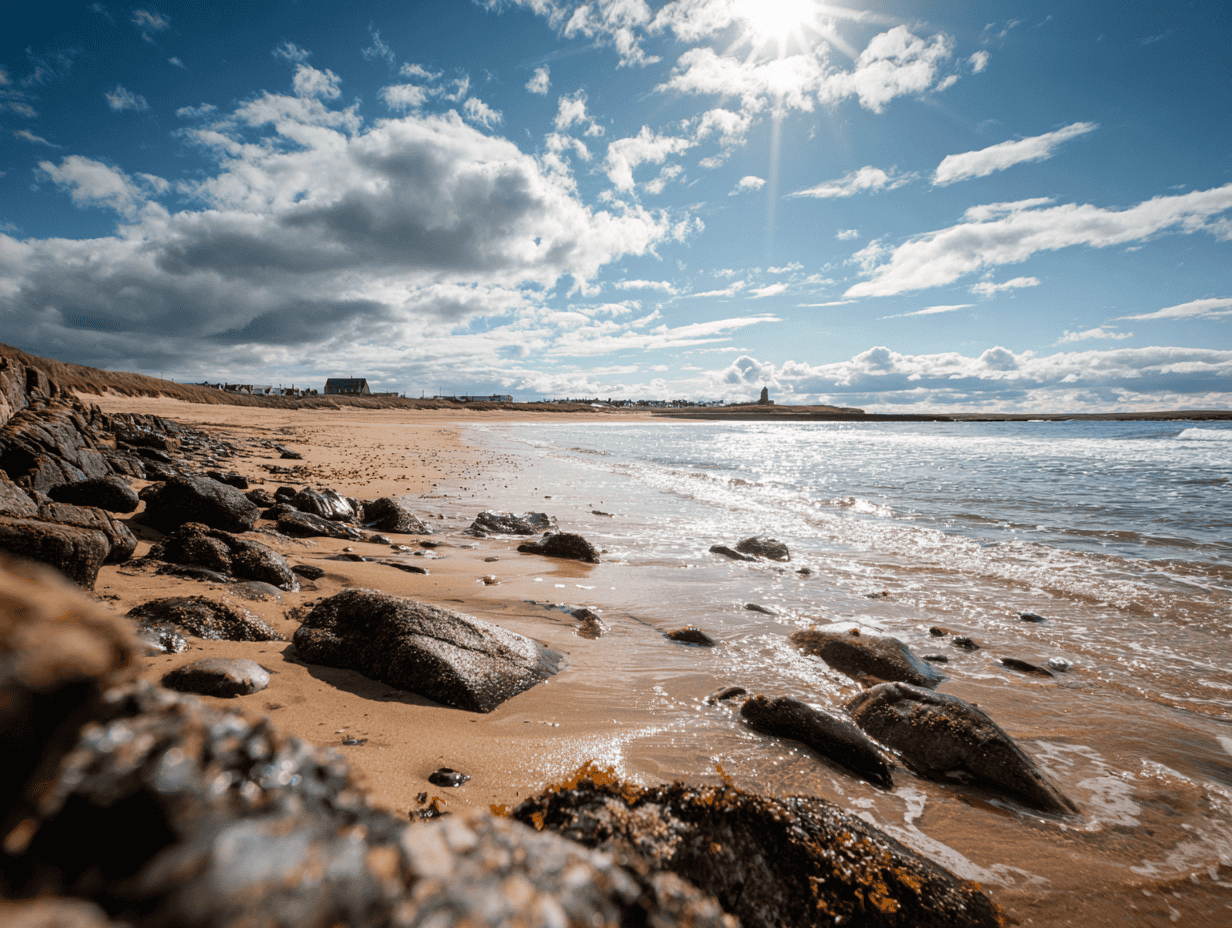
The beach runs roughly north-south for about two miles and is divided into sections by a series of wooden and stone groynes. Thirteen marked groynes line the main beach frontage. These are your friends. Each groyne bay catches and holds material that would otherwise wash along the shore, and the southern bays (closer to Footdee and the harbour) tend to be more productive for glass because they’re nearest to the historical source areas around the harbour and river mouths.
South end – Footdee to groyne 5: The most productive stretch. This is closest to the harbour and the River Dee outfall. Work the base of each groyne where material accumulates, and check the tideline carefully. Larger pebble and gravel deposits here give glass more places to hide, get down low, and look across the surface rather than straight down. This is also where the dog restriction applies during summer (groynes 5 to 13 are restricted May to September – see dog section), so out of season you can hunt the full length without interruption.
Mid-beach – groynes 5 to 9: Sandy and more open. Less glass than the south end, but worth a systematic walk of the strandline after storms.
North end – groynes 9 to 13 towards the Don mouth: Quieter and wilder as you head north towards the river. The Don brings additional material down from inland, and the beach gets rockier near the mouth. Worth exploring if you want space and solitude. The Donmouth Local Nature Reserve is at the northern end. Keep dogs on leads here as it’s a designated wildlife site.
Rock pools around Girdle Ness (south of the harbour): A bonus spot. The rocky headland at Girdle Ness, south of Footdee, has pockets in the rock that beautifully catch small pieces of glass. It’s a short extension to the main beach visit and is worth thirty minutes at low tide. Access via the coastal path.
Safety note: Aberdeen Beach is backed by a sea wall and promenade – it’s an accessible, safe stretch of coast. No dramatic cliffs or unstable ground. The water can be rough in winter storms, so stay well back from the waterline in heavy swells.
Key Tip
Start at the Footdee end of the beach and work each groyne bay individually. The southern groynes closest to the harbour and River Dee consistently produce more glass than the central sandy stretches, especially around the base of the groynes where material naturally accumulates.
Difficulty Level – Beginner
- Easy access along the entire promenade frontage
- Flat beach with straightforward walking
- Groynes create obvious hunting zones
- Large search area allows hunters to spread out
- Suitable for beginners and experienced hunters alike
Hunting Style – The Groyne Hopper
Aberdeen rewards hunters who move methodically from one groyne bay to the next. Search the strandline first, then inspect the gravel and pebble deposits gathered against each groyne. The most successful hunters treat each bay as a separate hunting ground, paying particular attention to the southern end near Footdee and the harbour.
Beach Personality
Aberdeen feels like a working coastal city with a surprisingly rewarding hunting beach. Fishing harbours, river mouths, historic Footdee and miles of open shoreline combine to create a beach that offers both variety and opportunity. While the central sands attract most visitors, sea glass hunters quickly discover that the real rewards lie amongst the groynes, where decades of tidal sorting have quietly concentrated treasures along the North Sea coast.
Dog friendly?
Partially, and the detail matters if you’re travelling with dogs.
Aberdeen Beach has a seasonal dog restriction between marked groynes 5 and 13 (the central section of the beach). This typically applies during the summer bathing season. Outside of those groynes and outside of the restriction season, dogs are welcome. The Footdee end of the beach (south of groyne 5) and the northern section towards the Don are generally accessible year-round.
The key rule: always check current restrictions with the Aberdeen City Council before your visit, as bylaws and seasonal orders can change. Dog fouling is taken seriously in Scotland. Fixed Penalty Notices are issued under the Dog Fouling (Scotland) Act. Bag it, always.
For a dog-friendly post-hunt café, Barking Mad at the Esplanade (AB24 5NS) is right on the beach and built entirely around dog owners. You can eat inside or outside with your dog, and the food is good. Café Ahoy on Beach Boulevard is another solid option and is part of a wider dog-friendly hospitality group.
Check our Yappy Places listing for Aberdeen for more dog-friendly spots near the beach, including options further into the city.
Practical information
Parking: The best option for sea glass hunters is Queens Links Leisure Park (AB24 5EN) – free parking with 847 spaces, located right on the beachfront. Queens Links manages it, but it’s open to all visitors. Beach Boulevard Retail Park (AB11 5QQ) offers up to four hours free for shoppers.
Pay-and-display street parking is also available along the Esplanade. Aberdeen City Council operates virtual parking meters (PayByPhone and RingGo) from August 2024 onwards. For early morning winter visits, the Queens Links car park is your easiest and cheapest starting point.
Toilets: Public toilets are available at the Esplanade near the Beach Ballroom end. Facilities are also available at Queens Links Leisure Park. Note that early morning winter visits may find facilities closed. Check before you go.
Food and drink: Barking Mad café (AB24 5NS) is right on the Esplanade and dog-friendly. The Pier café (also part of the same group) is on the beachfront and has outdoor seating with sea views. Café Ahoy on Beach Boulevard is a short walk from the beach. The food truck Roots operates year-round near the North Pier for vegan options.
Getting there without a car: Aberdeen has a mainline railway station well served by ScotRail, with direct connections from Edinburgh, Glasgow, Inverness and Dundee. The beach is about a 20-minute walk from Aberdeen station, or you can take bus routes 13 or 15 from the city centre, both of which run along Beach Boulevard. Note that since July 2022, the beach and Footdee are no longer on the 15 bus loop; check First Bus and Stagecoach for current timetables.
Accessibility: The Esplanade running behind the beach is fully accessible, flat, wide, and paved for its entire length. The beach itself involves crossing soft sand to reach the waterline, which is harder going in a wheelchair or with a pushchair, but manageable. The south end at Footdee involves some steps down from the promenade. Queens Links car park has 29 dedicated disabled parking bays.
What to bring
- Waterproof boots or wellies – Aberdeen is sandy rather than pebbly, but the North Sea wind is real, and it can be wet underfoot after storms
- A small container or zip-lock bags for your finds – the esplanade is a long walk back to the car if you’re juggling glass loose in a pocket
- A hand trowel or small garden rake for working through groyne bay deposits
- Warm, wind-proof layers – Aberdeen is exposed, and the haar (North Sea sea fog) rolls in fast and cold even in summer
- A fully charged phone – tide times and the Sea Glass Score widget work well on mobile
- Dog lead and bags – required for parts of the beach and the nature reserve at the north end
The history behind the glass
Aberdeen’s glass story doesn’t have a single dramatic origin like Seaham’s bottleworks, but that’s almost what makes it more interesting. This is a city that has been pouring its history into the North Sea for most of a thousand years.
Aberdeen Harbour is one of the oldest working ports in Britain, with records going back to 1136 when David I established the settlement at the mouth of the Dee. By the 16th century, it was one of Scotland’s most important trading ports, handling fish, wool, granite, and goods from across the Baltic and North Atlantic trade routes. With all that shipping activity came the inevitable accumulation of broken cargo, discarded bottles, and the debris of centuries of maritime trade, much of it washing out from the harbour into Aberdeen Bay.
The city’s industrial character added more. By the time Aberdeen reached full industrial capacity in the late Victorian and Edwardian era, breweries, distilleries, fish processing operations, and general industry were concentrated in a city that drained directly into the sea.
Aberdeen had 157 breweries recorded in 1509; by 1890, that had consolidated into eight large operations, with three distilleries alongside them. Centuries of glass from bottles, jars, and industrial waste have been slowly migrating north from the harbour, tumbled by the same North Sea swells that buffeted the trawlers heading out past Girdle Ness.
The two rivers complete the picture. The Dee enters the sea at the harbour, the Don about two miles north. Both carry material down from the Aberdeenshire interior; the Don, in particular, has a long industrial catchment and deposits it into the bay, where the tidal circulation distributes it along the beach. The groynes, installed to combat the significant sand erosion that has plagued Aberdeen Beach for over a century, act as unintentional glass traps, concentrating what the sea brings in.
Every piece you find here has passed through the North Sea’s hands for decades, maybe longer. Some of it arrived on ships from the Baltic. Some of it was bottled in Aberdeen, drunk in Aberdeen, and ended up back on Aberdeen’s shore. It’s a genuinely layered place.
From beach to jewellery
Found something worth keeping at Aberdeen? At Mermaid Tears, every piece of seaglass jewellery starts exactly as yours did, hand-hunted from UK beaches and made into something you’ll wear for years. Browse the collection.
Disclaimer: Tide times, dog restrictions, parking charges and beach conditions change regularly and should always be verified before your visit. Dog bylaws, in particular, are reviewed seasonally – always check the current rules with Aberdeen City Council before travelling with your dog. This post is a guide only, and the author accepts no liability for changes to access, facilities or conditions after the date of publication.
Last updated: Aug 2026
Frequently asked questions
Is Aberdeen Beach good for sea glass hunting? It’s a solid Good-rated beach with reliable finds if you time your visit around low tide, especially after North Sea storms in autumn and winter. Don’t expect Seaham volumes, but the glass is well-tumbled, and the setting makes it a genuinely enjoyable hunt. The groyne bays near Footdee are your best starting point.
Where exactly on Aberdeen Beach should I look for sea glass? Start at the Footdee end, south of groyne 5. Work each groyne bay systematically at low tide, checking where pebble and gravel deposits have built up against the groyne structures. The tidal strandline after a storm is also worth walking carefully. For something different, the rocky outcrops at Girdle Ness south of the harbour are worth thirty minutes at low water.
Are dogs allowed on Aberdeen Beach? Partially. There is a seasonal restriction between groynes 5 and 13 during the summer bathing season. The Footdee end (south of groyne 5) and the northern section near the River Don are generally accessible for dogs year-round, but always check current rules with Aberdeen City Council before visiting, as restrictions can change.
What is the best time of year to hunt sea glass at Aberdeen? Winter (October to March) is the prime season. North Sea storms replenish the beach, and the crowds disappear. A visit 24 to 48 hours after significant wave action is the sweet spot. Spring tides around new and full moon also expose more beach and concentrate fresh material in the groyne bays.
What colours of sea glass can I find at Aberdeen Beach? Green, brown and white are the most common finds. Aqua and pale blue turn up with some regularity, particularly near the harbour end. Cobalt blue, red, deep purple and orange are genuinely rare, but the mix of historical sources, harbour trade, brewing, and fishing industry means you occasionally land something unexpected.
Can I visit Aberdeen Beach as a day trip from further south? Aberdeen is on the main East Coast Main Line with direct trains from Edinburgh (around 2.5 hours) and connections from further south. It works as a longer day trip, but if you’re travelling from England specifically for the glass, it’s worth pairing it with Balmedie Beach to the north or a stop in Stonehaven to the south to make the journey count.
More Scottish Beaches
Check out our Full East Scottish Guide or plan your trip with our Interactive Sea Glass Map.