The South East’s Estuary Secret
Minster Leas is a good beginner-friendly sea glass hunting beach, especially around the groynes and upper shingle strandline on the Isle of Sheppey. White, pale green, and pale aqua are the most common finds, with blue, amber, and turquoise appearing occasionally, and cobalt blue, black, lavender, red, pink, and orange among the rarer colours reported. It’s an easy, methodical hunt where working each groyne bay carefully is more useful than simply walking the shoreline.
- Rating: Good Beach
- Terrain: Easy
- Level: Beginner
- Dog friendly: Seasonal – dogs banned from the main beach section 1 May–30 September; leads required on the promenade
- Location: Minster-on-Sea, Isle of Sheppey, Kent
- Sat Nav: ME12 2NL (main car park) · ME12 2LT (Shingle Bank end)
- Common colours: White, pale green, pale aqua
- Rare colours: Cobalt Blue, Black, Lavender, Red, “Sheppey Blue”, Pink, Orange, Grey
Today’s at Minster Leas
Below is the score and tide times for Minster Leas; scroll down for the full 7-day forecast
Minster Leas sea glass conditions
Minster Leas
Kent
44/100 — Limited, best window 15:45–18:45.
Best window is 15:45–18:45 with spring tides (near full/new moon) and calm sea, so the chance of fresh finds is limited today. Sea is likely calm and picked-over — go early.
Limited — better days ahead here
Ranked #89 in the UK ShoreSense leaderboard today.
| Tide | Time | Height |
|---|---|---|
| Low water | 04:40 | 1.3 m |
| High water | 10:52 | 5.5 m |
| Low water | 17:15 | 0.9 m |
| High water | 23:24 | 5.7 m |
Best For:
- Beginners
- Groyne hunting
- Shingle beach searching
- Dog walkers
- Quick hunting sessions
- Learning sea glass spotting skills
- Strandline hunting
- Less crowded searches
Why Minster Leas is worth the drive
The South East of England doesn’t have a great reputation for sea glass. Kent is famous for many things: the White Cliffs, the Cinque Ports, hopfields, Whitstable oysters, but sea glass hunting isn’t usually on the list. This makes Minster Leas one of the better-kept secrets on the English coastline.
The Isle of Sheppey sits in the Thames Estuary at the mouth of the Medway, separated from the rest of Kent by a narrow arm of the sea called the Swale. It’s an island that most people drive past on the way somewhere else, if they notice it at all. That’s a shame, because the beach at Minster Leas, facing north across the estuary towards Essex, is a genuinely productive sea glass location, and one that delivers finds you simply won’t see elsewhere in the South East.
The estuary’s dynamics are what make it work. The Thames has been one of the world’s great waterways for two thousand years. About 200 shipwrecks have been recorded around Sheppey’s coast. The Royal Navy was here for centuries. Samuel Pepys helped establish the Royal Navy Dockyard at Sheerness in the 1600s, and the dockyard served the Royal Navy until 1960. Victorian London’s commercial traffic, Napoleonic-era warships, Second World War naval operations- all of it has left material in the estuary, and the tides have been returning it to this shingle beach ever since.
Minster Leas won’t deliver the hauls of Seaham or Boulmer. This is the South East, not the North East, and expectations should be calibrated accordingly. But what it does produce has character, estuary-tumbled glass with distinctive colours, including the locally prized Sheppey Blue. And the beach itself, backed by a wide grassy bank with views across the estuary to Essex, is a genuinely pleasant place to spend a morning.
What you’ll find here
Colours commonly found: White, pale green, pale aqua/seafoam
Occasional finds: Blue, Aqua, Amber, Turquoise
Rare finds: Cobalt Blue, Black, Lavender, Red, Orange, Pink, Grey
Bonus: The “Sheppey Blue” – a distinctive pale blue-green colour specific to this estuary location that local collectors seek out specifically. Also worth looking for: older bottle glass with embossed lettering from Victorian manufacturers, and the occasional pottery shard from the estuary trade.
Find something special? Use our sea glass scanner, GlassLore, to find out rarity, value and history; then you can share to our finds gallery and, more importantly, earn points to climb our hunters leaderboard – are you ready to compete?
When to go
Minster Leas sits on the north coast of the Isle of Sheppey, facing across the Thames Estuary, so it responds to different conditions than the open-sea beaches further north. Northerly and northeasterly winds push estuary water onto this shore and are the best storm conditions. A period of settled weather followed by a sharp north wind and a high spring tide is the classic Minster combination.
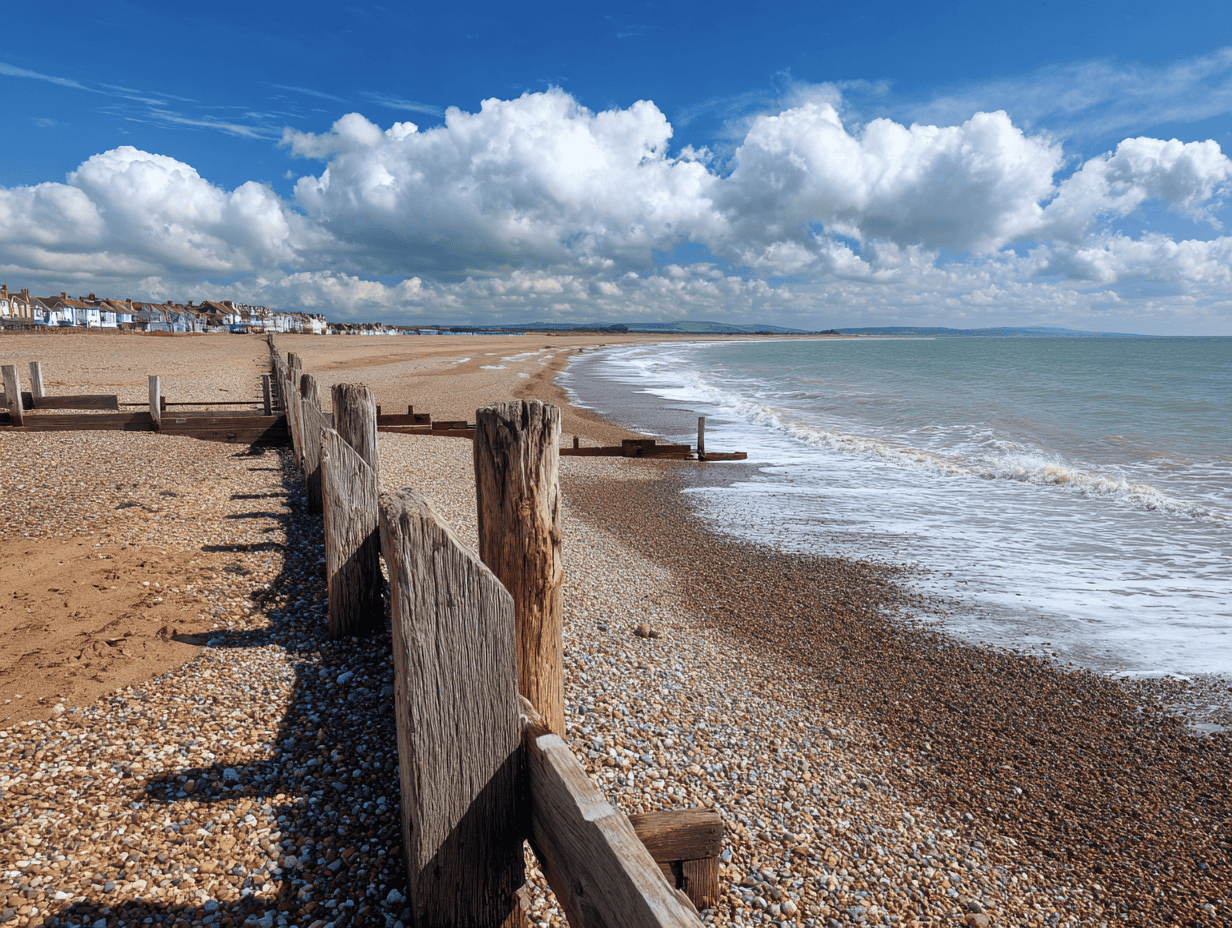
Low tide exposes the widest section of shingle and sand, including the groyne bases where glass accumulates. The groynes at Minster are a key feature; glass gets trapped in the shingle between them and builds up between big tides. Work each groyne bay methodically on an ebbing tide.
Autumn and winter are quieter on the beach, and conditions are more consistently productive. The summer dog restriction makes an early autumn visit – mid-September onwards- ideal: the restriction lifts, the beach is emptier, and the estuary weather picks up.
Today’s ShoreSense Score & Best Hunting Window
Minster Leas sits on the north coast of the Isle of Sheppey. The long sand and shingle beach slopes gently, flattening into a wide expanse of sand, shingle, and mud exposed when the tide retreats. The tidal range in the Thames Estuary here is around 4–5 metres on a spring tide, significant enough to expose a generous strip of new foreshore. The estuary tidal pattern is semi-diurnal but can be influenced by North Sea surge, which occasionally pushes water levels higher than predicted.
As the tide falls, start on the upper strandline around the main Minster Leas groynes, checking both sides of each timber structure where weed, shells and coarser shingle collect. As more foreshore opens, work down towards the groyne bases and the lower pebble bands rather than wandering across the wide exposed sand and mud. Then continue west towards the Shingle Bank, where there is less casual foot traffic and more groyne-edge shingle to search.
Bigger spring lows expose a much wider strip of this gently shelving estuary foreshore. After stronger northerly or north-easterly conditions begin to settle, recheck the groyne pockets and high strandline. Use today’s ShoreSense Best Window to choose when to arrive, then follow this strandline → groyne-bay → lower-shingle → Shingle Bank progression once you’re there.
The ShoreSense widget below combines recent marine conditions, tide timing and practical hunting weather to show today’s overall ShoreSense Score, Hunting Potential, Comfort and the best available hunting window for this beach. It uses UKHO tide data alongside current marine and weather inputs to help you judge whether conditions look promising for a hunt.
Minster Leas sea glass conditions
Minster Leas
Kent
44/100 — Limited, best window 15:45–18:45.
Best window is 15:45–18:45 with spring tides (near full/new moon) and calm sea, so the chance of fresh finds is limited today. Sea is likely calm and picked-over — go early.
Limited — better days ahead here
Ranked #89 in the UK ShoreSense leaderboard today.
| Tide | Time | Height |
|---|---|---|
| Low water | 04:40 | 1.3 m |
| High water | 10:52 | 5.5 m |
| Low water | 17:15 | 0.9 m |
| High water | 23:24 | 5.7 m |
Compare your Beaches on our Hot Beaches page, updated daily with the best beaches for today, the next seven days, as well as the movers and shakers.
Where to look on the beach
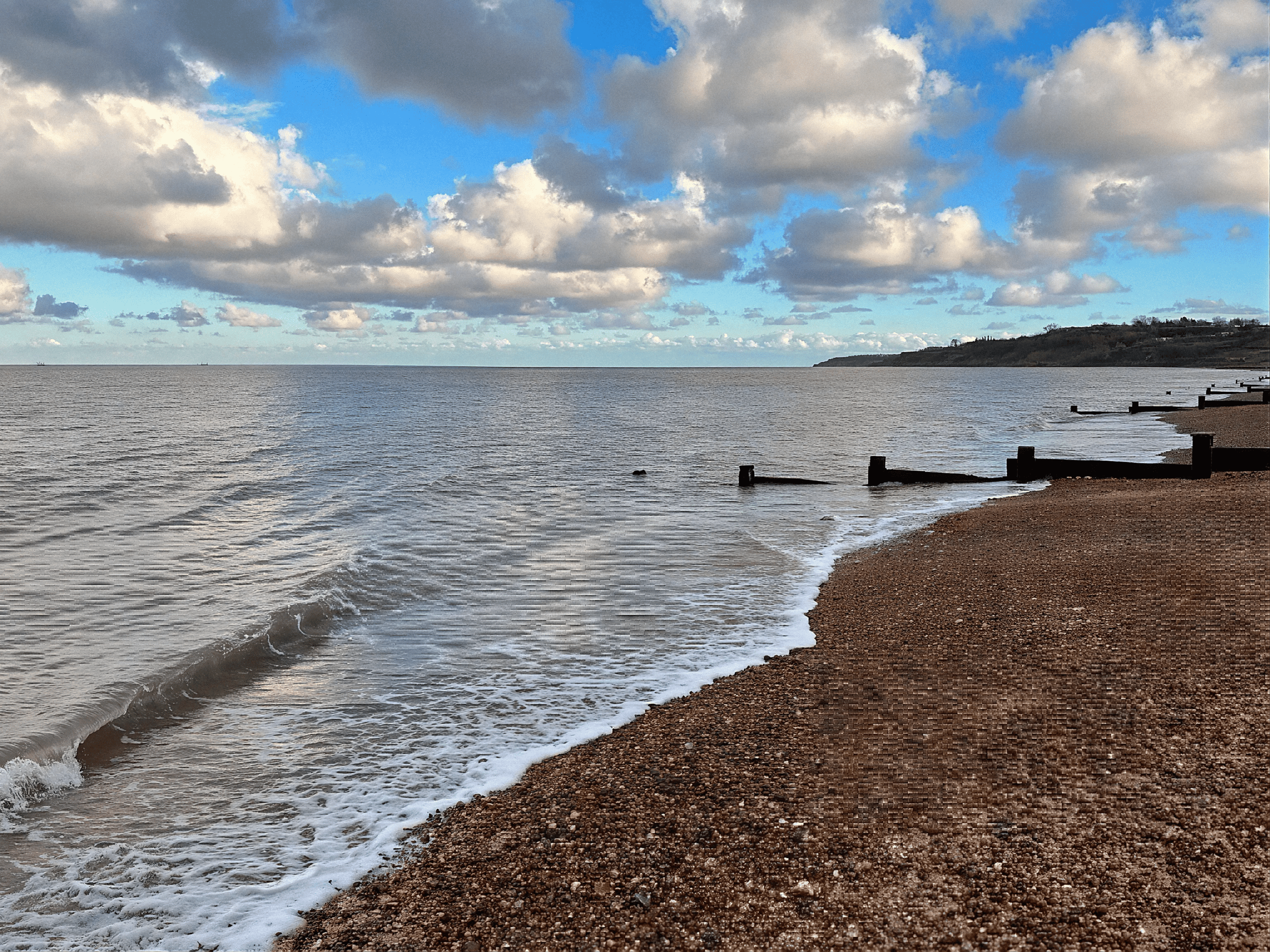
Minster Leas is a long shingle beach with several groynes extending into the sea. At low tide, a good expanse of sand and mud is revealed. The groynes are your friends. Glass collects in the pebble banks on either side, trapped by the timber structure. Work your way methodically from groyne to groyne rather than walking in a straight line.
The upper strandline (the high-water mark, identifiable by the line of weed and debris) is where glass concentrates after a tidal cycle. Crouch down, get your eye low, and scan rather than pick. Frosted glass catches light differently from wet pebbles; it has a slight dullness, a milkiness, that stands out once you’ve trained your eye.
The Shingle Bank section to the west of the main beach (used by windsurfers and paddleboarders) sees less foot traffic from casual visitors and is worth investigating, particularly around the groynes at its edges. There’s no dog ban on the Shingle Bank, which is useful in summer.
Safety note: The cliffs between Minster Leas and Warden Bay are subject to erosion and rock falls. Take care when walking along the exposed coast in the vicinity of the cliffs from Minster Leas around to Warden Bay. Stick to the accessible beach sections and watch the tide if you venture further east.
Key Tip
Don’t walk past the groynes. Search both sides of every one, paying particular attention to the upper strandline where weed, shells and debris have collected. These natural traps often hold the best concentration of sea glass after a tidal cycle.
Difficulty Level: Beginner
- Easy access along a long, open stretch of beach
- Productive hunting areas are easy to identify around the groynes
- No scrambling or difficult terrain required
- Glass often becomes trapped in predictable locations
- Ideal for learning how tides, strandlines and beach structures influence where sea glass settles
Hunting Style: The Hotspot Hopper
Rather than searching one continuous stretch of beach, move systematically from groyne to groyne. Each timber barrier creates its own collection zone where glass, pebbles and other material accumulate. Success comes from checking each hotspot carefully before moving on to the next.
Dog friendly?
Yes, but with meaningful seasonal restrictions that you need to know before you arrive.
Dogs are banned from 1 May to 30 September from the beach between the east side of the Playa Public House and the vehicle ramp opposite the Little Oyster Café, which is roughly the main bathing section. Dogs must also be on a lead on the promenade between the same dates. Swale Borough Council enforces this with £100 fixed penalty notices, reduced to £75 if you pay within 10 days, and up to £1,000 if it goes to court. Thirteen notices were issued across Sheppey over two recent summers, so the patrols are real.
One detail that helps: the council’s order specifically excludes the wide grass expanse between the concrete promenade and the main road. You can walk your dog across the grass all year. It’s the restricted stretch of sand that’s off-limits.
Outside those dates, or at the Shingle Bank end of the beach, you’re fine, and the Shingle Bank is good hunting ground anyway. If you’re visiting between May and September with a dog, head there.
The Playa Public House on the Leas is dog-friendly, with a reserved area and a dog menu handy for a post-hunt stop. Check our Yappy Places listing for Minster-on-Sea for the full run-down of dog-friendly spots on the island.
Practical information
Parking: There is a free 50-space car park at the end of The Leas road (ME12 2NL), with additional free road parking along The Leas itself. A second car park is around 200 metres away (ME12 2LT). Parking is free, unusual, and welcome.
Toilets: Public toilets are available just down from the junction of The Leas and The Broadway, and also just off the promenade at the junction of The Leas with Seaside Avenue.
Food and drink: Near the car park is the Little Oyster Café, selling light snacks and drinks at weekends and between 11 am and 5 pm during peak times. Halfway along the beach is the Playa Public House, which serves meals and light snacks. The Sweet Hut, in the former Lifeguard hut on the promenade, sells drinks and sweets.
Getting there without a car: The nearest railway station is Sheerness-on-Sea, about three miles from the beach. The number 367 bus stops near the beach, with stops at either end of The Leas. Trains run from London Victoria and St Pancras, with a change en route, allowing around 90 minutes from central London.
Accessibility: A wide concrete promenade runs the length of the beach for pedestrians and cyclists, with access steps and ramps at regular intervals. The promenade is flat and well-maintained, making the beach reasonably accessible. Note that the beach surface itself is shingle, which is harder going for wheelchairs.
What to bring
- Wellies or sturdy trainers – shingle is rough on footwear, and the beach surface shifts
- A small tub or zip-lock bag for your finds. Glass goes cloudy when it dries, so keep pieces damp until you get home
- Layers -the estuary is exposed, and the wind off the Thames can be bitter even in spring
- A hand rake or garden trowel to turn pebbles around the groynes
- Binoculars if you fancy a look at the shipping traffic – the estuary never stops moving
The history behind the glass
The Thames Estuary has been busy for two thousand years, and Sheppey has been at the centre of that business for most of it. The island has a history stretching from the Bronze Age through the Iron Age and Romans, and around 675 AD, the Anglo-Saxon queen Seaxburga founded a monastery at Minster. Queenborough reached its height of prosperity in Elizabeth I’s reign, when the town was a major wool shipping port with connections to Sir Francis Drake and Admiral Lord Nelson.
The naval history is what matters most for the glass. Samuel Pepys helped establish the Royal Navy Dockyard at Sheerness in the 1600s, and the dockyard served the Royal Navy continuously until 1960. Three centuries of naval provisioning, repair, victualling and waste disposal into the Thames, every ship that passed through Sheerness Roads contributed to the estuary’s glass inventory. Queenborough was also home to hundreds of minesweeping vessels during the Second World War, and the wartime naval traffic in and out of the Medway was extraordinary in scale.
About 200 shipwrecks have been recorded around Sheppey’s coast. Every one of them carried glass, medicines, provisions, spirits, and stores, which are now part of the estuary bed and periodically make their way onto the shingle at Minster Leas. Victorian London’s commercial traffic moved constantly through these waters too: coal, timber, cement, groceries, and manufactured goods. The glass that contained it all has been tumbling in the estuary ever since.
What washes up at Minster Leas is the accumulated legacy of all of it: centuries of London commerce, Royal Navy provisioning, Victorian household life, and the churning of the Thames Estuary through shingle and time. Every piece you pick up here has been on quite a journey.
Disclaimer: Tide times, dog restrictions, parking availability and beach conditions change regularly. Always verify before visiting. Dog PSPOs at Minster Leas are enforced with £100 Fixed Penalty Notices. Check the current Swale Borough Council website for the precise boundaries and current rules before visiting with a dog. Beach information was accurate at the time of publication, but is provided as a guide only.
Swale Borough Council reviews these orders every three years, and a review was under way in autumn 2026, so check swale.gov.uk before travelling with a dog.
Last updated: September 2026
Dog rules checked: September 2026 – Swale Borough Council (review in progress)
From beach to jewellery
Found a piece at Minster you’d love to see turned into something lasting? At Mermaid Tears, every piece of jewellery starts exactly where you’ve been standing, hand-hunted from UK beaches, handmade into something you’ll wear forever. Browse the collection.
Frequently asked questions
Is Minster Leas good for sea glass hunting? Yes, and it’s one of the better options in the South East. The volume won’t match the North East’s industrial beaches, but the estuary location and the groyne structure make it a reliable, beginner-friendly hunt. Manage expectations, and you’ll be pleasantly surprised.
What colours of sea glass can I find at Minster Leas? White, soft green and pale aqua are the most common finds. Occasional cobalt blue and purple do turn up. The most exciting local rarity is the “Sheppey Blue”, a distinctive colour found only on the Isle of Sheppey that locals seek out specifically.
Are dogs allowed on Minster Leas beach? Yes, outside the seasonal restriction period. Between 1 May and 30 September, dogs are banned from the main bathing section (roughly between the Playa pub and the Little Oyster Café vehicle ramp) and must be kept on a lead on the promenade during the same period. The Shingle Bank section has no ban. Outside those dates, dogs are welcome on the full beach.
When is the best time to visit Minster Leas for sea glass? Autumn and winter, on a falling tide, ideally a day or two after stormy estuary weather. Spring tides around the new and full moons expose more of the beach. Early morning, before the promenade gets busy.
Is there free parking at Minster Leas beach? Yes, both the main car park (ME12 2NL) and the second car park (ME12 2LT) are free of charge. There is also free on-street parking along The Leas Road itself.
How do I get to Minster Leas by public transport? Take the train to Sheerness-on-Sea (from London Victoria or St Pancras, with a change) and then the number 367 bus, which stops at both ends of The Leas. The whole journey from central London takes around 90 minutes.
More Beaches
Check out the Full Kent and Sussex Guide or plan your trip with our Sea Glass Map