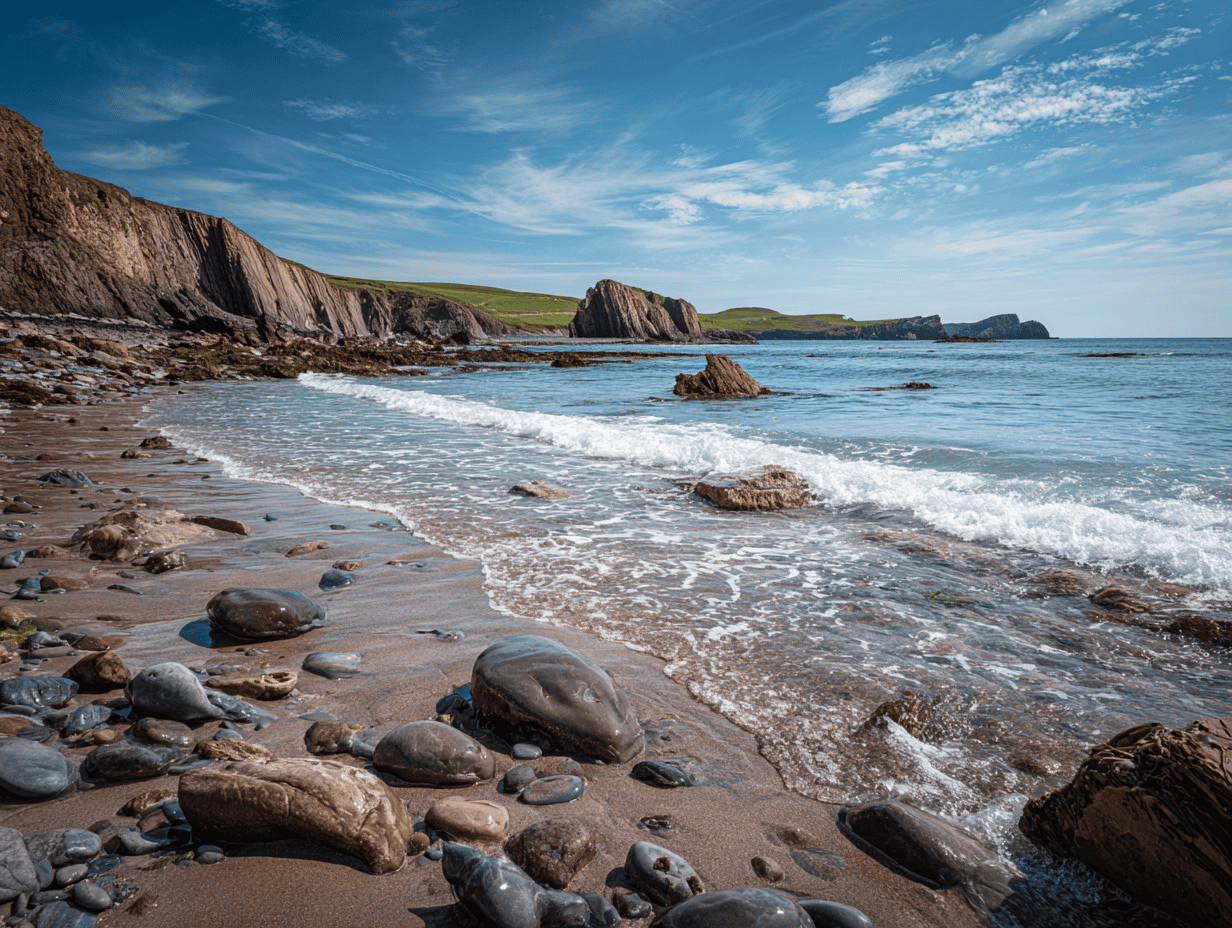
Where Lead Ore and the Celtic Sea Left Their Mark
Aberystwyth is a fair sea glass hunting destination, with the best ground around the castle headland, Harbour Beach and the rockier margins of North Beach. Green, brown, and white are the most common finds, with blue, aqua, amber, and turquoise appearing occasionally, and cobalt blue, black, lavender, and red among the rarer colours reported. The broad promenade beaches are less useful than the shingle, pebble and rock pockets around the harbour and headlands.
Where to hunt: Castle Headland shingle → Harbour Beach → Bath Rocks/pier margins → Tanybwlch
- Rating: Fair Beach
- Terrain: Easy
- Level: Beginner
- Dog friendly: Seasonal (dogs banned on North Beach and South Beach main sections 1 May–30 September; Harbour Beach section between slipway and harbour, and Tanybwlch Beach, unrestricted all year)
- Location: Aberystwyth, Ceredigion, Mid Wales
- Sat Nav: SY23 1JX (South Beach)
- Common colours: Green, brown, white
- Rare colours: Blue, Turquoise, Amber
Today at Aberystwyth Beach
Check below for the latest ShoreSense Score and tide times. Scroll down for your full 7-day forecast
Aberystwyth Beach sea glass conditions
Aberystwyth Beach
Wales — Sea settling
67/100 — Good, best window 13:43–16:43.
Best window is 13:43–16:43 with spring tides (near full/new moon) and building SW swell, so the chance of fresh finds is good today.
Good window, though this beach is hit-and-miss
Ranked #28 in the UK ShoreSense leaderboard today.
| Tide | Time | Height |
|---|---|---|
| Low water | 02:53 | 0.5 m |
| High water | 08:05 | 5.1 m |
| Low water | 15:13 | 0.6 m |
| High water | 20:26 | 5.2 m |
Best For
- Harbour and shingle hunting
- Post-storm hunting
- Maritime history
- Beach by train
- Year-round dog access at Harbour Beach and Tanybwlch
- Dolphin spotting
Why Aberystwyth- a lead port’s slow deposit on Cardigan Bay
Aberystwyth is the kind of town that surprises you. The university gives it energy that most Welsh coastal towns of its size don’t have. The mile-long Edwardian promenade, the pier, the cliff railway climbing Constitution Hill, the castle ruins on the headland- it has the full set of Victorian seaside credentials.
And tucked behind all of that is a harbour history that most visitors never think about, and which explains why the shingle sections of these beaches produce occasional glass finds that reward a careful look.
The key hunting ground isn’t the main promenade beach. It’s the shingle and dark sand sections around the castle headland, the harbour mouth, and the smaller Harbour Beach sheltered between the breakwater and the marina. That sheltered position is exactly what concentrates glass, and the harbour beside it was once one of the most active mineral export ports on the west coast of Wales.
That sheltered position is exactly what concentrates glass, and the harbour beside it was once one of the most active mineral export ports on the west coast of Wales.
Aberystwyth is an honest Fair Beach. The main beaches are predominantly sand and shingle, managed and busy in season. But the harbour area and the South Beach section near the castle headland produce genuine finds for the patient hunter, and the glass origin story behind them is one of the richest on Cardigan Bay: lead ore exports, a fleet of sixty herring boats, 242 ships built in the town, and a port that once registered nearly 300 vessels. Combine it with the cliff railway, the castle and a decent lunch, and it makes a genuinely good day out even if the bag stays light.
What you’ll find here
Colours commonly found: Green, brown, white
Occasional finds: Blue, Aqua, Amber, Turquoise
Rare finds: Cobalt Blue, Black, Lavender, Red
Bonus: Sea pottery, Victorian ceramic shards near the castle headland, smooth dark pebbles polished by Cardigan Bay swell, occasional dolphin and porpoise sightings offshore
Find something special? Use our sea glass scanner, GlassLore, to find out rarity, value and history; then you can share to our finds gallery and, more importantly, earn points to climb our hunters leaderboard – are you ready to compete?
When to go
South Beach and the harbour area reward a low-tide visit. The shingle sections near the castle headland and the harbour mouth open up properly as the tide retreats; the dark sand and pebble substrate at the castle end concentrates glass in a way the main promenade beach doesn’t. Give yourself the two hours either side of low water and work the South Beach castle end first, then the Harbour Beach shingle.
Semi-polished multicoloured pebbles can be found under the pier and below Constitution Hill, though care should be taken as there are strong undercurrents in these areas. The Pier end of North Beach has interesting substrate at its margins, rock platforms, and pebble patches that hold material between tides.
Westerly and northwesterly weather is onshore at Aberystwyth, Cardigan Bay faces west into the Irish Sea and the swell that comes in after Atlantic weather sorts the foreshore effectively. Post-storm visits are the most productive. The day after a significant westerly blow, the strandlines on both beaches are freshly worked.
Winter is better than summer for all the usual reasons. The dog restrictions are off, the beaches are quieter, and the harbour area is accessible. The Cardigan Bay bottlenose dolphins are sometimes visible from the South Beach breakwater end in autumn, one of the better bonuses of an off-season Aberystwyth visit.
Today’s ShoreSense Score & Best Hunting Window
Aberystwyth sits in the centre of Cardigan Bay facing west into the Irish Sea, with a spring tidal range of around 4 metres, the most modest tidal range of any beach in this Wales guide. The range is limited by the bay’s geography, but it’s still enough to expose the shingle sections around the castle headland and the harbour mouth that are the productive hunting areas. The west-facing aspect means the Atlantic westerly swell is onshore, which sorts and refreshes the foreshore.
Start at the castle end of South Beach and work the shingle and pebble pockets where the headland meets the beach. As more ground opens, move south to Harbour Beach and check the shingle around the harbour margins, then give the pier-side rock platforms and Bath Rocks a look if conditions allow. If you want a longer second hunt, finish at Tanybwlch south of the harbour. Use today’s ShoreSense Best Window to choose when to arrive, then follow this castle → harbour → Bath Rocks → Tanybwlch progression once you’re there.
The ShoreSense widget below combines recent marine conditions, tide timing and practical hunting weather to show today’s overall ShoreSense Score, Hunting Potential, Comfort and the best available hunting window for Aberystwyth. It uses UKHO tide data alongside current marine and weather inputs to help you judge whether conditions look promising for a hunt.
Aberystwyth Beach sea glass conditions
Aberystwyth Beach
Wales — Sea settling
67/100 — Good, best window 13:43–16:43.
Best window is 13:43–16:43 with spring tides (near full/new moon) and building SW swell, so the chance of fresh finds is good today.
Good window, though this beach is hit-and-miss
Ranked #28 in the UK ShoreSense leaderboard today.
| Tide | Time | Height |
|---|---|---|
| Low water | 02:53 | 0.5 m |
| High water | 08:05 | 5.1 m |
| Low water | 15:13 | 0.6 m |
| High water | 20:26 | 5.2 m |
Compare your Beaches on our Hot Beaches page, updated daily with the best beaches for today, the next seven days, as well as the movers and shakers.
Where to look on the beach
South Beach castle headland end is the most productive section of Aberystwyth’s beaches for glass. South Beach is a gently sloping sand and shingle beach sandwiched between the castle headland and the harbour breakwater. The northern end nearest the castle is the rocky, shingly section. Work this area carefully at low tide, checking the pebble pockets and rock margins where the castle cliff meets the beach. The transition from sand to shingle is where material concentrates.
Harbour Beach – the small shingle strip between the harbour walls and the marina entrance is your second stop. Harbour Beach is sheltered by the harbour and sea wall, with the River Afon Rheidol entering the sea nearby. Sheltered beaches accumulate material rather than losing it; centuries of harbour activity above this small strip of shingle means older, more varied glass is possible here. Work slowly along the shingle band and check the pebble pockets at the base of the harbour walls.
North Beach – pier and Bath Rocks end: the rocky platforms at the pier end of North Beach and around Bath Rocks are worth checking at low tide. The beach is made of dark sand and pebbles, backed by rocks and a stone sea wall, framed by the rocky platforms of the Pier and Bath Rocks. Rock pool margins here can hold pieces that have rolled in from the bay.
Tanybwlch Beach – a large pebbled beach south of the harbour, overlooked by the Pen Dinas hillfort. Dogs are welcome here all year. The shingle substrate is right, and it’s less visited than the main beaches, worth a look if you are extending the visit south of the harbour, particularly in the lower section nearest the water.
Key Tip
Skip the main promenade beach entirely. Work the shingle at the castle headland end of South Beach at low tide, then move to the Harbour Beach strip between the harbour walls and the marina. Those two sheltered pockets hold what the open sand doesn’t.
Dog friendly?
Dogs: Seasonal restrictions apply from 1 May to 30 September. On North Beach, dogs are excluded between the north side of the landing stage and Constitution Hill. On South Beach, they are excluded between the Castle Headland and the first groyne at the end of South Marine Terrace. Other sections remain available, and Tanybwlch is a useful year-round option. Dogs must be kept on leads along the main promenades.
In practice, the Harbour Beach section and Tanybwlch are accessible to your dog all year round, and those are the most productive hunting areas anyway. The castle headland end of South Beach and North Beach are restricted in summer, but by October, they are fully open again. Dogs must be kept on leads on the promenade and main streets in Aberystwyth year-round.
For a post-hunt stop with a dog, Aberystwyth has a good range of dog-friendly options. The town’s independent café scene is strong, and several harbour-area options offer dog-friendly outdoor seating.
Check our Yappy Places listing for Aberystwyth for current recommendations.
Practical information
Parking: Ceredigion County Council runs several car parks within walking distance of the beaches, including Maesyrafon (SY23 1PL), Park Avenue (SY23 1PG) and New Promenade (SY23 1JU). The standard tariff is £4 for two hours, £5 for four and £7 for 24 hours, charged daily from 8am to 6pm. On-street parking along the promenade between Castle Point and Constitution Hill is now also charged, following a scheme introduced in 2025; Blue Badge holders are exempt from charges and time limits there. Parking close to the beach is limited and fills quickly in summer, so the park and ride on the outskirts near the Rheidol Steam Railway station is worth using at peak times.
Public toilets: are available around the promenade and harbour area, with further facilities in Aberystwyth town centre. Check current opening hours before relying on them outside the main season.
Food and drink: Aberystwyth has a strong independent food scene for a town of its size, driven partly by the university population. The harbour and South Parade area have cafés with views over the bay. The town centre has a full range of pubs, cafés and restaurants within a short walk of the beach. The Glengower Hotel on Victoria Terrace is a reliable dog-friendly option with sea views.
Accessibility: North Beach promenade is flat and paved, and South Beach has access via a concrete slipway from South Marine Terrace. The actual sea-glass hunting areas around the castle headland, harbour shingle and Bath Rocks are uneven and much less suitable for wheelchairs or mobility aids. Tanybwlch is predominantly shingle and also difficult underfoot.
Getting there without a car: Aberystwyth has its own station on the Cambrian Line, with services via Shrewsbury and connections toward Birmingham. The station is within easy walking distance of the town centre, harbour and beaches, making this one of the easier Welsh sea-glass destinations to visit without a car.
What to bring
- Comfortable walking shoes – the castle headland rocks and pebble sections of South Beach and Harbour Beach require decent grip, particularly at low tide
- A bag or tin for finds – glass at Aberystwyth tends to be varied rather than prolific; the harbour shingle can produce well-tumbled older pieces
- A hand rake for working the pebble sections around the harbour walls and castle headland margins
- Layers – Aberystwyth faces the full width of Cardigan Bay, and the westerly wind is real even in summer
- A tide table – the modest tidal range here means the productive window is narrower than on beaches with bigger tides; timing matters
- Cash or card for the cliff railway- it would be a shame to visit Aberystwyth and not go up
The history behind the glass
Aberystwyth’s glass origin story is built on lead. The hills of mid-Wales behind this coastline were rich in silver-lead ore, and from the early eighteenth century onwards, the town became the primary export port for that mineral wealth. During the early nineteenth century, Aberystwyth served as the principal port for exporting lead ore from mines in the Ystwyth valley and the broader Cardiganshire hinterland, supporting a regional economy tied to metal extraction.
By the eighteenth century, Aberystwyth had a fleet of some sixty herring fishing boats, and trade increased so much that, in 1763, the Customs House was moved to Aberystwyth from Aberdyfi to control local trade. That transfer of Customs House status was significant; it made Aberystwyth the formal port of registry for the whole region, and the harbour activity grew accordingly.
By the mid-Victorian era, the port’s scale was remarkable. In 1877, the port registered 292 sailing vessels and 3 steamers, 295 ships in total, with a combined tonnage of nearly 38,000 tonnes. Nearly three hundred vessels are registered at what is now a quiet marina. During the nineteenth century, Aberystwyth exported lead, zinc ore, and tanning bark, and imported coal, limestone, slates, flagstones, timber, and household goods.
By the 1840s, trading ships were taking passengers from Aberystwyth to North America, returning with cargoes such as timber. Aberystwyth also supported a small shipbuilding industry, with rope and sail-makers, timber yards and a large saw mill. A total of 242 ships were built in the town itself.
Every one of those 295 registered vessels was provisioned from this harbour. Every voyage in and out brought bottled goods, spirit casks, medicine bottles and domestic glass. Every port community of that scale had boarding houses, taverns, chandlers and shops supplying the fleet. And all of it was concentrated in a relatively compact harbour bay with a shingle foreshore that has been accumulating that material ever since.
The arrival of the Cambrian Railways line in 1864 marked the pivotal shift connecting Aberystwyth to broader networks and catalysing its transformation into a Victorian seaside resort.
The lead trade declined, the fishing fleet contracted, and the harbour that had once registered nearly 300 vessels became the quieter marina it is today. But the shingle at the harbour mouth and the pebble sections beneath the castle headland have been quietly receiving and sorting that material for over two centuries. It doesn’t come up as freely as Seaham or as consistently as Saundersfoot. But the history behind what is there is some of the deepest on the Cardigan Bay coast.
From beach to jewellery
Found something worth keeping on the Aberystwyth shingle? At Mermaid Tears, every piece starts exactly where you’re standing: sea glass hand-hunted from UK beaches and handmade into something lasting. Browse the collection.
Disclaimer: Tide times, dog restrictions, parking charges and beach conditions change regularly. Always verify before visiting. Ceredigion’s seasonal dog restrictions are reviewed annually; always check current rules with Ceredigion County Council before visiting with a dog. Strong undercurrents exist around the pier and Constitution Hill end of North Beach; exercise caution in these areas.
Last updated: September 2026
Dog rules checked: September 2026 – Ceredigion County Council
Frequently asked questions
Is Aberystwyth good for sea glass? It’s a Fair Beach – genuine finds are possible, particularly in the shingle sections around the harbour and the Castle Headland end of South Beach, but this is not a high-volume hunt. The harbour history is deep, and the glass origin story is compelling, but the main beaches are predominantly sand and shingle rather than the concentrated pebble habitat that produces consistent finds. Target the harbour margins and castle headland end at low tide, and manage expectations accordingly.
Which part of Aberystwyth beach is best for sea glass? The castle headland end of South Beach and Harbour Beach – the small shingle strip between the harbour walls and the marina. These sheltered, pebble-substrate areas concentrate material. The open sandy promenade sections of North Beach and the main South Beach are less productive. Tanybwlch, south of the harbour, has the right shingle substrate and is dog-friendly all year.
Are dogs allowed at Aberystwyth beaches? Most of North Beach and South Beach ban dogs from 1 May to 30 September. The section of South Beach between the slipway and the harbour is unrestricted all year, as is Tanybwlch Beach south of the harbour. Dogs must be kept on leads on the promenade and main streets at all times. Always verify current rules with Ceredigion County Council before visiting.
Why is the sand dark at Aberystwyth? The sand and shingle at Aberystwyth is made up of dark local stone, the grey shale and mudstone characteristic of the Ceredigion coastline. It gives the beaches a distinctly different look from the golden sands of the Gower or Pembrokeshire, and creates a pleasing contrast effect for glass hunting: pale frosted pieces are easier to spot against the darker substrate.
Is the train journey to Aberystwyth worth it? Yes, the Cambrian Line from Shrewsbury and Birmingham through the Cambrian Mountains is genuinely one of the most scenic rail journeys in Britain. For a car-free visit, arriving by train and walking the ten minutes down to the harbour and South Beach is a thoroughly enjoyable way to do it.
What else is worth doing in Aberystwyth on the same visit? Quite a lot: the cliff railway up Constitution Hill for views over Cardigan Bay, the castle ruins on the headland, Ceredigion Museum in the old Assembly Rooms, and the National Library of Wales, a short walk from the seafront. The town has a good food scene and enough to justify a full day’s visit around the hunting window.
More Welsh Beaches
Check out our Full Wales Beaches Guide or plan your trip with our UK Sea Glass Map.