Europe’s Biggest Fishing Fleet and a Thousand Years of Glass
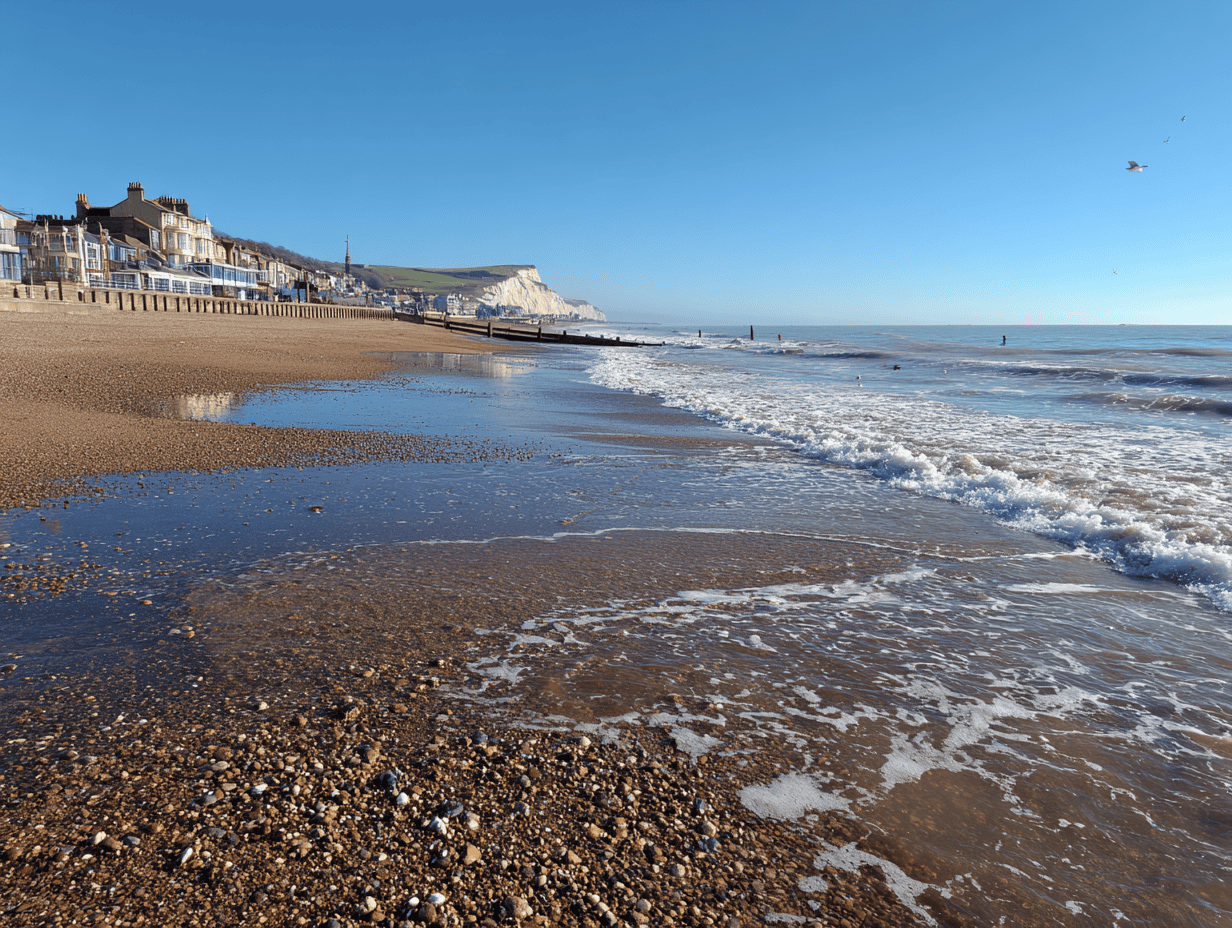
Hastings is a good sea glass hunting beach, especially around Rock-a-Nore and the Stade at the eastern end of the seafront. Green, brown and white are the most common finds, with aqua, blue, amber and turquoise appearing occasionally and cobalt blue, black, lavender and red among the rarer colours reported. The best hunting is around the pebble ridges, groynes and strandline beside the working fishing beach rather than the more open resort sections farther west.
- Rating: Good Beach
- Terrain: Easy
- Level: Intermediate
- Dog friendly: Seasonal – dogs banned from Pelham Beach and the main beach zones 1 April–30 September; Rock-a-Nore and the Stade are dog-friendly all year
- Common colours: Green, brown, white
- Rare colours: Cobalt Blue, Black, Lavender, Red
- Location: Hastings Old Town, East Sussex
- Sat Nav: TN34 3DW (Rock-a-Nore car park)
Hastings Beach Today
No need to scroll; here’s today’s ShoreSense Score and tide times. The full 7-day widget is further down the page.
Hastings Beach sea glass conditions
Hastings Beach
East Sussex
54/100 — Fair, best window 05:39–08:39.
Best window is 05:39–08:39 with spring tides (near full/new moon) and calm sea, so the chance of fresh finds is fair today.
Fair — a decent beach in the right window
Ranked #30 in the UK ShoreSense leaderboard today.
| Tide | Time | Height |
|---|---|---|
| High water | 00:07 | 7.6 m |
| Low water | 07:09 | 0.7 m |
| High water | 12:20 | 7.9 m |
| Low water | 19:27 | 0.5 m |
Best For:
- Historic sea glass hunting
- Working fishing beaches
- Thick frosted glass
- Pebble ridge searching
- Harbour-history enthusiasts
- Storm-following hunts
- Intermediate hunters
- Coastal heritage lovers
Why Hastings – where fishing history meets the shingle
There are a few places on the English Channel where the fishing past feels as alive as it does in Hastings. Walk to the eastern end of the seafront, and the modern resort town falls away entirely. What you find instead is the Stade, a Saxon word meaning landing place, home to Europe’s largest beach-launched fishing fleet, a cluster of extraordinarily tall black net shops, and a shingle beach that has been a working waterfront for well over a thousand years.
That history is why Hastings is worth hunting. A fishing community this old and this active, operating continuously from a beach rather than a sheltered harbour, generates glass in the water in a quiet, sustained way that no holiday resort can match. Bottles lost overboard, broken glass from fish processing, net float glass, domestic waste from generations of fishing families living hard by the shore, it all ends up in the shingle eventually, tumbled by Channel swells until it’s ready to be found.
The glass confirmed on the Odyssey Sea Glass database from the Stade is described as thick, frosted, rounded and smooth, exactly what you want. And just west of the Stade, the famous Bottle Alley, a Victorian covered promenade whose walls are literally encrusted with multicoloured glass set into the concrete, is a reminder of just how glass-saturated this stretch of coast has always been.
Hastings won’t give you the volume hauls of Seaham. But it will give you well-frosted, often chunky Channel glass on a beach unlike anything else on the south coast, with one of the best Old Towns in England as your backdrop.
What you’ll find here
Colours commonly found: Green, brown, white, aqua
Occasional finds: Blue, Aqua, Amber, Turquoise
Rare finds: Cobalt Blue, Black, Lavender, Red
Bonus: Victorian pottery sherds, clay pipe stems, sea pottery from old net floats, and occasional old bottle bases with embossed lettering
Found something unusual? Try GlassLore, our free sea glass scanner, to explore what it could be and log your find to the gallery and, more importantly, earn points and climb the leaderboard.
When to go
Arrive as the tide is going out. The shingle at the Stade and along Rock-a-Nore gets churned up after Channel storms, and the best glass appears in the days following rough weather. Winter is the prime season; the beach is quiet, storms are more frequent, and the fishing fleet is still working, so there’s always something happening.
Spring tides around new and full moon expose more of the foreshore and bring new material up from the seabed. Post-storm visits in October through to March are the most productive, as you get the beach largely to yourself, and the glass concentrations are at their highest after sustained Channel swells.
The Stade itself is a working beach at all hours; fishing boats launch and recover at unpredictable times. Give the working area a wide berth and stay aware of your surroundings. Early morning, before the tourist cafes open, is the best time to hunt.
Today’s ShoreSense Score & Best Hunting Window
Hastings beach faces south across the English Channel, with a tidal range of around 6.5 to 7 metres on a spring tide. That’s a generous range for a Channel beach, and at low water the foreshore along the Stade and Rock-a-Nore opens up significantly, exposing shingle that sits submerged for much of the tidal cycle.
As the tide falls, start east of the net shops at Rock-a-Nore and work the upper strandline and pebble ridges between the groynes. As more of the lower foreshore opens, move down through the darker flint shingle towards the waterline, then continue across the wider Stade if the working fishing area is clear.
Pelham Beach west towards the pier is a secondary hunt, not the main target. After stronger Channel weather begins to settle, recheck the strandline and freshly rearranged pebble ridges. Use today’s ShoreSense Best Window to choose when to arrive, then follow this Rock-a-Nore → groyne-ridge → lower-foreshore progression once you’re there.
The ShoreSense widget below combines recent marine conditions, tide timing and practical hunting weather to show today’s overall ShoreSense Score, Hunting Potential, Comfort and the best available hunting window for this beach. It uses UKHO tide data alongside current marine and weather inputs to help you judge whether conditions look promising for a hunt.
Hastings Beach sea glass conditions
Hastings Beach
East Sussex
54/100 — Fair, best window 05:39–08:39.
Best window is 05:39–08:39 with spring tides (near full/new moon) and calm sea, so the chance of fresh finds is fair today.
Fair — a decent beach in the right window
Ranked #30 in the UK ShoreSense leaderboard today.
| Tide | Time | Height |
|---|---|---|
| High water | 00:07 | 7.6 m |
| Low water | 07:09 | 0.7 m |
| High water | 12:20 | 7.9 m |
| Low water | 19:27 | 0.5 m |
Compare today’s scores on Hot Beaches.
Where to look on the beach
Rock-a-Nore Beach is your primary hunting ground: the shingle immediately east of the net shops and fishing fleet, running towards the base of the East Cliff. This is the working heart of the Stade and where glass has been accumulating for centuries. At low tide, the foreshore opens up towards the rocks at the cliff base. Glass concentrates along the strandline and in the pebble ridges between groynes. The Odyssey Sea Glass database confirmed the find here was thick, frosted sea green, the look of a piece that’s been in the water a very long time.
The Stade is the wider shingle beach in front of the net shops. It’s an active working beach where boats are hauled up, equipment is stored, and fishermen are working. Hunt with respect for the working environment. The glass is here, but you need to look carefully; it doesn’t carpet the beach the way it does at a high-volume site. Work the tide line methodically.
Pelham Beach runs west from the Stade towards the pier. It’s a longer, wider stretch of shingle and more of a standard resort beach, but finds are still possible, especially after storms. The section between the pier and the Stade is worth a slow walk at low water after rough weather.
Key Tip:
The key at Hastings is reading the strandline carefully. Channel glass blends into the dark flint shingle, so get your eye level low and look for a frosted edge catching the light against the darker stones.
The key at Hastings is reading the strandline carefully. Channel glass here blends well with the dark flint shingle. Get your eye level low and look for the telltale frosted edge catching the light against the darker stones around it.
Dog friendly?
Rock-a-Nore and the Stade: yes, all year round. Dogs were banned from these beaches in 2023, and the decision caused enough of an outcry, a petition of more than a thousand names and a public rally on the Stade, that the council ran a fresh consultation. More than 2,800 people responded, 64% wanted the restrictions lifted from both beaches, and in November 2024 the council’s cabinet agreed. Dogs have been welcome there year-round ever since, which is the best possible news for hunters, because these are the two best hunting areas.
Pelham Beach and the main beach zones: seasonal. Dogs are excluded from two sections of the main beach between 1 April and 30 September. Dogs must be on a lead on the promenade at all times, no more than six dogs per person, and failing to clear up can cost up to £1,000.
The council said it would keep the arrangement under review, so check the signs when you arrive. The Rock-a-Nore Road area has several dog-friendly cafés and pubs. Check our Yappy Places listing for Hastings for the best options after the hunt.
Practical information
Parking: Rock-a-Nore car park (TN34 3DW) sits right on the beach at the eastern end of the seafront, beside the net shops and fishing fleet, and it’s the obvious choice for hunting the Stade. It’s a large pay-and-display car park with 450 spaces, RingGo location code 17162. It fills fast on summer weekends, so arrive early or use Pelham Place as an overflow, a short walk along the seafront. There’s only one road in and out of Rock-a-Nore, so avoid peak exit times at the end of a busy day.
Note there’s only one road in and out of Rock-a-Nore, so avoid peak exit times at the end of a busy day.
Toilets: Public toilets are available near Rock-a-Nore and at the Pelham Place car park.
Food and drink: Rock-a-Nore Road is lined with fish shops, seafood stalls and cafes. The fresh catch is landed here daily, and you can buy straight from the boats. The Old Town itself has an excellent range of independent restaurants, pubs and cafes along George Street and the High Street. Hastings Contemporary, the modern art gallery right on the Stade, has a café with seafront views.
Getting there without a car: Hastings station has regular services from London Charing Cross, Brighton and Ashford International. The Stade and Rock-a-Nore are a 15–20 minute walk from the station, or take the number 20 or 20A bus directly to the Stade. It’s a flat, easy walk along the seafront from the station.
Accessibility: The promenade along the main beach is flat and accessible. Rock-a-Nore and the Stade involve some uneven shingle terrain, but there are accessible routes along the seafront. The East Hill cliff railway (one of the steepest funicular railways in the country) runs from Rock-a-Nore up to Hastings Country Park, which is worth knowing if you want to extend the day.
What to bring
- Comfortable flat shoes or wellies – the shingle is uneven but manageable
- A small bag or tin for your finds
- A hand rake or trowel for shifting pebbles around the groyne bases
- Layers – the Stade is exposed, and the Channel wind can be sharp
- A tide time app or table – Hastings has a generous tidal range, and timing your visit well makes a real difference
- A camera – the net shops and working fishing fleet are genuinely extraordinary to see up close
The history behind the glass
The Stade at Hastings Old Town has been a working beach for more than a thousand years. The word itself comes from the Saxon term for landing place, and fishing boats were pulling up on this shingle before the Norman Conquest. By the time William the Conqueror landed a few miles along the coast at Pevensey in 1066, Hastings was already an established fishing port important enough to become one of the original Cinque Ports, the medieval confederation of Channel towns obliged to provide ships for the Crown.
What makes the Stade remarkable and what explains the glass is that it never had a proper harbour. Unlike Dover or Folkestone, Hastings had no sheltered deep-water anchorage. The fishing fleet had to work directly off the shingle beach, launching into the Channel and hauling back up on wooden skids after every trip. That constraint produced the net shops: those extraordinarily tall, black, tarred wooden buildings, built upwards rather than outwards because beach space was so scarce. They’ve been storing fishing gear since the early 19th century, and they’re still in use today.
A fishing community that size, working a beach continuously for centuries, generates glass. Bottles broken during fish processing, domestic waste from net shop workers, equipment discarded at the water’s edge, cargo lost from vessels all of it enters the shingle eventually. And then there’s Bottle Alley, the Victorian covered promenade built in the 1930s between Hastings and St Leonards, whose walls are studded with thousands of pieces of coloured glass set permanently into the concrete. Hastings and Glass have a long relationship.
Today, the Stade is still home to the largest beach-launched fishing fleet in Europe. The boats are no longer than about ten metres, limited by the need to be hauled up the shingle by winch, and they still fish close inshore, bringing back bass, Dover sole, plaice and Channel skate. The fishermen’s cottages, net shops, fish stalls, and the smell of fresh catch are all still there. It’s one of the most genuine working seafronts left in the south of England, and the glass in the shingle is part of that story.
From beach to jewellery
Found something in the Hastings shingle? At Mermaid Tears, every piece of Sea Glass jewellery starts exactly where you’re standing, hand-hunted from UK beaches and handmade into something lasting. Browse the collection →
Disclaimer: Tide times, dog restrictions, parking charges and beach conditions change regularly. Always verify before visiting. Hastings dog restriction rules are under ongoing review, and the PSPO is updated annually. Always check with Hastings Borough Council or local signage for the current year’s rules before you go.
Last updated: September 2026
Dog rules checked: September 2026 – Hastings Borough Council (Stade and Rock-a-Nore restrictions removed November 2024)
Frequently asked questions
Is Hastings good for sea glass beginners? Yes, the Stade and Rock-a-Nore are straightforward to access, parking is right on the beach, and the terrain is easy. Volume is lower than the top northern beaches, but the finds are well-frosted, and the setting is exceptional. Worth pairing with a walk around the Old Town.
What is the best area of Hastings Beach for sea glass? Rock-a-Nore and the Stade, at the eastern end of the seafront by the net shops and fishing fleet. This is where historical activity has been concentrated for centuries and where you find the best-quality glass.
Are dogs allowed at Hastings Beach? Rock-a-Nore and the Stade welcome dogs all year round, after the council lifted the seasonal ban in November 2024. The main Pelham Beach zones still have a ban from 1 April to 30 September. Dogs must be on a lead on the promenade at all times.
What is the best time to visit Hastings for sea glass? After a Channel storm, at low water, particularly in winter and early spring. Arrive early on the ebb tide and work the strandline systematically. The beach is at its quietest and most productive between October and March.
What are the net shops at Hastings? The tall black tarred wooden sheds on the Stade are net shops, storage buildings for fishing gear that have been in use since the early 19th century. Built upwards because beach space was limited, they’re unique to Hastings and one of the most photographed features of the Old Town. Several are still in active use by the fishing fleet.
Can I buy fresh fish at the Stade? Yes, the fishermen sell directly from the beach at Rock-a-Nore. The wet fish stalls along Rock-a-Nore Road are open most mornings after the boats have come in. It’s one of the best places in Sussex to buy genuinely fresh Channel fish.
More Beaches
Check out our Full Kent Beaches Guide or plan your trip with our UK Sea Glass Map.