On the Trail of Portland Glass
Stevenston Beach is a fair but interesting sea glass hunting beach, especially along the southern stretch towards Irvine and across the wet foreshore exposed as the tide falls. White, green and brown are the most common finds, with amber, blue, aqua, turquoise, cobalt, black, lavender and occasional red also reported. It’s a slow, sandy-beach hunt where covering ground and watching the waterline matters more than searching one concentrated hotspot.
- Rating: Fair Beach
- Terrain: Easy
- Level: Beginner
- Dog friendly: Yes
- Location: Stevenston, North Ayrshire, Scotland
- Sat Nav: KA20 3EF (Stevenston Beach car park, Shore Road)
- Common colours: White, green, brown
- Rare colours: Cobalt Blue, Black, Lavender, Red
Today at Stevenson Beach
Check for the latest ShoreSense Score and tide times. Scroll down for the full 7-day forecast
Stevenston Beach sea glass conditions
Stevenston Beach
North Ayrshire — Sea settling
77/100 — Excellent, best window 13:25–14:25.
Best window is 13:25–14:25 with big seas in the last few days, now easing — glass should be washing in and spring tides (near full/new moon), so the chance of fresh finds is excellent today.
Rare excellent window at this spot
Ranked #19 in the UK ShoreSense leaderboard today.
| Tide | Time | Height |
|---|---|---|
| High water | 00:09 | 3.4 m |
| Low water | 05:43 | 0.3 m |
| High water | 12:25 | 3.3 m |
| Low water | 17:59 | 0.5 m |
Best For:
- Sea glass hunting
- Long beach walks
- Storm hunting
- Industrial history
Why the Ayrshire coast earns its place on this site
Let’s be honest upfront: Stevenston is a Fair beach. It’s predominantly sandy, the glass takes patience to find, and you won’t fill a jar on a typical visit. If you come expecting Seaham or even Wemyss Bay, you’ll be disappointed.
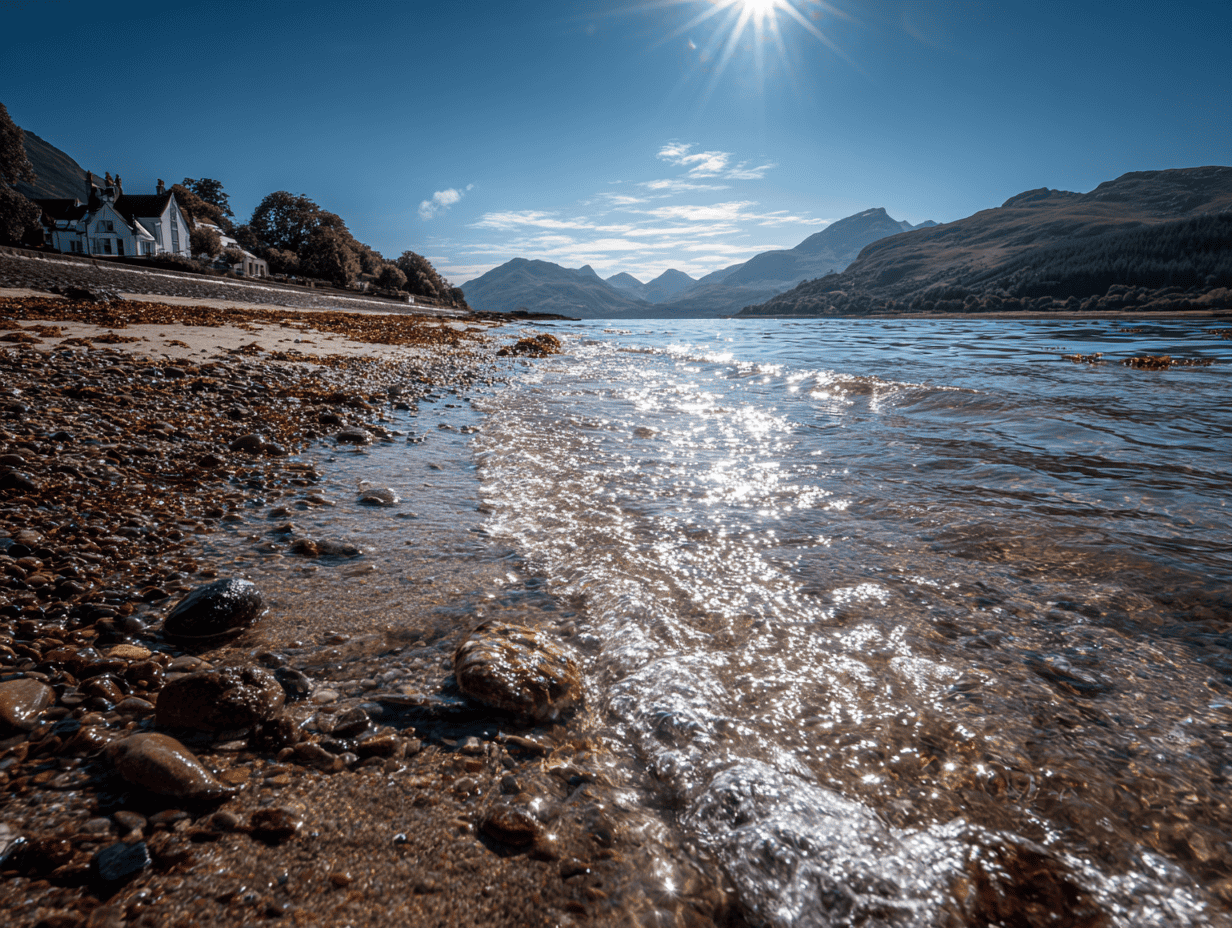
But the Ayrshire coast has two things that make it worth a post. The first is the striking view across the Firth of Clyde towards the Isle of Arran from a four-kilometre sweep of open beach. On a clear day with Arran’s mountains sitting purple and sharp across the water, it is genuinely one of the finest coastal views in Scotland. The second is the history, and it’s extraordinary.
Most of the glass along this coast traces back to Irvine, just south of here. Its harbour was one of Scotland’s most important ports in the 16th century, before Glasgow and Greenock overtook it in the 1800s. Then, in 1920, the Portland Glass Company set up at Irvine and made bottles and flasks there for nearly forty years. Add Alfred Nobel’s dynamite factory at Ardeer, once the largest explosives works in the world, and you have one of the most industrially layered stretches of coastline in Scotland. The glass on this beach has come from all of it.
Come with realistic expectations, the right tide, and some patience. The Ayrshire coast rewards slow hunters who take their time with the strandline.
What you’ll find here
Colours commonly found: White, green, brown, amber
Occasional finds: Blue, Aqua, Amber, Turquoise
Rare finds: Cobalt Blue, Black, Lavender, Red
Bonus: The Ayrshire coast is also home to some unusual and noteworthy geological rocks. Some of the oldest in Scotland are found there, and in addition to sea glass, there are incredible finds such as gemstones, including scenic and onyx agate, and fossils to be discovered on the beaches.
Worth keeping a separate bag for geological finds, agate hunting here is a serious hobby in its own right.
Find something special? Use our sea glass scanner, GlassLore, to find out rarity, value and history; then you can share to our finds gallery and, more importantly, earn points to climb our hunters leaderboard – are you ready to compete?
When to go
The Firth of Clyde has a tidal range of around 3 metres at Stevenston on a spring tide, modest but enough to expose a useful strip of foreshore when the water pulls back. Low tide is your window. The sandy beach makes glass harder to spot than on a shingle or rocky shore, so the wet foreshore at low water, where glass sits on the surface rather than buried under dry sand, is the most productive ground.
Autumn and winter are best. The Firth of Clyde can push a decent south-westerly swell, and after a period of rough weather, the beach turns over. The beach is also at its quietest in the off-season. A weekday morning in November with the tide going out and Arran sharp across the water is the ideal Ayrshire visit. Spring tides around new and full moon give the most exposed foreshore.
Walk slowly. Scan the wet sand at the waterline rather than the dry upper beach. Glass on a sandy beach shows itself in the light differently from pebbles; look for the frosted, slightly opaque quality rather than the shine of wet sand.
Today’s ShoreSense Score & Best Hunting Window
Stevenston sits on the Firth of Clyde facing south-west towards the Isle of Arran, with a tidal range of around 3 metres on a spring tide, enough to expose a good strip of wet foreshore along this four-kilometre sandy beach when the tide retreats.
As the tide falls at Stevenston, concentrate on the broad wet foreshore rather than the dry upper sand, where small pieces are much harder to spot. Start near the main access and work south towards Irvine, scanning slowly along the retreating waterline for frosted glass showing against the darker wet sand. On bigger spring lows, more of this flat lower beach opens up and gives you a much wider search strip. After stronger westerly or south-westerly weather begins to settle, also walk the high strandline along the four-kilometre beach, where shells, pebbles and debris can create easier-to-read patches. Use today’s ShoreSense Best Window to choose when to arrive, then treat Stevenston as a distance hunt rather than a single-hotspot beach.
The ShoreSense widget below combines recent marine conditions, tide timing and practical hunting weather to show today’s overall ShoreSense Score, Hunting Potential, Comfort and the best available hunting window for Stevenson. It uses UKHO tide data alongside current marine and weather inputs to help you judge whether conditions look promising for a hunt.
Stevenston Beach sea glass conditions
Stevenston Beach
North Ayrshire — Sea settling
77/100 — Excellent, best window 13:25–14:25.
Best window is 13:25–14:25 with big seas in the last few days, now easing — glass should be washing in and spring tides (near full/new moon), so the chance of fresh finds is excellent today.
Rare excellent window at this spot
Ranked #19 in the UK ShoreSense leaderboard today.
| Tide | Time | Height |
|---|---|---|
| High water | 00:09 | 3.4 m |
| Low water | 05:43 | 0.3 m |
| High water | 12:25 | 3.3 m |
| Low water | 17:59 | 0.5 m |
Compare your Beaches on our Hot Beaches page, updated daily with the best beaches for today, the next seven days, as well as the movers and shakers.
Where to look on the beach
Stevenston beach is 4km long and is backed at its northern end by a large Beach Park and Local Nature Reserve, principally composed of semi-mobile dunes containing a wealth of coastal wildflower and insect species. That’s a lot of beach. For sea glass purposes, know where to focus.
The southern end towards Irvine is the most productive section. The proximity to the old Portland Glass factory site at Irvine, and to Irvine Harbour itself, means the southern stretch has the highest concentration of industrial glass history feeding into this part of the bay. Work the waterline south from the main car park at low tide.
The Ardeer section– the central and northern stretch of the beach running alongside the former Nobel/ICI factory peninsula is worth walking on a low spring tide. The factory ran for over 125 years right on the shoreline, and the waste from that industry found its way into the Clyde. This is not a high-density hunting ground, but the glass here has a distinctive origin.
The strandline anywhere along the four-kilometre length is worth a slow walk after a westerly blow, as glass deposited at the high-tide mark after rough weather is sometimes easier to spot on the dry upper beach than hunting the wet foreshore.
The beach is Easy terrain throughout -flat sand, straightforward walking, accessible for all. The dune footpaths are well-maintained and clearly signposted.
Key Tip:
Focus your efforts on the southern end of the beach towards Irvine. The combination of Irvine Harbour and the former Portland Glass works makes this stretch the most historically productive section of an otherwise very long beach.
Difficulty Level – Beginner
- Wide, open beach with straightforward walking
- Easy access from multiple points
- No scrambling or difficult terrain
- Large search area allows hunters to spread out
- Suitable for beginners willing to cover some distance
Hunting Style – The Coastal Wanderer
Stevenston rewards hunters who enjoy covering ground. Walk the strandline after rough weather, then work the waterline on a falling tide, paying particular attention to the southern sections of the beach. Success here comes from persistence and distance rather than focusing on a single concentrated hotspot.
Beach Personality
Stevenston feels expansive, open and quietly industrial. Behind the dunes lies a rich natural landscape, while beneath the waves sits a history shaped by glassmaking, harbour trade and heavy industry. The beach doesn’t give up its secrets easily, but patient hunters willing to walk its long shoreline can uncover pieces of a fascinating past scattered amongst the sand and shingle.
Dog friendly?
Yes, and North Ayrshire Council has been unusually clear about it. In June 2025 the council confirmed that dogs are welcome on all its beaches, with no bans or restrictions anywhere, naming Stevenston specifically. It asks owners to keep dogs on a lead in busy areas and to pick up after them.
Four kilometres of open beach, views across to Arran, and virtually no crowds outside summer. You can walk north towards Saltcoats or south towards Irvine, and there’s room for everyone.
The dunes behind the beach are a Local Nature Reserve with ground-nesting birds in spring, so keep dogs under control and stick to the footpaths up there. On the sand itself, there are no restrictions at any time of year.
Saltcoats is a short walk along the promenade from the northern end and has cafés and a town centre. Check our Yappy Places listings for Stevenston, Saltcoats and Irvine for dog-friendly stops.
Practical information
Parking: Free car park off Shore Road, Stevenston (KA20 3EF), with fenced footpaths leading through the dunes to the beach. There’s more parking at the northern end, near the Stevenston–Saltcoats promenade.
Toilets: Facilities available at the beach car park and at Saltcoats town centre, a short walk along the promenade.
Food and drink: Saltcoats town centre, within walking distance of the northern beach, has cafes, a chip shop and a range of amenities. Irvine town centre is similarly accessible from the southern end. The Red Squirrel pub in Stevenston is a local option. For a proper post-hunt meal, Irvine’s harbourside has developed into a reasonable destination in recent years.
Getting there without a car: Stevenston railway station (KA20 3DP) is a short walk from the beach, with regular ScotRail services from Glasgow Central; the journey takes around 45 minutes. Saltcoats station is also close to the northern end of the beach. The Ayrshire coast is one of the better-served stretches of Scottish coastline for public transport.
Accessibility: Flat, easy terrain throughout. Access from the beach car park is straightforward, with fenced dune footpaths. One of the most accessible beaches on the Scottish west coast.
What to bring
- Sturdy shoes or wellies – the wet foreshore at low tide can be soft underfoot
- A small container or zip-lock bag for sea glass and a separate one for agates and geological finds
- A hand rake for working the waterline
- Windproof layers – the Firth of Clyde funnels a cold south-westerly, and the beach is fully exposed
- Binoculars – Arran views, wading birds on the foreshore, and occasional dolphin sightings offshore
- Patience – this is a slow, contemplative beach. Give it time.
The history behind the glass
Three distinct industrial chapters feed the glass on this beach, and each is worth understanding.
The oldest is Irvine Harbour. Irvine’s northern harbour was one of the most important ports in 16th-century Scotland before being overtaken in the 19th century by those in Glasgow and Greenock. For three centuries, the harbour handled coal, salt, cattle, grain and goods moving in and out of Ayrshire. The glass from that maritime trade has been in the Clyde for centuries.
The most dramatic is Nobel’s factory at Ardeer. Alfred Nobel established the British dynamite factory at Ardeer in 1871, the first factory of that type in the United Kingdom, and it became the largest explosives factory in the world. At its peak, the factory employed 12,700 people, sustaining the economies of Stevenston, Irvine, Saltcoats and Ardrossan.
The Ardeer peninsula, jutting into the Firth of Clyde directly adjacent to the beach, was the site of this extraordinary operation for over 125 years. The glass laboratory equipment, storage vessels, and domestic waste from a workforce of thousands all found their way into the Clyde.
The most directly relevant to the sea glass is the Portland Glass Company. The Portland Glass Co. was formed at Irvine, Ayrshire, in 1920 and produced liquor flasks and bottles until it became part of Rockware Glass Ltd in 1958.
Nearly 40 years of bottle production on the Clyde coast, with the factory on Galles Road in Irvine. The amber glass you find on this beach very likely started its life as a whisky or spirits flask from that factory, produced, sold, discarded and tumbled by the Clyde into the frosted piece now sitting in your hand.
Nearly forty years of bottle production a couple of miles down the coast, at the factory on Galles Road. Nobody can tell you which piece came from where, but when you pick up an amber fragment on this beach, a whisky flask from Portland Glass is a fair guess.
From beach to jewellery
An amber piece from the Firth of Clyde. An aqua tumbled smooth by years of Clyde swell. At Mermaid Tears, every piece of jewellery starts exactly where you’re standing, hand-hunted from UK beaches and handmade into something worth keeping. Browse the Mermaid Tears collection
Disclaimer: Tide times, dog restrictions, parking information and beach conditions change regularly. Always verify before visiting. The dune areas behind Stevenston Beach are designated as a Local Nature Reserve. Please keep to footpaths in the dunes and keep dogs under control near ground-nesting bird areas in spring. Beach byelaws are updated annually – check with North Ayrshire Council for the most current rules.
Last updated: September 2026
Dog rules checked: September 2026 — North Ayrshire Council (no restrictions on any beach)
Frequently asked questions
Is Stevenston beach good for sea glass hunting? It’s a Fair beach. Patient hunters who work the wet foreshore at low tide come away with finds, but don’t expect the volume of a shingle beach. The glass quality, when you do find it, tends to be well-tumbled and smooth. The history behind the glass- Portland Glass, Nobel’s factory, and Irvine Harbour makes every find more interesting than it would be on a more prolific beach.
Where exactly should I look for sea glass at Stevenston? Work the wet foreshore at the waterline as the tide retreats, particularly the southern section towards Irvine, where the Portland Glass factory history is closest. The strandline after a westerly blow is worth a careful, slow walk. Avoid the dry upper beach glass, which buries itself in sand and becomes invisible.
What else can I find on Stevenston beach besides sea glass? The Ayrshire coast is genuinely excellent for agates; scenic agate, onyx agate and other geological finds are a real bonus here. Fossil fragments also turn up. Bring a separate bag for non-glass finds, and you may leave with something as interesting as the glass itself.
Is Stevenston beach dog-friendly? Yes, all year round. North Ayrshire Council confirmed in 2025 that there are no bans or restrictions on any of its beaches. Keep dogs under control in the dunes during nesting season.
How do I get to Stevenston beach from Glasgow? Take the train from Glasgow Central to Stevenston station; ScotRail services run regularly, with a journey time of around 45 minutes. The beach is a short walk from the station. By car, take the A78 south from Largs or north from Irvine; use KA20 3EF for the beach car park.
What is the Portland Glass Company, and why does it matter for sea glass? The Portland Glass Co. was a bottle and flask manufacturer based in Irvine from 1920 to 1958, producing liquor bottles for the Scotch whisky industry, among others. Its waste and products entered the Firth of Clyde over nearly four decades, and the amber and green glass on Stevenston beach is largely traceable to this source. It became part of Rockware Glass Ltd in 1958.
More Scottish Beaches
Check out the Full West Scotland Guide or plan your trip with our UK Sea Glass Map.