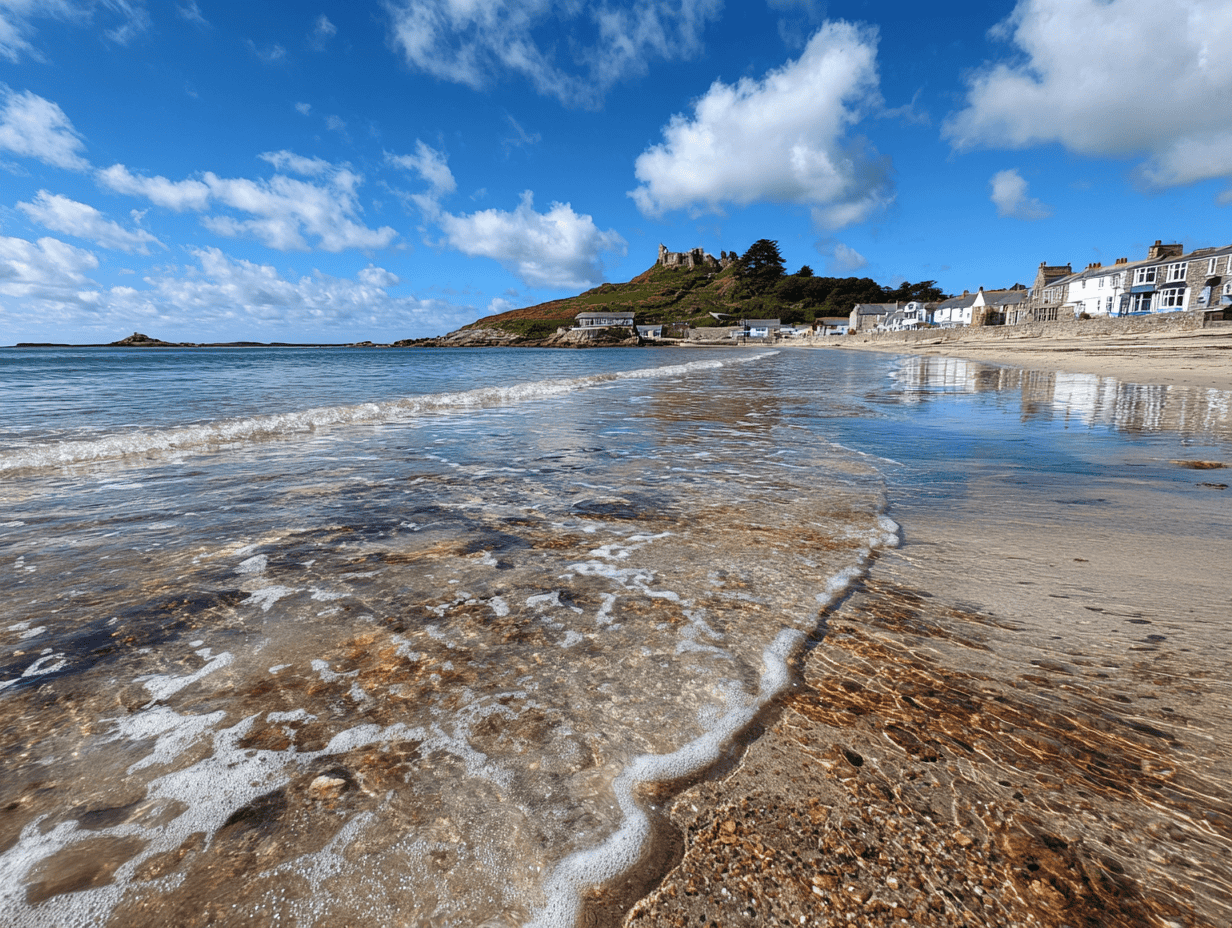
Atlantic Storm Glass on the North Cornwall Coast
Porthtowan is a good sea glass hunting beach, especially around the tidal rock pool, rocky margins, cave entrances and mixed shingle exposed at lower water. Green, white, and brown are the most common finds, with blue, aqua, amber, and turquoise appearing occasionally, and cobalt blue, black, lavender, and red among the rarer colours reported. The open sandy centre is less useful than the rocky ground at either end and the route towards Chapel Porth
- Rating: Good Beach
- Terrain: Easy
- Level: Intermediate
- Dog friendly: Seasonal – dogs banned 15 May to 30 September, 10am–6pm
- Location: Porthtowan, Cornwall
- Sat Nav: TR4 8AA (Porthtowan beach car park)
- Common colours: Green, white, brown
- Rare colours: Cobalt Blue, Black, Lavender, Red
Today at Porthtowan
Here’s the latest Tide Times and ShoreSense Score. Scroll down for the full 7-day forecast.
Porthtowan Beach sea glass conditions
Porthtowan Beach
Cornwall — Fresh swell
94/100 — Perfect, best window 08:52–11:52.
Best window is 08:52–11:52 with strong recent seas delivering glass and spring tides (near full/new moon), so the chance of fresh finds is perfect today. Great combo of sea state and weather — worth the trip.
Strong window at a solid beach
Ranked #5 in the UK ShoreSense leaderboard today.
| Tide | Time | Height |
|---|---|---|
| High water | 04:02 | 6.7 m |
| Low water | 10:22 | 1.1 m |
| High water | 16:19 | 7.0 m |
| Low water | 22:42 | 0.9 m |
Best For
- Rock pool searching
- Storm hunting
- Historic sea glass
- Cave exploration
- Atlantic coast adventures
- Low-tide hunting
- Coastal photography
- Exploring multiple beaches
Where Atlantic storms do the hard work for you
Porthtowan is primarily known as a surf beach. Tucked into a valley on Cornwall’s north Atlantic coast, backed by dramatic cliffs and home to a consistently good wave, it draws surfers from across the south west. Sea glass hunters rarely feature in the brochures.
That’s useful information. A beach that draws surfers rather than beachcombers is a beach where the glass hasn’t been picked over. Porthtowan is a large sandy beach backed by imposing cliffs in the St Agnes Area of Outstanding Natural Beauty, north-west facing and popular with surfers. The rock pools, the tidal coves and the mixed substrate sections are largely left to people who aren’t looking for waves, which, on a good low tide, means they’re largely left for you.
At low tide, the beach extends north-east to join Chapel Porth, below the cliffs where the Wheal Coates engine house stands. Wheal Coates was one of the most significant tin and copper operations on this stretch of coast, with seams running out under the sea floor.
The view from Porthtowan at low tide, with the Towanroath engine house of Wheal Coates visible on the clifftop above Chapel Porth, is one of the most visually distinctive of any beach in this guide. You’re hunting glass below a UNESCO World Heritage Site while Atlantic swells move in from the west. It’s quite a setting.
What you’ll find here
Porthtowan’s mining heritage is the key to understanding its glass. The St Agnes area was one of the most intensively mined parts of Cornwall, with tin and copper extraction for centuries, and all the coastal industry and habitation that it brings. That history is in the water along this stretch of coast.
Porthtowan has a mixture of soft sand and shingle areas filled with all kinds of treasures, plus a great rock pool to explore. The variety at Porthtowan tends toward smaller, well-tumbled pieces. The Atlantic surf does thorough work on glass here. What you find is typically well-frosted and well-shaped.
At low tide, the beach opens out into a vast expanse of firm sand with rock pools and caves to discover. The rock pools and the base of the cliffs at low tide are your primary targets, where glass accumulates, where the sandy beach gives way to rock.
Colours commonly found: Green, white, brown
Occasional finds: Blue, Aqua, Amber, Turquoise
Rare finds: Cobalt Blue, Black, Lavender, Red
Bonus: The cave sections at low tide are worth exploring; glass gets trapped in cave entrances and crevices away from the main beach.
Found something special? Scan it with GlassLore, our free sea glass identifier, to explore what it could be and how rare it is. Then add it to the finds gallery and earn points to climb the hunter leaderboard.
When to go
At low tide, the beach grows exponentially in size. The beach stretches nearly 1.5 miles to include Chapel Porth. That extended low-tide beach is your best opportunity. The rock pools and mixed substrate sections between the two beaches only reveal themselves at lower tides, and the Atlantic-facing aspect means post-storm conditions here are outstanding.
Porthtowan faces northwest into the open Atlantic. Every westerly and southwesterly storm pushes energy directly onto this shore. A beach visit a day or two after a good Atlantic blow, when the surf has calmed enough to let you onto the beach safely, but the foreshore has been freshly worked, is the ideal scenario.
There is a concrete dam in the rocks to the northeast of the bay, creating a tidal rock pool. Be cautious of the tides, as you could be cut off. Always check tide times before heading into the Chapel Porth section at low water.
Autumn and winter lift the dog restriction and tend to coincide with the best Atlantic swell activity. October through May is the prime hunting window.
Today’s ShoreSense Score & Best Hunting Window
Porthtowan faces northwest into the open Atlantic on Cornwall’s north coast, with a spring tidal range of around 5–6 metres, generous exposure that reveals a vast strip of sand, rock pools, and mixed substrate at low water. On a big spring tide, the beach merges with neighbouring Chapel Porth to the northeast, creating nearly a mile and a half of accessible foreshore. The tidal pattern is semi-diurnal with two highs and two lows per day.
As the tide falls, start on the upper strandline and work towards the tidal rock pool before moving onto the rockier margins, crevices and cave entrances as they become safely exposed. On lower water, continue towards Chapel Porth and check the mixed shingle and broken rocky ground rather than the broad open sand.
Bigger lows expose much more usable foreshore, but the Chapel Porth section can cut off on the flood, so keep a generous safety margin. Use today’s ShoreSense Best Window to choose when to arrive, then follow this strandline → tidal-pool → rocky-crevice → Chapel Porth progression once you’re there.
The widget below uses Perranporth tide data, the nearest UKHO standard port, approximately 7 miles north, to show today’s Seaglass ShoreSense Score, tide curve and best hunting window.
Porthtowan Beach sea glass conditions
Porthtowan Beach
Cornwall — Fresh swell
94/100 — Perfect, best window 08:52–11:52.
Best window is 08:52–11:52 with strong recent seas delivering glass and spring tides (near full/new moon), so the chance of fresh finds is perfect today. Great combo of sea state and weather — worth the trip.
Strong window at a solid beach
Ranked #5 in the UK ShoreSense leaderboard today.
| Tide | Time | Height |
|---|---|---|
| High water | 04:02 | 6.7 m |
| Low water | 10:22 | 1.1 m |
| High water | 16:19 | 7.0 m |
| Low water | 22:42 | 0.9 m |
Compare the score with our Hot Beaches
Where to look on the beach
Rock pools at low tide: Porthtowan reveals fascinating caves, cliffs, and rock pools. These are your best areas. Glass gets trapped in rock pool crevices and cave entrances away from the sandy main beach, where it would sink and disappear.
The high tide strandline: After a storm, work the strandline carefully. The northwest-facing aspect means the beach catches Atlantic swell directly and deposits material in concentrated lines.
Chapel Porth at low tide: Porthtowan and neighbouring Chapel Porth join up at low tide, giving you twice the beach to hunt. Chapel Porth is a National Trust beach with a dramatically different character, rocky, narrow, flanked by old mine workings. Glass there tends to be older and more varied. Check tide times carefully before attempting the walk between the two, as it cuts off at high tide.
A safety note: signs warn of strong undercurrents and risk of falling rocks, and there is a risk of getting cut off at high tide. Always check tides before exploring the cave sections or walking to Chapel Porth.
Key Tip:
Plan your visit around low tide and head straight for the rocky sections rather than the open sand. If conditions allow, continue on to Chapel Porth and search the rock pools, crevices and old mining-influenced shoreline where older and more unusual pieces are often found.
Difficulty Level – Intermediate
- The most productive hunting areas are only accessible around low tide
- Rock pools, caves and rocky foreshore require careful footing
- Tide timing is important if you plan to reach Chapel Porth
- The sandy main beach is generally less productive than the surrounding rocky areas
- Success depends on targeting specific habitats rather than searching the entire beach
Hunting Style- The Rock Pool Forager
Porthtowan rewards hunters who leave the open sand behind and focus on the rocky margins. Search rock pools, cave entrances and crevices revealed by the retreating tide, where glass becomes trapped and protected from constant movement. The best finds are often hidden in places many visitors never think to check.
Beach Personality
Porthtowan is wild, energetic and shaped by the full force of the Atlantic. Huge swells, dramatic cliffs and a coastline rich in mining history create a beach that feels different every time you visit. While the broad sandy bay grabs most people’s attention, experienced hunters know the real treasures are tucked away amongst the rocks and caves at either end. Add neighbouring Chapel Porth into the mix, and you’ve got a coastline built for exploration.
Dog friendly?
Yes – with seasonal restrictions on the main beach.
Dogs are banned on Porthtowan Beach from 15th May to 30th September between 10am and 6pm. Outside those hours and in winter, they’re welcome.
For sea glass hunters, this works perfectly. Winter and early morning are your best times anyway. The South West Coast Path passes behind Porthtowan, allowing longer walks, and the Towanroath Valley behind the beach has scenic trails for extending your day.
The walk to Chapel Porth via the coast path is one of the best dog walks on the north Cornwall coast, with dramatic cliff scenery, the ruins of Wheal Coates engine house, and a second beach at the end. Worth building a whole day around.
Looking for dog-friendly stops nearby? Check our Yappy Places listing for Porthtowan and St Agnes →
Practical information
Parking: Porthtowan Beach Car Park (Beach Road, TR4 8AA) is large, with level access to the beach and four disabled spaces. Charges apply 1 April to 31 October, 9am to 4pm only: £1 for an hour, £1.70 for two, £4 for 24 hours, and £9.80 for a week. It’s free from 4pm to 9am, and free all day from 1 November to 31 March. The machine takes coins, card and contactless, but there’s no pay-by-phone option here. Height restriction: 2.1m, and no motorhomes or campers between 11pm and 8am.
Toilets: Public toilets on the seafront with seasonal showers. All within steps of the car park.
Food and drink: The Blue bar and restaurant sit above the beach, offering good food and spectacular views. There are also cafes and a surf shop in the village. The Watering Hole at Perranporth (a short drive north) is the only pub on a beach in England, worth knowing about for the end of a long hunting day.
Getting there without a car: Buses serving Porthtowan include the 304 between Truro and Porthtowan and the 315 between Redruth and Goonbell. From Redruth station, the bus connection is manageable. Not the easiest beach without a car, but doable.
Accessibility: Level access to the beach via ramps and paths from the main car park. The soft sand and high-tide bank can make some sections harder going for wheelchairs. Rock pool sections involve uneven terrain.
What to bring
- Sturdy shoes – rock pools and cave sections require solid footwear
- A small container for finds
- A hand rake for working rock pool crevices
- Layers – the northwest-facing aspect means wind even on fair days
- Cash for the car park pay machine
- Tide times – essential before exploring caves or walking to Chapel Porth
The history behind the glass
Porthtowan lies within the Cornwall and West Devon Mining Landscape, a UNESCO World Heritage Site. The cliffs between Porthtowan and St Agnes were one of the most intensively mined stretches of coastline in the world during the 19th century. The St Agnes mining district produced prodigious quantities of tin and copper from seams that ran both inland and out under the sea floor.
Wheal Coates, on the clifftops directly above Chapel Porth and visible from the low-tide beach at Porthtowan, opened in 1802 and was worked until 1889, with a final reworking between 1911 and 1913. At its height, it employed around 140 miners. Over its lifetime, the mine produced 717 tons of tin and 335 tons of copper. The seams ran out under the seabed, and the mine had to be abandoned when it proved unprofitable.
Wheal Lushington, also known as New Wheal Towan, was a copper mine on the hill overlooking Porthtowan beach, working mainly between 1826 and 1862. Its engine house, built in 1872, was later converted and now houses the café above the beach. You can eat your pasty in a converted copper mine engine house. Cornwall takes some beating for context.
Mining communities generated glass in quantities that are easy to underestimate. Every household had medicine bottles, food jars, beer and cider containers, and all of it was discarded at the cliff edge or into the valley. The glass from a mining community of 140 workers and their families, disposed of over decades, has been working its way down the cliffs and onto the beach below ever since the mines closed. Add to that the general maritime traffic of a north-facing Atlantic coast, and Porthtowan’s sea glass has a depth of history that the surf culture doesn’t advertise.
From beach to jewellery
Atlantic glass is some of the most thoroughly tumbled in the UK. Open-ocean exposure and long fetch mean pieces have been worked hard before they reach the shore. At Mermaid Tears, that quality of frosting is what we look for. Every piece of jewellery starts as hand-harvested from UK coastlines and is made into something lasting. Browse the collection.
Disclaimer: Tide times, dog restrictions, parking charges and beach conditions change regularly. Always verify before visiting. The Chapel Porth section of the low-tide beach can be cut off quickly – always check tide times before walking south from Porthtowan. Dog restrictions are reviewed annually -confirm with Cornwall Council before visiting with a dog in the restricted period.
Last updated: September 2026
Dog rules checked: September 2026 – Cornwall Council PSPO (15 May–30 September band)
Frequently asked questions
Is Porthtowan good for sea glass? Yes – it’s a consistently good beach, particularly at low tide when the beach extends to Chapel Porth and reveals the rock pool sections and cliff base areas where mining-era glass concentrates. The Atlantic surf produces well-tumbled, well-frosted pieces. Volume won’t match the North Sea industrial beaches, but quality is high.
What is the Wheal Coates connection to Porthtowan? Wheal Coates is a former tin mine on the clifftops above Chapel Porth, visible from Porthtowan’s low-tide beach. Active from 1802 to 1889, it employed around 140 miners whose community waste- bottles, jars, and domestic glass has been working its way onto the beach below for over a century. The mine is now a UNESCO World Heritage Site maintained by the National Trust
Are dogs allowed at Porthtowan? Seasonally restricted: dogs are banned from 15 May to 30 September between 10am and 6pm. Outside those dates and hours, the full beach is open. Restrictions are reviewed annually – check with Cornwall Council.
When is the best time to visit Porthtowan for sea glass? Low tide after an Atlantic storm, particularly in autumn and winter. The low-tide beach extension to Chapel Porth is the most productive section – arrive on a big spring low tide and work the rock pools and cliff base areas as they open up.
Can I walk from Porthtowan to Chapel Porth at low tide? Yes, at low tide, the beach merges, and it’s approximately a 15-minute walk along the sand. Always check tide times before you go; the return route can be cut off by a rising tide if you misjudge. A cliff path alternative is available above if needed.
How do I get to Porthtowan without a car? By bus: Porthtowan is served by the 304 from Truro and the 315 between St Agnes and Redruth. Both stop at Beach Road, a short walk from the beach. Check current timetables before travelling, as services and diversions can change. Redruth railway station is approximately 5 miles away on the Great Western Main Line. A taxi from Redruth is the most practical car-free option.
More Cornwall Beaches
Check out our interactive map to find more beaches; you can even filter by colour.
Our full Cornwall Guide will help you if you decide to take a sea glass road trip around one of the most beautiful places in the UK.