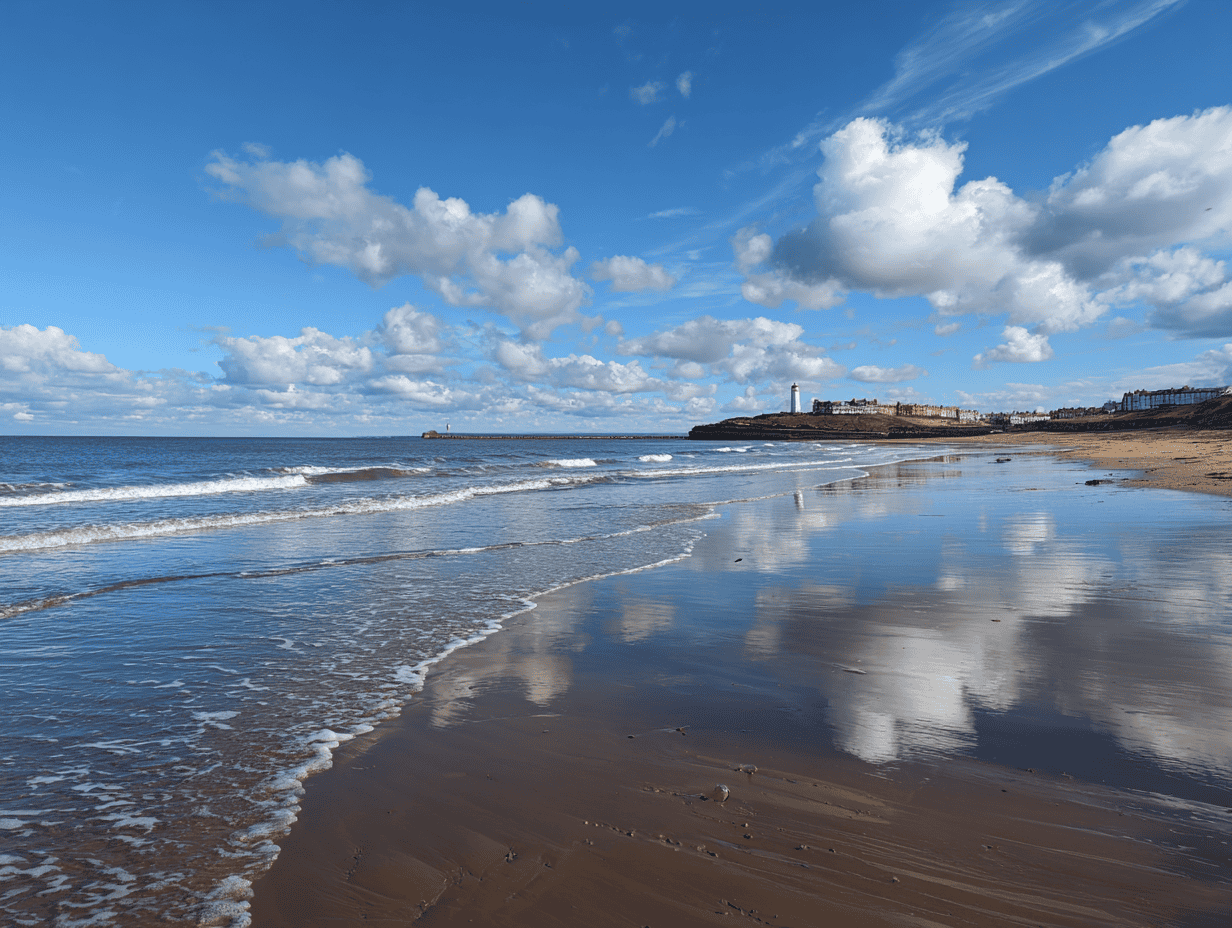
Hunting Below the Glass Capital of England
Marsden Beach is a good sea glass hunting beach, especially around the rock pools, pebble pockets and cave entrances exposed around Marsden Rock at lower tides. Green, white and brown are the most common finds, with blue, aqua, amber, turquoise, cobalt, black, lavender and occasional red also reported. The beach is trickier than a simple sandy hunt, but its dramatic limestone terrain and South Shields’ glassmaking history make it one of the North East’s most interesting places to search.
- Rating: Good Beach
- Terrain: Tricky
- Level: Intermediate
- Dog friendly: Yes – dogs welcome all year round, no seasonal restrictions
- Location: Marsden, South Shields, Tyne and Wear
- Sat Nav: NE34 7BS (Marsden Bay car park, A183 Coast Road)
- Common colours: Green, white, brown
- Rare colours: Cobalt Blue, Black, Lavender, Red
Today at Marsden Beach
Check for the latest ShoreSense Score and Tide Times. Scroll down for your 7-day forecast
Marsden Beach sea glass conditions
Marsden Beach
Tyne and Wear — Sea settling
61/100 — Good, best window 06:32–09:32.
Best window is 06:32–09:32 with spring tides (near full/new moon) and calm sea, so the chance of fresh finds is good today. Sea is likely calm and picked-over — go early.
Good day at a reliable beach
Ranked #66 in the UK ShoreSense leaderboard today.
| Tide | Time | Height |
|---|---|---|
| High water | 01:31 | 4.8 m |
| Low water | 08:02 | 1.0 m |
| High water | 14:06 | 4.8 m |
| Low water | 20:16 | 1.3 m |
Best For
- Sea glass hunting
- Rock pool searching
- Historic finds
- Storm hunting
- Photography
- Cave exploration
- Well-tumbled glass
- Coastal adventures
Why Marsden is the most historically significant sea glass beach in the North East
Most people know about Seaham. Fewer people know the story behind Marsden, which is a shame, because in terms of industrial glass history, South Shields makes Seaham look like a late arrival.
Glassmaking on the Tyne dates back to the 17th century, and South Shields’ first glasshouse followed around 1707. By the early 1800s, South Shields was one of the country’s largest glass-making centres, with eight large glassworks operating in the town. In 1827, about two-fifths of all English glass was made in the Tyneside area. By 1845, South Shields was making more plate glass than anywhere else in England.
The glass produced here, crown glass, plate glass, flint glass, bottle glass, supplied the whole of southern and eastern England. South Shields supplied the whole of southern and eastern England with glass, with about 60 per cent of the trade going through a London warehouse.
All of that industrial activity sat directly on the River Tyne, less than two miles from the Tyne mouth. And at the Tyne mouth, the North Sea takes over. Marsden Bay sits immediately south of the river entrance on the same magnesian limestone coast, positioned to receive exactly what the Tyne and two centuries of glass manufacturing put into these waters.
Marsden Beach is backed by tall, dramatic cliffs, featuring some of the most striking rock formations on the Northeast coast, including sea stacks, rock arches and the famous 30-metre Marsden Rock. Built into the cliff face is Marsden Grotto, one of only two cave bars in Europe, hewn from the rock when smugglers worked this shore.
It’s one of the most atmospheric beaches in the North East, and the sea glass story here is one of the best in the country.
What you’ll find here
Colours commonly found: Green, white, brown
Occasional finds: Blue, Aqua, Amber, Turquoise
Rare finds: Cobalt Blue, Black, Lavender, Red
Bonus: Littlehaven Beach, by South Shields pier at the mouth of the Tyne, is a few miles north and worth adding if you’re making a day of it. It sits right where the river meets the sea, and dogs are allowed year-round.
The caves accessible at low tide around Marsden Rock are worth exploring; glass accumulates in the sheltered cave floors between tides.
Find something special? Use our sea glass scanner, GlassLore, to find out rarity, value, and history; then share to our finds gallery and, more importantly, earn points to climb our hunters leaderboard – are you ready to compete?
When to go
Marsden faces east into the North Sea, the same aspect as Seaham and the Durham Heritage Coast immediately south. The same rules apply: after a northeasterly or easterly blow, on spring tides, arrive on the ebb. The tidal range at the Tyne mouth runs to around 4.5 metres on a spring tide, providing generous exposure that reveals the rock pools, cave entrances, and lower cliff-base sections where glass concentrates.
At low tide it is possible to walk out to Marsden Rock itself and explore the caves. These cave sections are the most sheltered and least picked-over sections of the beach; glass deposited there sits undisturbed between tides. Low tide access to the caves is the Marsden experience that casual visitors miss entirely.
Winter is the prime glass season, with North Sea storms, empty beaches and the biggest tides. Come back in spring or summer if you can, when Marsden Rock is home to one of England’s most important seabird colonies, and the kittiwakes are nesting on the stack.
Today’s ShoreSense Score & Best Hunting Window
Marsden Bay faces east into the North Sea, immediately south of the River Tyne mouth on the magnesian limestone coast of South Tyneside. The tidal range here runs to around 4–4.5 metres on a spring tide, enough to expose the rock pool sections, cave entrances and lower cliff base areas where glass concentrates most reliably. The tidal pattern is semi-diurnal with two highs and two lows per day.
As the tide falls, start on the main-bay strandline and the pebble pockets around the cliff base, then move into the rocky channels as more of the foreshore opens. Around lower water, the approach to Marsden Rock and the cave entrances becomes accessible, revealing sheltered shingle and rock pockets that are covered for much of the tidal cycle. Bigger spring lows expose more of these lower cliff-base sections. After stronger easterly or north-easterly weather begins to settle, also check the fresh strandline and lee sides of the larger rocks. Use today’s ShoreSense Best Window to choose when to arrive, but treat safe cave access around low water as a separate hard constraint.
The ShoreSense widget below combines recent marine conditions, tide timing and practical hunting weather to show today’s overall ShoreSense Score, Hunting Potential, Comfort and the best available hunting window for Marsden Beach. It uses UKHO tide data alongside current marine and weather inputs to help you judge whether conditions look promising for a hunt.
Marsden Beach sea glass conditions
Marsden Beach
Tyne and Wear — Sea settling
61/100 — Good, best window 06:32–09:32.
Best window is 06:32–09:32 with spring tides (near full/new moon) and calm sea, so the chance of fresh finds is good today. Sea is likely calm and picked-over — go early.
Good day at a reliable beach
Ranked #66 in the UK ShoreSense leaderboard today.
| Tide | Time | Height |
|---|---|---|
| High water | 01:31 | 4.8 m |
| Low water | 08:02 | 1.0 m |
| High water | 14:06 | 4.8 m |
| Low water | 20:16 | 1.3 m |
Compare your Beaches on our Hot Beaches page, updated daily with the best beaches for today, the next seven days, as well as the movers and shakers.
Where to look on the beach
The beach is both pebbly and sandy, backed by tall limestone cliffs with rock formations including sea stacks and arches. For sea glass, there are three distinct zones:
The main bay strandline -work the high-tide strandline from the cliff lift southward. Glass accumulates here after any significant North Sea swell, mixed in with the pebble and shell debris that collects along the wrack line. This section is most productive post-storm.
The rock pool sections – the rocky areas around the base of the cliffs and between the stacks produce the most consistent glass. Work the pebble pockets between rock formations carefully; glass concentrates in the same channels that trap driftwood and heavier debris. Wet pebbles at the waterline are far easier to read than dry ones further up the beach.
Marsden Rock and the cave mouths. At lower tides you can reach the foot of Marsden Rock, and the entrances to the caves along the cliff base. Glass settles in the sheltered pockets at the cave mouths, so work those edges. Don’t go deep inside or linger under overhangs, though: these cliffs are prone to rockfalls, and the water comes back round the rocks faster than you’d expect. Marsden Rock is also a seabird colony, so admire it from the sand.
Key Tip:
Time your visit for the last hours of the falling tide and head for the cave mouths around Marsden Rock. Work the sheltered pockets at the entrances, then start back well before the tide turns.
Difficulty Level: Intermediate
- Some of the best hunting areas are only accessible at low tide
- Rocky sections require careful footing, especially when wet
- Accessing caves and rock formations requires good timing
- Productive hunting grounds are spread across several different habitats
- Tide awareness is important to maximise your hunting window
Hunting Style: The Cave Explorer
Marsden rewards hunters who venture beyond the obvious. Search the strandline first, then move into the rocky channels, pebble pockets and cave entrances revealed at low tide. The most interesting finds are often tucked away in sheltered corners that many visitors overlook.
Beach Personality
Marsden feels wild, dramatic and full of secrets. Towering limestone cliffs, sea caves and the iconic Marsden Rock create one of the most atmospheric hunting locations on the North East coast. It’s the sort of beach where every rock formation seems to hide another crevice worth checking, and every low tide reveals new ground to explore. The combination of history, geology, and constantly shifting coastal conditions makes every visit feel like a genuine treasure hunt.
Dog friendly?
Yes. Dogs are welcome on Marsden Beach all year round, with no restrictions. South Tyneside’s summer dog ban covers only Sandhaven Beach, a few miles north. Keep your dog close around the cliff base and the cave mouths, and away from the seabirds on Marsden Rock in spring and summer. The Grotto welcomes dogs inside too, so it’s an easy post-hunt stop.
Souter Lighthouse, a 15-minute walk south along the coast path, is also dog-friendly and well worth including on any visit. The coastal path between Marsden and Souter is one of the better cliff walks in the North East.
For dog-friendly café and pub recommendations in South Shields, check our Yappy Places listings for the area. The Marsden Grotto itself is a unique stop, a pub carved into a limestone cliff above the beach with its own cliff lift.
Practical information
Parking: South Tyneside Council’s pay and display car park at Marsden Bay (NE34 7BS) sits on the clifftop beside the Grotto lift. Seafront parking starts at £1.20 for the first hour, and you can pay by cash or the PayByPhone app. It fills early on sunny weekends.
Access to the beach: There are two ways down. The Grotto’s lift runs from the clifftop straight down to the beach. The Grotto asks for a small donation, and the lift can close around high tide, so check its Facebook page before you go. The Redwell Bank steps, a timber-and-steel staircase rebuilt in 2022, are the other route, but the bottom can be cut off at high tide. The Grotto steps beside the lift were closed by the council for safety surveys in December 2025, so check whether they’ve reopened before relying on them. Whichever way you go down, factor in the climb back up.
Accessibility: replace the first sentence with: The Grotto lift is the only step-free way down, and it can close at high tide.
Toilets: Public toilets are available at the beach.
Food and drink: Marsden Grotto is literally carved out of the rock face and accessed by the cliff lift, one of the most extraordinary pub locations in England. It serves food and drinks throughout the day. Colman’s Seafood Temple in South Shields is a Northeast institution for fish and chips, a 10-minute drive north.
Getting there without a car: The nearest Metro station is South Shields, with the E1 bus from South Shields to Sunderland stopping at Marsden Bay. South Shields Metro station is on the Tyne and Wear Metro network, with services from Newcastle.
Accessibility: The cliff lift provides access to the beach for those who cannot manage the steps; a voluntary donation is requested for its use. The beach is a mix of sand and pebble, with uneven sections around the rock formations.
What to bring
- Sturdy footwear with grip – the rock pool sections and cave approaches are slippery, especially when wet
- A tide table, and a plan to be off the rocks before the tide turns
- A small container for finds – the cave sections may produce older and more unusual pieces
- Layers – the cliff-backed beach creates its own wind-channelling effect, and the North Sea air arrives with intent
- A tide table – cave access closes quickly; check the window before heading out to the rock
The history behind the glass
The glass story at Marsden begins not on the beach but in the town two miles to the north. The first glasshouse at South Shields was established around 1707. By 1737, the Cookson family, who would become the dominant glassmakers of the Northeast, had set up their crown and plate glass works on the Tyne, with the whole of southern and eastern England receiving consignments from their works.
Glass-making had been introduced to South Shields in the 17th century by Huguenot exiles fleeing persecution in France, skilled craftsmen who brought Continental techniques to a town perfectly positioned for the industry: coal for the furnaces, the Tyne for transport, and the North Sea for disposal of waste. By 1827, two-fifths of all English glass was made on Tyneside. By 1845, South Shields was making more plate glass than anywhere else in England.
Among the last of the great South Shields glassmakers was Edward Moore, whose Tyne Flint Glass Works produced extraordinary Victorian pressed glass until the works finally closed in 1913. The works used a ballast wagonway to take waste material directly to the coast. The glass from two centuries of production- crown glass, plate glass, flint glass, bottle glass, pressed glass- entered the Tyne and the North Sea in quantities that dwarf most other UK glass beach sources outside of Seaham itself.
Marsden Bay itself has its own darker history. The limestone caves in the cliff face were smugglers’ haunt for centuries. The ghost of John the Jibber, who was suspended in a bucket halfway down the cliff after betraying his fellow smugglers to the customs men, is said to haunt the Grotto to this day. The smuggling trade brought its own glass to these shores: Dutch gin jars, French brandy bottles, spirit flasks from across the Channel. Every era of this coast’s history has contributed to what the North Sea returns to the beach today.
From beach to jewellery
Marsden glass carries the history of Tyneside’s great glassworks, two centuries of industrial production that supplied the whole country, tumbled by North Sea tides in the shadow of the cliffs where smugglers once worked. At Mermaid Tears, every piece of jewellery starts exactly where you’ve been standing, hand-hunted from UK coastlines and made into something lasting. Browse the collection.
Disclaimer: Tide times, parking charges and beach conditions change regularly. Always verify before visiting. Cave access at Marsden Rock is only safe around low water; always check tide times before exploring. Beach access routes can close for safety work or at high tide; check South Tyneside Council and the Grotto before you go. Check the Marsden Grotto website for current lift operating hours. National Trust parking charges are subject to change.
Last updated: Sept 2026
Frequently asked questions
Is Marsden Beach good for sea glass? Yes – it’s a consistently good beach with a glass origin story that rivals any beach in the UK. The eight South Shields glassworks that supplied two fifths of all English glass by 1827 sat two miles from this beach on the Tyne, and the North Sea has been returning their output ever since. The cave sections at low tide are the most productive and least picked-over areas.
What is the history of glassmaking at South Shields? South Shields was one of the most important glass manufacturing centres in England for over two centuries, beginning with Huguenot craftsmen in the 17th century. By the early 1800s, the town had eight large glassworks; by 1845, it was making more plate glass than anywhere else in England. The glass from these works entered the Tyne and the North Sea in enormous quantities and is still being returned to Marsden Bay today.
Are dogs allowed at Marsden Beach? Yes, all year round. South Tyneside’s summer dog ban applies only to Sandhaven Beach.
Can I explore the caves at Marsden Rock? Around low tide, you can reach the cave mouths at the base of the cliffs, and the sheltered pockets there are worth checking for glass. Don’t go deep inside or stand under overhangs, because the cliffs are prone to rockfalls, and head back well before the tide turns.
How do I get to Marsden Beach without a car? Take the Tyne and Wear Metro to South Shields station, then the E1 bus towards Sunderland, which stops at Marsden Bay. South Shields Metro station is on the Yellow Line from Newcastle city centre.
What is the Marsden Grotto? The Marsden Grotto is a pub and restaurant literally carved out of the limestone cliff face above the beach, accessed by a cliff lift. It’s one of only two cave bars in Europe and has been serving the beach since the 18th century, originally a haunt of smugglers, now a very good place for a post-hunt meal. The cliff lift is a voluntary donation and also provides beach access for those who can’t manage the wooden steps.
More North East Beaches
Check out our Full North East Guide or plan your trip with our UK Sea Glass Map.