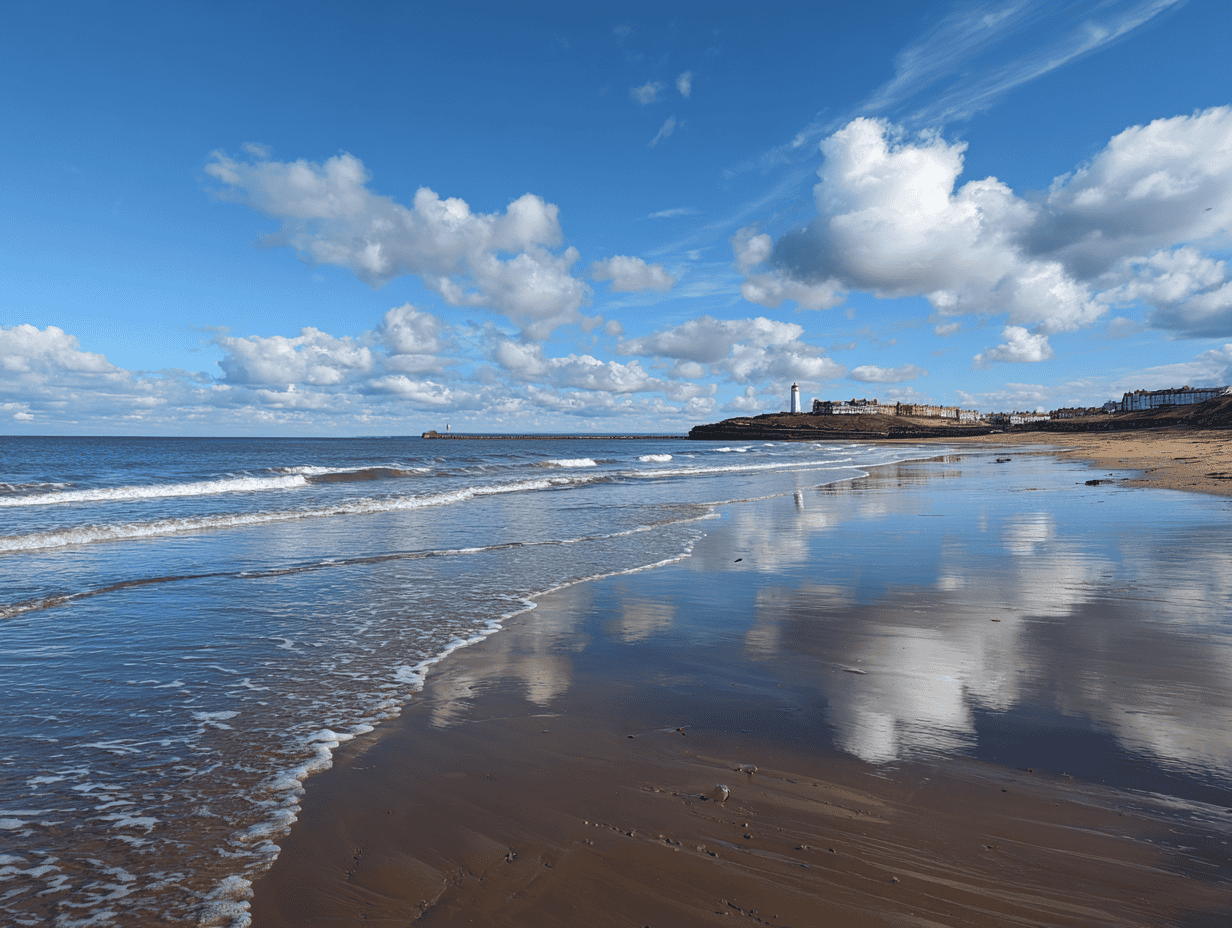
Where English Glassmaking Began
Roker and Seaburn are good sea glass hunting beaches, with the best hunting concentrated around the lower foreshore at Roker Pier, the rocky section at Seaburn’s Cat and Dog steps, and the quieter stretch towards South Bents. Green, white, brown and pale blue are the most common finds, with blue, aqua, amber, turquoise, cobalt, black, lavender and occasional red also reported. The open sandy sections are less productive, so focus on rocks, groynes, shingle pockets and strandline accumulations.
- Rating: Good Beach
- Terrain: Easy
- Level: Beginner
- Dog friendly: Seasonal -two separate summer exclusion zones (1 May to 30 September), with a long dog-friendly stretch between them, including the Cat and Dog Steps
- Location: Roker & Seaburn, Sunderland, Tyne and Wear
- Sat Nav: SR6 0ZZ (Roker, Harbour View car park) · SR6 7QE (Seaburn, Dykelands Road car park)
- Common colours: Green, white, brown, pale blue
- Rare colours: Cobalt Blue, Black, Lavender, Red
Today at Roker & Seaburn
Check for your latest ShoreSense Score and tide times. Scroll down for the full 7-day forecast
Roker & Seaburn sea glass conditions
Roker & Seaburn
Tyne and Wear — Sea settling
62/100 — Good, best window 06:29–09:29.
Best window is 06:29–09:29 with spring tides (near full/new moon) and calm sea, so the chance of fresh finds is good today. Sea is likely calm and picked-over — go early.
Good day at a reliable beach
Ranked #58 in the UK ShoreSense leaderboard today.
| Tide | Time | Height |
|---|---|---|
| High water | 01:24 | 4.9 m |
| Low water | 07:59 | 1.0 m |
| High water | 14:02 | 5.0 m |
| Low water | 20:13 | 1.3 m |
Best For:
- Sea glass hunting
- Harbour finds
- Beginners
- Long beach walks
- Sea pottery
- Storm hunting
- Family visits
- Sunderland history
Why Roker and Seaburn have the most extraordinary glass history in the UK
Most sea glass beaches have a history. Seaham has the Londonderry Bottleworks. South Shields had eight Victorian glassworks. But Roker and Seaburn sit at the mouth of the River Wear, and the Wear’s glass story begins not in the Victorian era, not in the 18th century, but in the year 674 AD.
The first recorded production of glass in England took place in 674 AD, when the Venerable Bede described how glassmakers from Gaul were brought in to make windows for the newly built church and monastery at Monkwearmouth in Sunderland. That monastery, St Peter’s Church, which still stands today a mile from this beach, is where English glassmaking began.
The Victorian era took that ancient tradition to an industrial scale. James Hartley established the Wear Glass Works in Sunderland in 1836. By the 1860s, the works employed 700 men and supplied one-third of the country’s plate glass. Turnbull’s Cornhill Flint Glassworks at Southwick operated from 1865 to 1953.
The Wear Flint Glass Works became James A. Jobling and Co., which, from 1922, manufactured every piece of Pyrex sold in Britain, the iconic heat-resistant ovenware found in every British kitchen for decades, all made here on the Wear. Arc Glass’s closure in 2007 ended Wearside’s long history of commercial glass production, a tradition that had run continuously for over thirteen centuries.
All of that glass, the waste, the cullet, the breakages from over a century of industrial production, entered the River Wear and the North Sea. Roker and Seaburn beaches sit directly at the Wear mouth.
The glass from one of the longest glassmaking traditions in the world is still being returned to these beaches by the North Sea today.
What you’ll find here
Colours commonly found: Green, white, brown, pale blue
Occasional finds: Blue, Aqua, Amber, Turquoise
Rare finds: Blue, Aqua, Amber, Turquoise
Bonus: Roker Beach is noted for well-tumbled, frosted glass pieces. The North Sea does thorough work on material from the Wear mouth before it reaches the shore.
The rock pool section accessible from the Cat and Dog steps at Seaburn produces older pieces that have been trapped between tides. The National Glass Centre, 10 minutes’ walk from the seafront, is worth visiting on any trip, with glassblowing demonstrations and the full story of Wearside’s glass history in one building.
Find something special? Use our sea glass scanner, GlassLore, to find out rarity, value and history; then you can share to our finds gallery and, more importantly, earn points to climb our hunters leaderboard – are you ready to compete?
When to go
Both beaches face northeast into the North Sea, the same aspect as the Durham Heritage Coast immediately to the south. Post-storm conditions after a northeasterly blow are the best scenario. The longshore drift runs north to south along this coast, which means material produced at the Tyne mouth and further north gradually works its way south past these beaches.
Spring tides run to around 4.5 metres at the Wear mouth, providing generous exposure that opens up the rock pool sections and lower beach areas. The Cat and Dog steps section at Seaburn and the rocks around the base of Roker Pier are the most productive areas and are only fully accessible at lower tides.
Autumn and winter are the prime glass season, with bigger seas, emptier beaches and no dog restrictions from October to April. In summer, dog owners can still hunt the Cat and Dog Steps, which sit outside both exclusion zones.
Today’s ShoreSense Score & Best Hunting Window
Roker and Seaburn sit at the mouth of the River Wear facing northeast into the North Sea, with a tidal range of around 4–4.5 metres on a spring tide. The semi-diurnal tidal pattern produces two highs and two lows per day.
At low water, the rock pool sections at Seaburn’s Cat and Dog steps and the lower foreshore around Roker Pier are accessible. These are the most productive sections and only reveal themselves on a decent ebb.
As the tide falls, start around the lower foreshore at Roker Pier, checking the mixed pebble and rock around the pier base rather than the open sand. As more of the shoreline opens, move north to Seaburn and work the rock pools and shingle around the Cat and Dog steps. Bigger spring lows expose much more of these lower rocky sections, and if time allows, continue towards South Bents and Whitburn, where the shoreline is quieter, and the shingle accumulations are worth scanning.
After stronger north-easterly weather begins to settle, also check fresh strandlines and the lee sides of groynes along the route. Use today’s ShoreSense Best Window to choose when to arrive, then follow this Roker Pier → Cat and Dog steps → South Bents progression once you’re there.
With a dog between May and September, start at the Cat and Dog Steps rather than the pier, and use the promenade to get past the Seaburn zone.
The ShoreSense widget below combines recent marine conditions, tide timing and practical hunting weather to show today’s overall ShoreSense Score, Hunting Potential, Comfort and the best available hunting window for Roker & Seaburn. It uses UKHO tide data alongside current marine and weather inputs to help you judge whether conditions look promising for a hunt.
Roker & Seaburn sea glass conditions
Roker & Seaburn
Tyne and Wear — Sea settling
62/100 — Good, best window 06:29–09:29.
Best window is 06:29–09:29 with spring tides (near full/new moon) and calm sea, so the chance of fresh finds is good today. Sea is likely calm and picked-over — go early.
Good day at a reliable beach
Ranked #58 in the UK ShoreSense leaderboard today.
| Tide | Time | Height |
|---|---|---|
| High water | 01:24 | 4.9 m |
| Low water | 07:59 | 1.0 m |
| High water | 14:02 | 5.0 m |
| Low water | 20:13 | 1.3 m |
Compare your Beaches on our Hot Beaches page, updated daily with the best beaches for today, the next seven days, as well as the movers and shakers.
Stop 1 – Roker Beach
Roker is the southern stop and the more sheltered of the two beaches, tucked partly behind the impressive Victorian Roker Pier. The pier and lighthouse extend into the North Sea and are a distinctive local landmark. The pier is a great place for a scenic walk, and the lighthouse opens for tours.
For sea glass, focus on two areas: the lower beach around the base of the pier at low tide, where centuries of maritime activity and river mouth drift have deposited material; and the rocky sections at the southern end of the beach, where mixed pebble and rock concentrate glass more effectively than the open sandy central beach.
Roker Beach has a very gentle access from the promenade, no steps, no cliff descent, just a straightforward walk onto the beach from the seafront road. That ease of access makes it a good starting point before working north to Seaburn.
Parking: Pay and display parking at SR6 9NS along the seafront. Charges apply – check the Sunderland City Council website for current tariffs.
From May to September, this end of Roker is inside the dog exclusion zone. If you’ve got your dog with you, start at the Cat and Dog Steps instead and work outwards from there.
Stop 2 – Seaburn Beach
Seaburn is the northern stop, and together with the rocks that separate it from Roker, it’s where glass concentrates most reliably. Park on Stanhope Street, cross the seafront road and take the Cat and Dog steps down to the rocks where Roker beach gives way to Seaburn. The rock pools and shingle pockets here trap material between tides, so work them slowly on a falling tide.
A promenade runs alongside the beach connecting Seaburn south to Roker. At low tide, you can walk the full length of both beaches without retracing your steps. That connected foreshore means a single visit can cover both stops efficiently on a good spring low tide.
Further north, the stretch between South Bents and Whitburn, around Sea Lane, is quieter and less picked-over, with rock pools and shingle worth scanning on a good low tide.
Parking: Spaces along Queens Parade require a ticket. The car park next to The Stack (SR6 8AA) has charges. The Dykelands Road car park (SR6 8DD) charges £3 all day. Free parking is available at Morrisons with time limits.
Key Tip
Start around Roker Pier and work your way north towards Seaburn, checking every groyne and strandline accumulation. The areas where shingle and heavier material collect often produce far more glass than the open sandy sections.
Difficulty Level – Beginner
- Wide, accessible beaches with straightforward walking
- Productive hunting areas are easy to identify around the pier, groynes and strandline
- Minimal scrambling required
- Plenty of beach is exposed at lower tides
- Suitable for first-time sea glass hunters and families
Hunting Style – The Strandline Wanderer
Roker and Seaburn reward hunters who cover ground. Work the strandline after storms, search around the groynes and gradually move away from the busiest promenade sections. Freshly deposited material often appears along long stretches of beach rather than in a single hotspot.
Beach Personality
Roker and Seaburn feel like classic North East sea glass beaches. Backed by promenades, piers and a rich maritime history, they combine easy access with genuine hunting potential. The beaches are large enough to absorb plenty of visitors while still leaving productive stretches for those willing to walk a little further. After a good blow from the North Sea, the shoreline can produce some surprisingly rewarding finds.
Dog friendly?
Seasonal, but this is one of the easier restricted beaches to hunt with a dog, as long as you know where the lines are.
From 1 May to 30 September, Sunderland City Council enforces two separate dog exclusion zones: a section of Roker beach at the southern end, running up from the pier, and a stretch much further north at Seaburn. Between them is a sizeable unrestricted stretch, and that includes the Cat and Dog Steps, one of the best hunting spots on the whole shoreline. You can hunt the rocks there with your dog all summer.
The catch comes if you carry on south towards Roker Pier. The exclusion zone starts partway along, so watch for the council signs before you get there. The same goes heading north into Seaburn. Breaches carry a £100 fixed penalty notice, and the zones are marked on the council’s Roker and Seaburn dog control maps at sunderland.gov.uk.
From October to April, both beaches are open to dogs end to end, and that’s peak glass season anyway.
Walking the whole shoreline north to South Bents with your dog in summer? The Seaburn zone is in the way: a stretch of beach running from the Seaburn junction to roughly opposite Morrisons. Hop up onto the promenade to pass it, then drop back down. The beach beyond, along Whitburn Bay towards South Bents, is unrestricted.
For dog-friendly café and pub recommendations in Roker and Seaburn, check our Yappy Places listings for Sunderland.
Practical information
Parking: For Roker Pier, Harbour View car park (Marine Walk, SR6 0ZZ) has 128 spaces at 70p an hour or £3 all day, 8am to 10pm. It’s locked overnight, so don’t get caught out on an evening tide. For Seaburn, Dykelands Road car park (SR6 7QE) has 92 spaces at 80p an hour or £3 all day, 8am to 10pm. Blue Badge holders park free with no time limit at both. There’s more pay and display along Queens Parade and beside The Stack, and Morrisons at Seaburn has a time-limited customer car park.
Toilets: Available at both Roker and Seaburn seafronts.
Food and drink: There are plenty of places to eat and drink along the promenade at both Roker and Seaburn. Latimer’s Seafood Deli at the northern end of Seaburn is a Northeast institution, with outstanding seafood, directly on the coast road. The Snow Goose café at Roker is popular with sea glass hunters.
National Glass Centre: Just a 10-minute walk from the seafront, the National Glass Centre tells the full story of Sunderland’s glassmaking heritage with exhibitions and daily glassblowing demonstrations. Free entry, worth every minute; the context it gives to the glass you’ve just found on the beach is remarkable.
Getting there without a car: Seaburn and St Peter’s stations on the Tyne and Wear Metro are both within walking distance of the seafront. Seaburn is best for the northern beach; St Peter’s is best for Roker and the National Glass Centre. Buses also run from Sunderland city centre to the seafront; check Nexus for current routes.
Accessibility: Both beaches have flat, easy promenade access. Roker has a gentle slope to the beach. The Cat and Dog steps at Seaburn involve steps; the rest of the beach is accessible from the promenade.
What to bring
- Flat, comfortable footwear – the rock pool sections at the Cat and Dog steps are slippery
- A small container – two stops means two bags, keeps the finds organised by location
- Layers – the Wear mouth is fully exposed to the North Sea, and the northeast wind arrives without warning
- A tide table – the Cat and Dog steps section and Roker Pier base are only fully productive around low water
- Time for the National Glass Centre – combine a beach visit with a stop at the centre, and you’ll leave understanding these beaches in a way most visitors never do
The history behind the glass
The first chronicled production of glass in England was in 674 AD when Bede described how glassmakers were brought from Gaul to make windows for the monastery of St Peter’s at Monkwearmouth, Sunderland. That church still stands today, less than a mile from Roker Beach. England’s glass story begins here, on the Wear, over thirteen centuries ago.
Over the following centuries, Sunderland became famed for its glassware, from bottles to high-class dinner services, with many factories setting up during the Industrial Revolution, including world-renowned glassmakers Hartley Wood. The Wear Glass Works was established in 1836 by James Hartley, who had previously worked with Chance Brothers in Birmingham.
The works produced roller plate window glass, stained glass, and tableware, and by the 1850s produced one third of all plate glass in the country, with coal brought along the Hetton Railway directly to the works.
The Wear Flint Glass Works was launched in 1858, with ownership eventually passing to James Augustus Jobling in 1885. From 1922, Jobling’s manufactured Pyrex under licence from the American firm Corning; every piece of Pyrex heat-resistant ovenware in every British kitchen for decades was made here on the Wear.
Few people outside the North East realise that the iconic Pyrex designs Gaiety, Snowflake, Matchmaker, Fiesta, and Tally-Ho, found in virtually every British kitchen after the Second World War, originated in Sunderland.
The closure of Arc Glass in 2007 brought to a close Wearside’s long history of commercial glass production, closing a story that began with Bede’s glassmakers more than thirteen centuries earlier. The glass you find on Roker and Seaburn beaches today is the last physical evidence of that tradition: tumbled by the North Sea, returned to the shore, waiting to be found.
From beach to jewellery
Roker and Seaburn glass comes from the river where English glassmaking began, tumbled by North Sea tides and returned to the shore. At Mermaid Tears, every piece of jewellery starts exactly where you’ve been standing,hand-hunted from UK coastlines and made into something lasting. Browse the collection.
Disclaimer: Tide times, dog restriction boundaries, parking charges and beach conditions change regularly. Always verify before visiting. Dog exclusion zones are enforced with £100 Fixed Penalty Notices. Check the current Sunderland City Council PSPO map at sunderland.gov.uk before visiting with a dog between May and September. The PSPO was renewed in 2024 for three years, but boundaries may be updated; always check the current signage on the day.
Last updated: Sept 2026
Frequently asked questions
Is Roker and Seaburn good for sea glass? Yes – a consistent Good Beach with a glass origin story that stretches back 1,350 years. The rock pool section at Seaburn’s Cat and Dog steps and the lower foreshore around Roker Pier are the most productive sections. Volume won’t match Seaham, but the quality and historical context are extraordinary.
What is the glassmaking history of Sunderland? English glassmaking began at Monkwearmouth, Sunderland, in 674 AD. By the Victorian era, the Wear had multiple major glassworks producing a third of all English plate glass. From 1922, every piece of British Pyrex was made on the Wear by James Jobling and Co. Commercial production continued until Arc Glass closed in 2007, ending 1,333 years of continuous glassmaking.
Are dogs allowed at Roker and Seaburn? Seasonally. From 1 May to 30 September there are two separate exclusion zones, one at the southern end of Roker near the pier and one further north at Seaburn, with a long unrestricted stretch between them that includes the Cat and Dog Steps. From October to April, dogs can go anywhere on both beaches. Breaches carry a £100 fixed penalty notice.
What is the National Glass Centre? The National Glass Centre is a free museum and working glass studio on the banks of the Wear, a 10-minute walk from the seafront. It tells the full story of Sunderland’s glassmaking history and runs daily glassblowing demonstrations. It’s essential context for understanding what you’re finding on the beach.
When is the best time to visit for sea glass? Low tide after a northeasterly North Sea blow in autumn or winter. The Cat and Dog steps section at Seaburn and the Roker Pier base are most productive; arrive on an ebbing tide and work the rocks as they open up. October through April is the prime window with no dog restrictions.
Can I walk from Roker to Seaburn along the beach? Yes- at low tide, the connected foreshore allows a continuous walk from Roker Pier northward to Seaburn and beyond towards South Bents. The promenade provides the same route at any tide level. Plan the walk to start at Roker on an ebbing tide and work north as the beach opens up.
More North East Beaches
Check out our Full North East Guide or plan your trip with our UK Sea Glass Map.