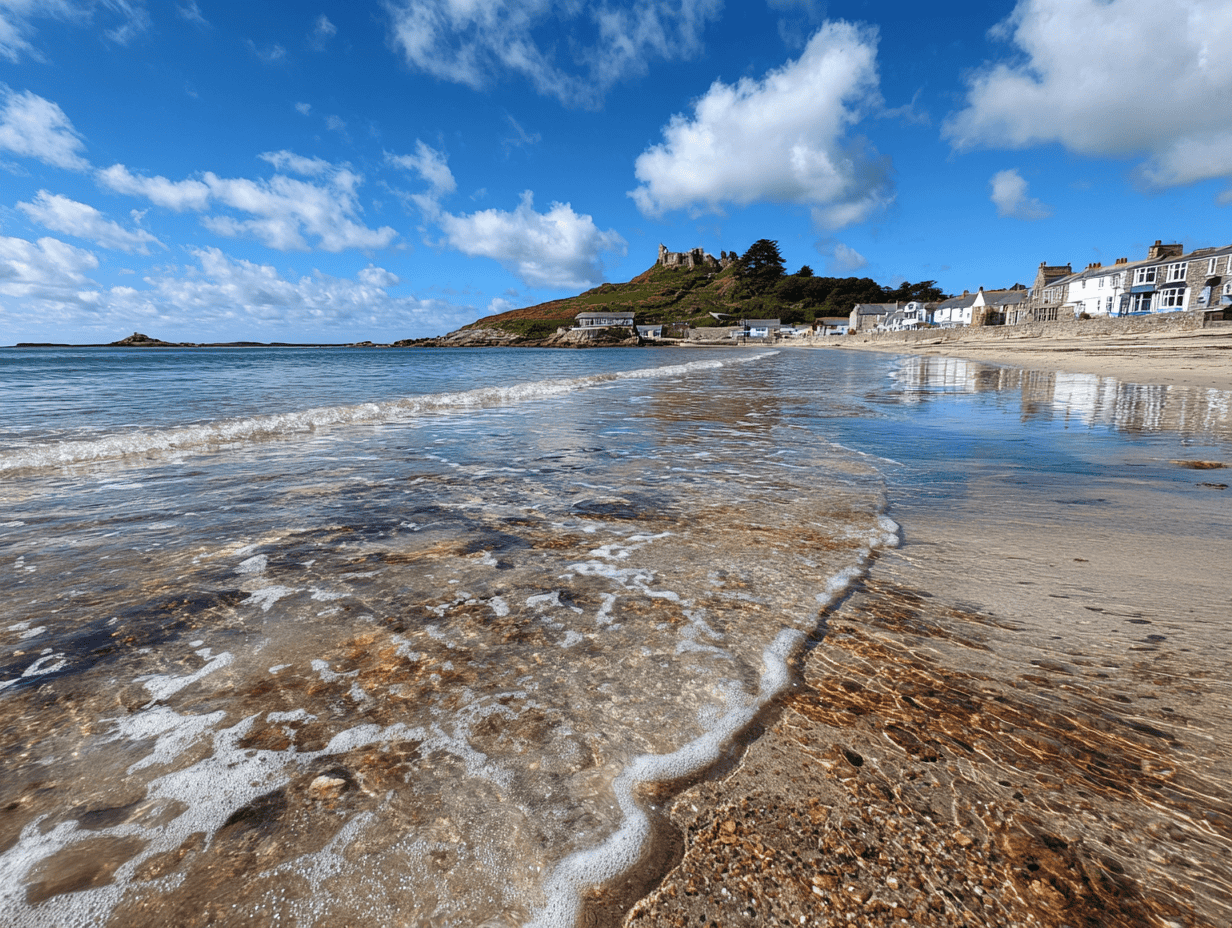
Cornwall’s Industrial Port and the Glass It Left Behind
. Portreath is a good sea glass hunting beach, especially around the harbour wall, tidal pool margins, western rock pockets and Smuggler’s Cove at lower water. Green, brown, and white are the most common finds, with blue, aqua, amber, and turquoise appearing occasionally, and cobalt blue, black, lavender, and red among the rarer colours reported. The sandy centre is worth a strandline scan, but the harbour-side and rocky sections are the areas I’d prioritise.
- Rating: Good Beach
- Terrain: Easy
- Level: Intermediate
- Dog friendly: Seasonal (dogs banned 1 July–31 August, 10am–6pm)
- Location: Portreath, near Redruth, North Cornwall
- Sat Nav: TR16 4NN (beach car park)
- Common colours: Green, brown, white
- Rare colours: Cobalt Blue, Black, Lavender, Red
Today at Portreath Beach
Check the latest ShoreSense score and tide times. Scroll down to find out your 7-day Forecast
Portreath Beach sea glass conditions
Portreath Beach
Cornwall — Fresh swell
93/100 — Perfect, best window 08:52–11:52.
Best window is 08:52–11:52 with strong recent seas delivering glass and spring tides (near full/new moon), so the chance of fresh finds is perfect today. Great combo of sea state and weather — worth the trip.
Strong window at a solid beach
Ranked #8 in the UK ShoreSense leaderboard today.
| Tide | Time | Height |
|---|---|---|
| High water | 04:02 | 6.7 m |
| Low water | 10:22 | 1.1 m |
| High water | 16:19 | 7.0 m |
| Low water | 22:42 | 0.9 m |
Best For:
- Historic sea glass
- Harbour finds
- Rock pool searching
- Sea pottery
- Hidden coves
- Low-tide exploration
- Storm hunting
- Cornwall adventures
Why Portreath – the most important industrial port in Cornwall, and a glass story three centuries deep
Portreath doesn’t look like a place that once drove the Industrial Revolution. The village is small, the valley steep, the beach sandy and family-friendly. On a summer afternoon, it could be any pleasant north Cornish cove, a surf break off the harbour wall, a tidal pool, children in the shallows, ice creams from the café.
But look at the harbour. The eastern quay was once lined with hutches where copper ore was stored awaiting shipment. The harbour mouth is notoriously narrow and exposed to the Atlantic swell; the violent seas at Portreath made it very difficult for the sailing ships that carried copper out and Welsh coal in. And at its peak, Portreath handled up to 700 ships a year and exported around 100,000 tons of copper ore annually. By 1827, it was described as Cornwall’s most important port.
That is the glass story at Portreath. Three centuries of industrial maritime activity: copper, coal, tin, limestone, shipbuilding, fishing, rope making- all of it feeding into the north Cornish sea. Commercial operations in the harbour only ceased around 1960. The Atlantic has been working that material ever since, and the beach and its coves are where it deposits what’s left.
The Atlantic does the rest. The swell that makes Portreath a surf beach also breaks glass down into thick, well-frosted pieces, and after a storm the tide lands them along the strandline and in the rocky corners. The harbour wall, the rock pools and the small coves are where they gather.
This is a genuinely good glass beach with a history story that puts it in a different class from a standard north Cornwall surf beach.
What you’ll find here
Colours commonly found: Green, brown, white
Occasional finds: Blue, Aqua, Amber, Turquoise
Rare finds: Cobalt Blue, Black, Lavender, Red
Bonus: Sea pottery, Victorian stoneware fragments, smooth Cornwall pebbles, occasional fragments of coal from the harbour era
Want to understand how unusual your find is? See our Sea Glass Colours & Rarity Guide
Found something unusual? Try GlassLore, our free sea glass scanner, to explore what it could be and log your find to the gallery and, more importantly, earn points and climb the leaderboard.
When to go
The period after stronger Atlantic conditions can be worth watching, especially once the sea begins to settle. Portreath’s north-facing exposure means northwesterly swell can deliver significant marine energy to the beach, while lower tides expose the harbour wall, rock pools and other productive hunting areas. Check the current ShoreSense Score and Best Window before travelling.
The spring tidal range here is around 5.5–6 metres, significant enough that the foreshore changes considerably between high and low water. At high tide, the beach narrows, and the shorebreak can be heavy. At low tide, the full beach opens, the rock pools become accessible, and the area around the harbour wall base is reachable. Arrive on an ebbing tide.
Winter and autumn are the best seasons. The Atlantic storms are more frequent, the beach is quiet after the summer visitors leave, and the dog restrictions lift entirely. The tidal pool beside the harbour wall, sheltered from the swell, is accessible in all but the roughest conditions.
One seasonal curiosity: in January 2016, after a powerful storm, the remains of a petrified forest were uncovered on the beach. The tree stumps emerge every few years and are believed to be between 4,000 and 6,000 years old. Portreath gives up more than just glass.
Today’s ShoreSense Score & Best Hunting Window
Portreath sits on the north Cornwall coast facing directly into the Atlantic, with a tidal range of around 6 to 6.5 metres
on a spring tide. That range means the foreshore changes significantly between high and low water. At low tide, the beach widens, the rock pools open up, and the harbour wall section becomes fully accessible.
As the tide falls, start beside the harbour wall and work the rougher ground and rock-pool edges exposed at its base. Then check the margins of the tidal pool, followed by the western rock pockets around the Lady Bassett baths and, if conditions are safe, Smuggler’s Cove. The main sandy beach is better treated as a strandline scan than the primary hunt.
Bigger lows expose more of the rocky ground, but the Atlantic shorebreak can be powerful here, so keep a generous safety margin. Use today’s ShoreSense Best Window to choose when to arrive, then follow this harbour-wall → tidal-pool → western-rock → strandline progression once you’re there.
The widget below uses UKHO tide data alongside recent marine conditions and practical hunting weather to show today’s overall ShoreSense Score, Hunting Potential, Comfort and the best available hunting window for Portreath. ShoreSense doesn’t predict whether glass will definitely be present; it helps you judge whether conditions look more or less promising for a hunt.
Portreath Beach sea glass conditions
Portreath Beach
Cornwall — Fresh swell
93/100 — Perfect, best window 08:52–11:52.
Best window is 08:52–11:52 with strong recent seas delivering glass and spring tides (near full/new moon), so the chance of fresh finds is perfect today. Great combo of sea state and weather — worth the trip.
Strong window at a solid beach
Ranked #8 in the UK ShoreSense leaderboard today.
| Tide | Time | Height |
|---|---|---|
| High water | 04:02 | 6.7 m |
| Low water | 10:22 | 1.1 m |
| High water | 16:19 | 7.0 m |
| Low water | 22:42 | 0.9 m |
Compare your Beaches on our Hot Beaches page, updated daily with the best beaches for today, the next seven days, as well as the movers and shakers.
Where to look on the beach
Portreath has three distinct hunting zones, each with its own character.
The harbour wall section is the most productive. At low water, the base of the wall on the beach side and the rock pools beside it are reachable, and centuries of harbour activity have left material in the crevices and shingle pockets there. Work slowly along the full length. Take care in any swell: waves break hard against the wall, and this is not a place to have your back to the sea.
The tidal pool beside the harbour wall is a sheltered gem. Protected from the main swell by the harbour arm, its margins collect glass sorted by the water moving in and out on each tide. Check the edges rather than the pool floor.
Smuggler’s Cove / Amy’s Cove – to the west of the main beach, separated at high water, is a small secluded cove known as Smuggler’s Cove or Amy’s Cove. Quieter and less visited than the main beach, it’s worth the short scramble around the rocks at low tide. Material blown around the western headland accumulates here.
The six Lady Bassett rock baths cut into the western side of the beach are an extraordinary historical feature: six small baths cut into the rocks in the 19th century for Lady Frances Bassett, who owned the harbour and estate. The rocky sections around and between them trap glass in their natural pockets.
The main sandy beach holds glass in the strandline and in shingle patches, but the rocky sections concentrate material most consistently.
Key Tip:
Time your visit for low tide and start at the harbour wall. Work every crevice, shingle pocket and rock pool along its length before moving on to the tidal pool and Smuggler’s Cove. The majority of the best finds come from these concentrated collection zones rather than the open beach itself.
Difficulty Level- Intermediate
- The most productive areas are only fully accessible around low tide
- Several hunting zones require moving between rocks, pools and harbour structures
- Smuggler’s Cove is separated at high water and requires careful timing
- Success comes from targeting specific hotspots rather than searching the open beach
- Rocky terrain can be slippery when wet
Hunting Style- The Harbour Forager
Portreath rewards hunters who search around structures. Focus on harbour walls, tidal pools, rock baths and sheltered coves where material becomes trapped and protected from constant movement. The best finds often come from carefully investigating pockets and crevices rather than covering lots of distance.
Beach Personality
Portreath feels like a beach built for treasure hunting. Between the historic harbour, hidden coves, tidal pool and the remarkable Lady Bassett rock baths, almost every corner of the shoreline seems to have a story attached to it. The beach combines maritime history, mining heritage and Atlantic energy in a way that creates endless places for glass to hide. It’s the sort of location where curiosity is often rewarded and where one productive pocket can easily make an entire visit worthwhile.
Dog friendly?
Seasonal – dogs are not allowed on Portreath Beach from 1 July to 31 August between 10am and 6pm. Outside those hours and dates, dogs are welcome on the full beach. The cliffs and coastal path above the beach on the South West Coast Path are accessible year-round.
In practice, autumn and winter visits are unrestricted, which lines up neatly with the best glass conditions. In July and August, an early start before 10am or an evening visit after 6pm gives you the full beach with your dog, and those are the quieter hunting windows anyway.
Check our Yappy Places listing for Portreath for dog-friendly options in the village after the hunt.
Practical information
Parking: One privately run pay and display car park right on the beach at TR16 4NN, with around 125 spaces. It’s the only designated car park in Portreath, so it fills fast in summer. Charges start from about £2 an hour, and the car park closes at 10pm. No motorhomes. There’s some roadside parking in the village on the B3301, which is where campervans tend to end up. Unlike Cornwall Council’s beach car parks, this one charges year-round.
Toilets: Public toilets on the road just before the car park, with disabled facilities available.
Food and drink: Café, pub and shops in the village, all within easy reach of the beach. The beach café is open throughout the season. The Basset Arms and the Waterfront pub are the main options for a post-hunt drink or meal.
Getting there without a car: Bus services connect Portreath to Redruth, which is on the mainline from London Paddington. Check current First Kernow services for the Portreath route, not the most frequent service outside summer.
Accessibility: Level access to the beach from the road at the car park end. Short steps to the beach at the far end are unsuitable for wheelchairs. The main beach and promenade area are accessible.
What to bring
- Sturdy shoes or wellies – the rock pool sections and harbour wall base require careful footing
- A bag or tin for finds – glass at Portreath tends to be well-frosted from the powerful Atlantic swell
- A hand rake for working shingle pockets along the harbour wall and in Smuggler’s Cove
- Layers and a windproof outer – Portreath faces north, and the wind off the Atlantic is serious in winter
- A tide table or app – the difference between high and low water is significant; the harbour section is only worth hunting at low water
- A camera – the view along the coast path west toward St Agnes Head is one of the finest on the north Cornwall coast
The history behind the glass
Portreath is part of the Cornwall and West Devon Mining World Heritage Site, a designation that puts it on a par internationally with Stonehenge, the Taj Mahal and the Great Wall of China. That context is worth sitting with before you start looking at the ground.
The harbour was developed in the early 1700s for the Welsh Fleet, a flotilla of schooners, brigs and brigantines, to export copper to south Wales, where coal was available for smelting. They shipped coal and limestone back in return. The mining families who drove this were formidable: the Bassets of Tehidy, who owned both the mines and the harbour, were one of the most powerful dynasties in Cornwall.
Portreath was once known as Basset’s Cove, and the family often stayed in Smuggler’s Cottage above the beach’s western corner.
The Portreath Tramroad – the first railway in Cornwall was started in 1809 to link the harbour with the copper mines at Scorrier and St Day, seven miles inland. By the 1840s, Portreath was handling a staggering 700 shiploads per year. The tramroad carried ore down to the harbour and coal back up to the mines, a continuous industrial conveyor running for fifty years.
Copper production slumped in the 1860s, and ships began to sail out under ballast before returning with loads of coal. The harbour adapted but never fully recovered its earlier scale. Fishing continued; limestone for soil improvement came in; quarrying and rope-making kept the village working. Commercial operations in the harbour only ceased around 1960, within living memory.
That is 250 years of continuous industrial harbour activity: copper ore in hutches on the quay, coal ships grinding through the narrow harbour mouth, crews landing, breakages, domestic waste, maritime equipment, all of it feeding into the north Cornwall sea generation by generation. Some remnants of the industrial heritage can still be seen around the village.
The information boards on the harbour are worth reading before you start hunting.
From beach to jewellery
Found something in the Portreath shingle? At Mermaid Tears, every piece starts exactly where you’re standing, hand-hunted from UK beaches and handmade into something lasting. Browse the collection
Disclaimer: Tide times, dog restrictions, parking charges and beach conditions change regularly. Always verify before visiting. Dog restriction dates are updated annually; check with Cornwall Council before visiting with a dog.
Portreath beach is exposed to powerful Atlantic swells and strong undercurrents. Heed all warning signs, stay clear of the harbour mouth in heavy seas, and never turn your back on the water when working the harbour wall rocks. The area around the harbour arm can be particularly dangerous in swell.
Last updated: September 2026
Dog rules checked: September 2026 – Cornwall Council PSPO (1 July–31 August band; Portreath is not a Blue Flag or Seaside Award beach)
Frequently asked questions
Is Portreath good for sea glass? Yes – a reliable Good Beach, particularly around the harbour wall base, the tidal pool margins, and Smuggler’s Cove to the west. The powerful Atlantic swell produces well-frosted glass, and the 250-year industrial harbour history gives the finds genuine depth. Post-storm visits at low tide are the most productive.
What is the history of Portreath harbour? Portreath was one of Cornwall’s earliest and most important industrial ports, developed in the early 1700s to serve the copper mines of Redruth and Camborne. At its peak, it handled 700 ships a year and exported 100,000 tons of copper ore annually. The Portreath Tramroad, the first railway in Cornwall, was built in 1809 to connect the harbour to the inland mines. Commercial operations continued until around 1960. The harbour is now part of the Cornwall and West Devon Mining World Heritage Site.
Are dogs allowed at Portreath beach? Seasonally, dogs are banned from 1 July to 31 August between 10am and 6pm. Outside those hours and dates, dogs are welcome on the full beach.
What is the tidal pool at Portreath? A sheltered sea pool beside the harbour wall on the north side of the beach. Protected from the main swell by the harbour arm, it provides calmer water for swimming outside the main beach break zone. At low tide, the margins of the pool are productive for glass hunting.
What are the Lady Bassett rock baths at Portreath? Six small bathing pools were cut into the rocks on the western side of the beach in the 19th century for Lady Frances Bassett, whose family owned the harbour and the Tehidy estate. They are a distinctive and unusual feature of the beach geology, still visible at low tide.
When does a petrified forest appear at Portreath? Ancient tree stumps, believed to be 4,000 to 6,000 years old, periodically emerge on the beach after significant storms uncover them. They were last seen after a powerful storm in January 2016. Their appearance is unpredictable and dependent on storm erosion of the beach sand covering them.
Other Beaches
Check out our interactive map to find more beaches; you can even filter by colour.
Our full Cornwall Guide will help you if you decide to take a sea glass road trip around one of the most beautiful places in the UK.