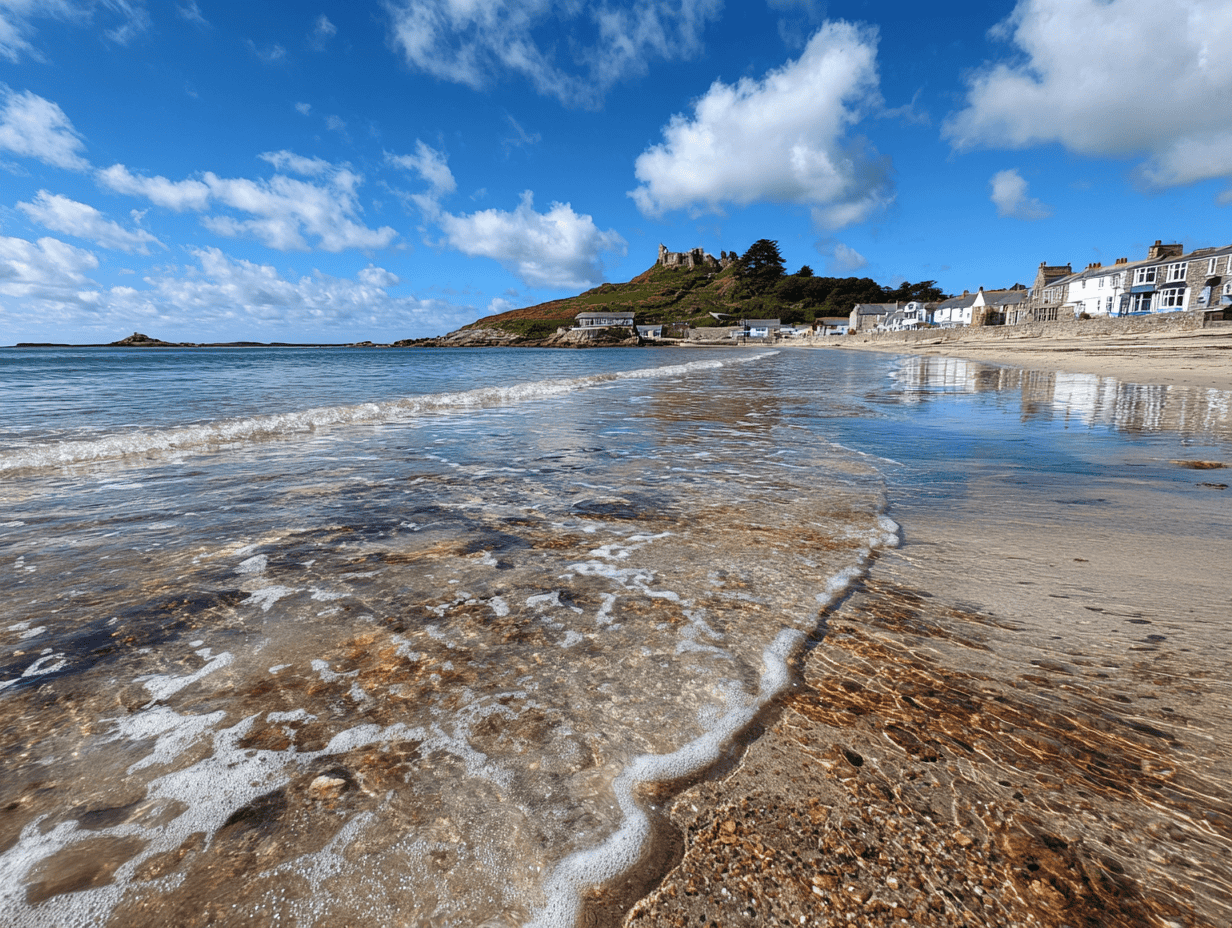
The Silted Harbour and the Sea Pottery Beach
Pentewan is better for sea pottery than sea glass. The best hunting is at the northern village end, around the old harbour, St Austell River mouth, shingle patches, and pebble pockets, rather than across the wide sandy beach to the south. White, green and brown are the usual sea-glass finds, with aqua, pale amber, cobalt blue and purple turning up more occasionally. If you collect pottery as well as glass, Pentewan is far more rewarding.
- Rating: Fair Beach
- Terrain: Easy
- Level: Beginner
- Dog friendly: No privately owned beach; dogs currently not permitted (see below; this one needs checking before you travel)
- Location: Pentewan, near St Austell, Cornwall
- Sat Nav: PL26 6BX (Pentewan village car park) · PL26 6BT (Pentewan Sands Holiday Park)
- Common colours: White, green, brown
- Rare colours: Cobalt blue, purple
Today’s ShoreSense Score
Check below for our score and tide times; scroll down for the full 7-day forecast
Pentewan Sands sea glass conditions
Pentewan Sands
Cornwall — Sea settling
65/100 — Good, best window 11:20–14:20.
Best window is 11:20–14:20 with calm sea and offshore wind, so the chance of fresh finds is good today. Sea is likely calm and picked-over — go early.
Good window, though this beach is hit-and-miss
Ranked #37 in the UK ShoreSense leaderboard today.
| Tide | Time | Height |
|---|---|---|
| Low water | 00:29 | 0.7 m |
| High water | 06:28 | 5.5 m |
| Low water | 12:50 | 0.7 m |
| High water | 18:50 | 5.4 m |
Why Pentewan is worth knowing about- and why it’s only Fair
Pentewan turns up on every “best sea glass beaches in Cornwall” list going. I want to be straight with you about why it’s rated Fair here when half the internet has it in the top five.
The history is real. Between 1818 and 1826, the local landowner Sir Christopher Hawkins substantially rebuilt the harbour here, partly to improve the existing pilchard fishery and partly to turn the village into a major china clay port. At its peak, Pentewan shipped a third of Cornwall’s china clay.
A century of coal coming in and clay going out, a working village, a narrow gauge railway running down the valley, ships in the basin. That’s exactly the kind of industrial harbour history that produces glass.
But the beach itself is a wide, near-white sandy bay facing east into the shelter of St Austell Bay, and shelter is the problem. There’s no Atlantic swell here doing the grinding work you get at Porthtowan or Trebarwith. The glass that comes up is small, often clear, and you have to work for it. On a decent low tide with a bit of patience, you’ll come away with a handful of pieces, mostly white, a few greens, the odd brown. It’s a nice afternoon, not a haul.
What Pentewan does genuinely well is sea pottery. Old crockery, transferware fragments, glazed shards worn to pebbles, the leavings of a Victorian working port and the ballast of the ships that used it. The shingly sand here has abrasive, smoothing qualities that increase the odds of finding well-polished pieces.
If you collect pottery as well as glass, Pentewan moves up the list considerably. If you’re strictly a glass hunter, temper your expectations and go for the history.
And then there’s the access. This is a privately owned beach, and it’s the only beach on this site where I’d tell you to make a phone call before you set off.
What you’ll find here
Colours commonly found: White and clear, green, brown. The white dominates; that’s the honest picture from hunters who work this beach regularly, and it matches what the sheltered conditions would predict.
Occasional finds: Aqua, pale amber. Bottle stock from the port era, turning up in ones and twos rather than in quantity.
Rare finds: Cobalt blue and purple. Both are reported here, and both are genuinely uncommon. Pentewan is not a rare-colour beach, and I’d rather tell you that than have you drive down hoping.
Bonus: and this is the real draw: Sea pottery in quantity. Blue and white patterned fragments, glazed shards, transferware. Also worth knowing: the sand here is shot through with the residue of the china clay industry, and you’ll find smoothed clay and stone pieces alongside the pottery. Pentewan stone was quarried locally for centuries and used in churches and grand houses across Cornwall. Some of what you’re walking on has that pedigree.
Pieces here tend to be small. The sheltered bay doesn’t produce the chunky, thick glass you get on the north coast. Bring your eye down close.
If you find something a little special, why not upload it to GlassLore to find out its rarity, value and history. Add it to the Finds Gallery and see if you can beat the other hunters.
When to go
Winter, and the quieter the better.
Pentewan is a family holiday beach in summer. The holiday park behind it holds a lot of people; the beach is zoned off with swimming buoys, and hunting on a busy beach in August is a waste of a tide. October through March you’ll often have it to yourself.
Storms matter more here than on most sheltered beaches, because there’s less routine wave energy doing the work. A strong easterly blowing straight into St Austell Bay is what you want; that’s the one wind direction Pentewan is fully exposed to, and it rearranges the strandline properly. The day after an easterly blow is the best hunting this beach offers.
Work an ebbing tide, starting a couple of hours before low water. And go for a spring tide if you can; the range here is modest, and you need every metre of foreshore you can get.
Today’s ShoreSense Score & Best Hunting Window
Pentewan sits on the western edge of St Austell Bay on Cornwall’s south coast, with a tidal range of around 4.5 metres on a spring tide, modest by Cornish standards and noticeably smaller than the 6 to 7 metres you’ll see on the north coast, so the beach opens up steadily rather than dramatically and the productive strandline stays fairly narrow.
As the tide falls, start at the northern village end beside the old harbour and work the strandline around the mouth of the St Austell River. Concentrate on the shingle patches, pebble pockets and shell-rich areas rather than the open sand. As more foreshore appears, follow those coarser patches rather than automatically walking south across the bay.
Bigger spring lows expose a little more usable ground, but Pentewan remains a relatively sheltered hunt compared with Cornwall’s Atlantic coast. After stronger easterly conditions begin to settle, recheck the northern strandline and shingle pockets. Use today’s ShoreSense Best Window to choose when to arrive, then follow this harbour-end → river-mouth → shingle-pocket progression once you’re there.
The ShoreSense widget below combines recent marine conditions, tide timing and practical hunting weather to show today’s overall ShoreSense Score, Hunting Potential, Comfort and the best available hunting window for Pentewan Sands. It uses UKHO Mevagissey tide data alongside current marine and weather inputs to help you judge whether conditions look promising for a hunt.
Pentewan Sands sea glass conditions
Pentewan Sands
Cornwall — Sea settling
65/100 — Good, best window 11:20–14:20.
Best window is 11:20–14:20 with calm sea and offshore wind, so the chance of fresh finds is good today. Sea is likely calm and picked-over — go early.
Good window, though this beach is hit-and-miss
Ranked #37 in the UK ShoreSense leaderboard today.
| Tide | Time | Height |
|---|---|---|
| Low water | 00:29 | 0.7 m |
| High water | 06:28 | 5.5 m |
| Low water | 12:50 | 0.7 m |
| High water | 18:50 | 5.4 m |
Where to look on the beach
The beach runs a little over half a mile, and the two ends behave completely differently.
The village end (north). This is where I’d start, and it’s where most hunters do best. Coming down from Pentewan village, you reach the northern corner of the beach near the old harbour and the mouth of the St Austell River. This is the section with the most shingle, the most concentrated strandline, and the highest density of both glass and pottery. It’s also, not coincidentally, the closest point to where a century of harbour activity happened.
Work the shingle patches and the pebble pockets rather than the open sand. A small stream crosses the beach here; you’ll need to cross it to continue south onto the main stretch, and after heavy rain that crossing can be more of a wade than a step.
The main sands (south). Wide, flat, near-white, and mostly empty of anything interesting. It’s a beautiful walk and a poor hunt. If you’re going to spend an hour here, spend fifty minutes at the village end and ten walking south for the view.
The old harbour. Worth ten minutes even though you won’t find glass in it. The water-filled basin is still there, but the harbour is now entirely cut off from the sea. Standing in a Georgian dock basin that ships used to sail into, now stranded behind a bank of sand, is the single best way to understand this beach.
Key Tip:
Start at the northern end of the beach closest to Pentewan village and the old harbour. Concentrate on the shingle patches, pebble pockets and strandline around the mouth of the St Austell River rather than the wide sandy beach to the south. This is where both sea glass and Pentewan’s excellent sea pottery are most likely to collect.
Difficulty Level – Beginner
- Generally easy, flat beach terrain
- Productive areas are close to the village access
- No scrambling or difficult rock-hopping required
- Shingle and pottery fragments make finds easier to spot
- Best suited to patient, methodical hunting rather than covering lots of ground
Hunting Style – The Harbour Sifter
Pentewan rewards hunters who slow down and work the small pockets of material left behind by the old harbour. Follow the shingle lines, search around the northern strandline and inspect areas where pebbles and shell fragments have gathered. Don’t rush south across the open sand; the best hunting is concentrated around the village end, where more than a century of harbour activity has left its mark.
Beach Personality
Pentewan is a beach where the history is almost more interesting than the haul. Its pale sand and sheltered waters make it look like a classic Cornish holiday beach, but the abandoned harbour at its northern end tells a very different story. China clay, coal, ships and railway wagons once moved through here, leaving behind small pieces of glass and an unusually rich supply of sea pottery. It’s not a beach for filling your pockets quickly; it’s one for hunting slowly and wondering what each worn fragment might once have been.
Safety: Signs warn of unstable cliffs at the edges of the bay; keep off the cliff bases. There’s no lifeguard cover outside summer, and the stream crossing at the north end can rise fast after rain in the valley. The stone and shingle at the village end gets slippery with weed on a falling tide.
Dog friendly?
This is the one to check before you travel, and I can’t give you a clean answer.
Pentewan beach is privately owned by Pentewan Sands Holiday Park, which means the dog rules here aren’t set by Cornwall Council’s Public Spaces Protection Order; they’re set by the owners, and they can change them whenever they like. Visit Cornwall’s own listing says exactly that: the beach is privately owned, the owners have the right to say when dogs can go on the beach, they may change this policy at any time, and you should check directly with the holiday park.
Here’s where it gets messy. Published beach guides list a seasonal ban running roughly from 1 March to the first Sunday in November, a much longer window than any council beach in Cornwall. But the holiday park’s current FAQ page states that dogs and other pets are not allowed anywhere on Pentewan Sands, including the beach, except registered assistance dogs on a harness. No seasonal wording at all.
So the safest read for 2026 is: assume no dogs, and ring the park to confirm before you go. Some hunters report walking the village end out of season with a dog without issue, but that’s an anecdote, not a policy, and I’m not going to send you four hours down the A30 with Trigger in the back on the strength of it.
Trigger and I have hunted almost every beach on this site together. Pentewan is one of the very few I’d plan without him. If you’re travelling with a dog and want the same stretch of coast, Gorran Haven and the beaches around Mevagissey are the better bet, and there’s plenty on the Pentewan Valley Trail, the old railway route inland, which is a genuinely lovely dog walk.
For dog-friendly cafés and pubs around St Austell and Mevagissey, check the Yappy Places listings for the area; the Mevagissey harbourfront has several good ones.
Practical information
Parking: The free-to-park era at Pentewan has largely gone. There’s a small car park at West End in the village (PL26 6BX), run by the parish council, with overspill at The Square, it’s genuinely small and fills fast in season. The alternative is the large pay car park behind the beach at the holiday park (PL26 6BT), which uses ANPR and a pay machine or app. Check current signage on arrival; the arrangements here have changed more than once in recent years.
Toilets: In the village, and at the holiday park behind the beach.
Food and drink: The Ship Inn in the village is the pub, a St Austell Brewery house, and the obvious post-hunt stop. There’s a coffee shop and restaurant at the holiday park open to non-residents. Mevagissey is five minutes down the road and has considerably more choice, including a proper working harbour to look at while you eat.
Getting there without a car: Buses run from St Austell along the B3273 towards Mevagissey and stop at Pentewan. St Austell has a mainline station on the Great Western route from London Paddington via Plymouth. It’s about four miles from St Austell, doable, and the Pentewan Valley Trail makes for a very pleasant walk or cycle in if you’ve got the time.
Accessibility: The beach access from the holiday park car park is flat and level, which is unusually good. Access from the village involves paths with steps in places and isn’t suitable for wheelchairs. The village-to-beach walk is about 500 metres along the old harbour lane.
What to bring
- Trainers or light boots, the sand is firm and flat, this isn’t a wellies beach except at the stream crossing
- A small container for pottery as well as glass; you’ll pick up more pottery than you expect
- A hand rake or trowel for working the shingle pockets at the village end
- Waterproofs, St Austell Bay catches the weather coming up the Channel
- A charged phone for tide times, and the holiday park’s number if you’re bringing a dog
- Patience. Pentewan rewards slow, low, methodical hunting more than it rewards covering ground
The history behind the glass
Pentewan’s story is one of the best pieces of industrial irony on the Cornish coast: the industry that built the port is the same industry that killed it.
Pentewan had been an important harbour town for centuries; during the 13th and 14th centuries, it overshadowed Mevagissey in importance, shipping stone from Polrudden Quarry. The first harbour was built in 1744 by the Hawkins family of Trewithen. Then, in 1818, Sir Christopher Hawkins, MP, businessman, and mine owner, set about turning it into something far bigger. The rebuilt harbour opened in February 1826, trading china clay, coal, limestone and timber, with a 500-foot pier and ships entering through a dredged channel.
Three years later, in 1829, he opened a four-mile narrow-gauge railway down the valley from St Austell to feed it, horse-drawn at first, converted for steam locomotives in 1874. At its height, Pentewan was shipping a third of all the china clay produced around St Austell.
And the clay destroyed it. Most of the silt that choked the harbour was carried down by the St Austell River, known then and still known locally as the White River, for the milky appearance given to it by the kaolin particles washing down from the clay works upstream. The clay running out into the sea gave the water a distinctive turquoise-blue colour, visible on old postcards and photographs of Pentewan.
Picture that. A Victorian harbour town where the river ran white, and the sea ran turquoise, year after year, while the same suspended clay quietly built a sandbar across the harbour mouth. Silting would leave the channel unnavigable for weeks at a time, stranding ships inside the basin. The clay companies drifted away to Charlestown, Par and Fowey, and the railway closed in 1918, its rails sold and sent to France. The last trading ship left in 1940, and although small boats could still get in during the 1960s, the harbour is now entirely cut off from the sea.
Everything you find on this beach comes from that century: the bottles of a working port, the crockery of the households that served it, coal, glass, clay and stone. It’s all sitting in a bay that the industry itself gradually sealed shut. That’s why the pieces are small and worked-over: they’ve been circulating in a closed, sheltered system for a very long time.
From beach to jewellery
Pentewan glass is small, pale and thoroughly worn, the kind of piece that suits a delicate setting rather than a statement one. At Mermaid Tears, every piece of jewellery starts on a UK beach exactly like this one, hand-hunted and handmade into something you’ll keep. Browse the collection
Disclaimer: Tide times, dog restrictions, parking charges and beach conditions change regularly. Pentewan is a privately owned beach, and the owners set their own access and dog policies, which can change at any time and are not covered by Cornwall Council’s beach byelaws. Always check directly with Pentewan Sands Holiday Park before visiting, particularly if you’re bringing a dog.
Last updated: September 2026
Dog rules checked: September 2026 – Pentewan Sands Holiday Park (private beach; no dogs except assistance dogs)
Frequently asked questions
Is Pentewan Sands good for sea glass?
It’s decent rather than exceptional. Pentewan produces small, mostly white and green glass in modest quantities; the sheltered east-facing bay doesn’t generate the wave energy that makes the north Cornwall beaches productive. It genuinely excels at sea pottery, thanks to a century as a working china clay port. Rated Fair on this site: worth combining with Mevagissey or the Pentewan Valley Trail rather than driving down for on its own.
Can dogs go on Pentewan beach?
Currently no. The beach is privately owned by Pentewan Sands Holiday Park, whose own policy excludes dogs other than registered assistance dogs. Published guides list a seasonal ban from around 1 March to early November, but the park’s stated policy is stricter, and the owners can change it at any time. Ring the park before you travel.
Where do you park for Pentewan beach?
Two options: the small parish council car park at West End in Pentewan village (PL26 6BX), which fills quickly, or the larger pay car park at the holiday park behind the beach (PL26 6BT). The village car park is a five-minute walk from the northern end of the beach, which is the end you want anyway.
What’s the best part of Pentewan beach for hunting sea glass?
The northern end, nearest the village and the old harbour. That’s where the shingle concentrates and where the harbour history is closest. The wide southern sands are lovely to walk and largely empty of finds.
Why is the sand at Pentewan so white?
Because of the china clay. For over a century, the St Austell River carried kaolin particles down the valley and into the bay; locals called it the White River, and that material is still in the sand. The same process is what silted up the harbour and ended Pentewan’s life as a port.
Is Pentewan beach open to the public?
Yes. It’s privately owned, but public access is permitted, most straightforwardly from Pentewan village along the old harbour lane. Access arrangements and dog policy are set by the owners rather than the council, so they can and do change.
Other Beaches
Check out all of Cornwall’s best seaglass beaches